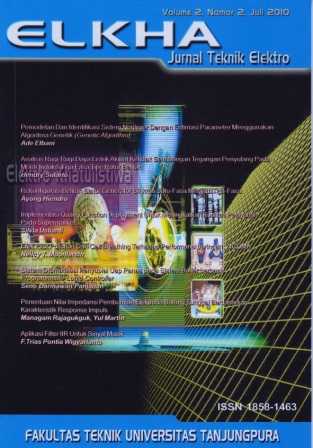
Penentuan Nilai Impedansi Pembumian Elektroda Batang Tunggal Berdasarkan Karakteristik Response Impuls
DOI:
https://doi.org/10.26418/elkha.v2i2.176Abstract
Abstract– Sampai saat ini sistem pembumian masih dianggap baik jika resistansinya kecil yaitu nilai resistansi yang diukur dengan sumber DC atau frekuensi rendah. Sementara itu, peristiwa sambaran petir menyebabkan arus impuls dengan frekuensi tinggi sampai orde kHz, sehingga ketika sistem pembumian bekerja karena dikenai arus impuls petir, maka dari hasil penelitian diperoleh rata-rata persentase perbedaan antara resistansi pembumian yang diukur dengan sumber DC dan impedansi pembumian yang diukur dengan sumber impuls sebesar 8,0 %. Dari model tersebut dihitung nilai impedansi pembumian untuk berbagai variasi kedalaman elektroda batang pembumian dari kedalaman 2m sampai 6m berdasarkan respon impulsnya. Dari hasil-hasil pengukuran dan perhitungan diperoleh nilai impedansi pembumian terkecil sebesar 23,01 pada kedalaman elektroda batang 6m dengan penurunan impedansi pembumian rata-rata pada setiap kedalaman 1m mulai 2m sampai 6m sebesar 5,25. Untuk setiap kenaikan kedalaman 1m nilai induktansi mengalami kenaikan rata-rata 0,00158 mH dan kapasitansi mengalami kenaikan rata-rata 0,0000574F. Dari hasil penelitian, dengan memperkecil waktu muka impuls injeksi akan sangat berpengaruh pada hasil pengujiannya. Dengan menggunakan sumber input yang sama untuk waktu muka 3,0 terlihat lebih banyak ripple dibandingkan dengan waktu muka 4,0 yang sedikit ripple, terjadinya ripple merupakan tanggapan peralatan ukur impuls yaitu resistif voltage devider terhadap frekuensi tinggi karena dengan memperkecil waktu muka impuls berarti memperbesar frekuensinya. Dari hasil pengujian dan hasil simulasi diperoleh persentase perbedaan tegangan terpotong oleh elektroda batang pembumian sebesar 0,57% dengan selang kepercayaan 99% sedangkan untuk perbedaan antara nilai respon arus impulas maksimum antara hasil pengujian dan hasil simulasi sebesar 2,57%.
Keywords– Respon impuls, impedansi pembumian, resistansi pembumian.
Downloads
Published
Issue
Section
License
Copyright (c) 2012 ELKHA : Jurnal Teknik Elektro

This work is licensed under a Creative Commons Attribution-NonCommercial-NoDerivatives 4.0 International License.
1. Proposed Policy for Journals That Offer Open Access
Authors who publish with this journal agree to the following terms:
- Authors retain copyright and grant the journal right of first publication with the work simultaneously licensed under a Creative Commons Attribution License that allows others to share the work with an acknowledgement of the work's authorship and initial publication in this journal.
- Authors are able to enter into separate, additional contractual arrangements for the non-exclusive distribution of the journal's published version of the work (e.g., post it to an institutional repository or publish it in a book), with an acknowledgement of its initial publication in this journal.
- Authors are permitted and encouraged to post their work online (e.g., in institutional repositories or on their website) prior to and during the submission process, as it can lead to productive exchanges, as well as earlier and greater citation of published work (See The Effect of Open Access).
2. Proposed Policy for Journals That Offer Delayed Open Access
Authors who publish with this journal agree to the following terms:
- Authors retain copyright and grant the journal right of first publication, with the work [SPECIFY PERIOD OF TIME] after publication simultaneously licensed under a Creative Commons Attribution License that allows others to share the work with an acknowledgement of the work's authorship and initial publication in this journal.
- Authors are able to enter into separate, additional contractual arrangements for the non-exclusive distribution of the journal's published version of the work (e.g., post it to an institutional repository or publish it in a book), with an acknowledgement of its initial publication in this journal.
- Authors are permitted and encouraged to post their work online (e.g., in institutional repositories or on their website) prior to and during the submission process, as it can lead to productive exchanges, as well as earlier and greater citation of published work (See The Effect of Open Access).
