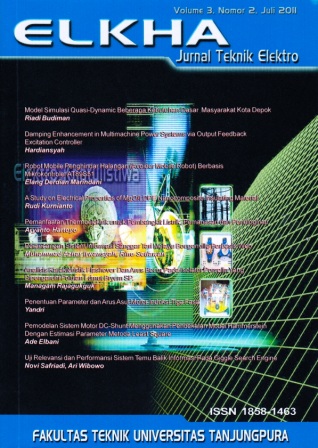
Robot Mobile Penghindar Halangan (Avoider Mobile Robot) Berbasis Mikrokontroler AT89S51
DOI:
https://doi.org/10.26418/elkha.v3i2.239Abstract
Abstrak- Kemampuan menghindari halangan dapat diberikan pada sebuah robot dengan berbagai cara, salah satunya adalah dengan menggunakan sensor ultrasonik. Penggunaan sensor ultrasonik sebagai pendeteksi halangan dapat dilakukan dengan mendeteksi ada atau tidaknya pantulan gema ultrasonik. Robot mobile yang dirancang adalah robot berkaki yang memiliki kemampuan untuk menghindari halangan menggunakan sensor ultrasonik dimana penghalang akan dideteksi oleh sensor ultrasonik, kemudian sinyal ada atau tidaknya halangan akan menjadi masukan pada mikrokontroler AT89S51. Sinyal tersebut diproses yang kemudian akan memerintahkan kedua motor DC menggunakan Pulse Width Modulation (PWM) untuk bergerak menghindari halangan. Dari hasil pengujian menunjukkan bahwa robot mobile penghindar halangan yang dirancang telah dapat berfungsi dengan baik sesuai dengan rancangan yang dibuat
Kata kunci – Robot Mobile, penghindar halangan, sensor ultrasonik, mikrokontroler AT89S51
Downloads
Additional Files
Published
Issue
Section
License
Copyright (c) 2012 ELKHA : Jurnal Teknik Elektro

This work is licensed under a Creative Commons Attribution-NonCommercial-NoDerivatives 4.0 International License.
1. Proposed Policy for Journals That Offer Open Access
Authors who publish with this journal agree to the following terms:
- Authors retain copyright and grant the journal right of first publication with the work simultaneously licensed under a Creative Commons Attribution License that allows others to share the work with an acknowledgement of the work's authorship and initial publication in this journal.
- Authors are able to enter into separate, additional contractual arrangements for the non-exclusive distribution of the journal's published version of the work (e.g., post it to an institutional repository or publish it in a book), with an acknowledgement of its initial publication in this journal.
- Authors are permitted and encouraged to post their work online (e.g., in institutional repositories or on their website) prior to and during the submission process, as it can lead to productive exchanges, as well as earlier and greater citation of published work (See The Effect of Open Access).
2. Proposed Policy for Journals That Offer Delayed Open Access
Authors who publish with this journal agree to the following terms:
- Authors retain copyright and grant the journal right of first publication, with the work [SPECIFY PERIOD OF TIME] after publication simultaneously licensed under a Creative Commons Attribution License that allows others to share the work with an acknowledgement of the work's authorship and initial publication in this journal.
- Authors are able to enter into separate, additional contractual arrangements for the non-exclusive distribution of the journal's published version of the work (e.g., post it to an institutional repository or publish it in a book), with an acknowledgement of its initial publication in this journal.
- Authors are permitted and encouraged to post their work online (e.g., in institutional repositories or on their website) prior to and during the submission process, as it can lead to productive exchanges, as well as earlier and greater citation of published work (See The Effect of Open Access).
