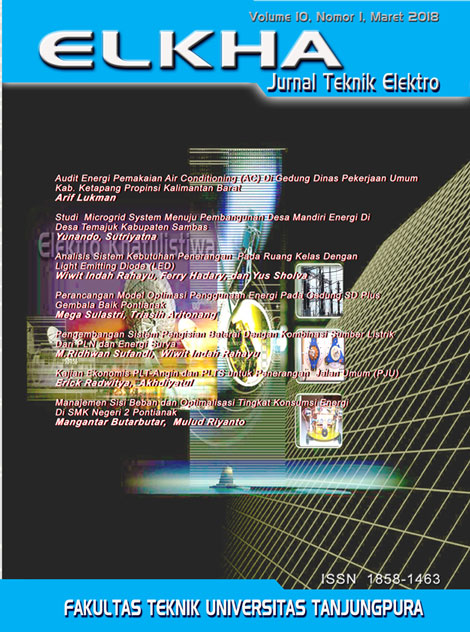
Studi Microgrid System Menuju Pembangunan Desa Mandiri Energi Di Desa Temajuk Kabupaten Sambas
DOI:
https://doi.org/10.26418/elkha.v10i1.25277Keywords:
Microgrid System, cost savingsAbstract
Abstract"“ Temajuk Village is one of the villages in Kecamatan Paloh Sambas regency, West Kalimantan Province, which borders directly with Sarawak (Malaysia). From 1980 to 2011 Desa Temajuk has no permanent electricity yet. In 2011, the village will have electrical energy by utilizing local energy such as Micro Hydro Power Generation, by 2012, Centralized Solar Power Generation and by 2015 Diesel Power Plant, all of which will carry each load without being integrated with the same network . So it is necessary to do the study of merging a network that is connected to one another to be able to bear the same load.Microgrid System study was then created with the aim of producing a sustainable distribution network study by combining 3 different types of plants and operational savings from the use of diesel fuel oil costs as the main power plant after the network system.
Keywords- Microgrid System, cost savings
References
J. D. Kueck, R. H. Stauton, S. D. Labinov, B. J. Kirby. January 29, 2003. Microgrid Energy Management System
Robert H. Lasseter, Paolo Piagi University of Wisconsin-Madison Madison, Wisconsin Germany, 20-25 June 2004. Microgrid : A Conceptual Solution
Giuliani Marshall, Supervisor : Dr. Colin Cotes. The University of Newcastle, Australia Oktober 2004. Modelling of a Micro-grid System
Arwindra Rizqiawan, March 4, 2009. Microgrid : Wacana Solusi Daerah Mandiri Energi
BPPT, Program Insentif Riset Litbang Perekayasa. 2010. Desain Sistem Pendukung Operasi Jaringan Pembangkit Energi Terbarukan Skala Kecil Tersebar Dengan Teknologi Microgrid
Kazuhito Ishida (presenter), Yoshihide Shimogawa, Tadakazu Imayoshi, Koji Takano, Hidemi Hayashi, ToshikazuYamada, and Toshirou Noguchi Kyushu Electric Power Co., Inc.
Takehiko Kojima and Toshiharu Mounai Fuji Electric System Co., Ltd.
Hassan Feroze, August 7th, 2009. Multi-Agent System in Microgrid : Design and Implementation
Downloads
Additional Files
Published
Issue
Section
License
Copyright (c) 2018 ELKHA : Jurnal Teknik Elektro

This work is licensed under a Creative Commons Attribution-NonCommercial-NoDerivatives 4.0 International License.
1. Proposed Policy for Journals That Offer Open Access
Authors who publish with this journal agree to the following terms:
- Authors retain copyright and grant the journal right of first publication with the work simultaneously licensed under a Creative Commons Attribution License that allows others to share the work with an acknowledgement of the work's authorship and initial publication in this journal.
- Authors are able to enter into separate, additional contractual arrangements for the non-exclusive distribution of the journal's published version of the work (e.g., post it to an institutional repository or publish it in a book), with an acknowledgement of its initial publication in this journal.
- Authors are permitted and encouraged to post their work online (e.g., in institutional repositories or on their website) prior to and during the submission process, as it can lead to productive exchanges, as well as earlier and greater citation of published work (See The Effect of Open Access).
2. Proposed Policy for Journals That Offer Delayed Open Access
Authors who publish with this journal agree to the following terms:
- Authors retain copyright and grant the journal right of first publication, with the work [SPECIFY PERIOD OF TIME] after publication simultaneously licensed under a Creative Commons Attribution License that allows others to share the work with an acknowledgement of the work's authorship and initial publication in this journal.
- Authors are able to enter into separate, additional contractual arrangements for the non-exclusive distribution of the journal's published version of the work (e.g., post it to an institutional repository or publish it in a book), with an acknowledgement of its initial publication in this journal.
- Authors are permitted and encouraged to post their work online (e.g., in institutional repositories or on their website) prior to and during the submission process, as it can lead to productive exchanges, as well as earlier and greater citation of published work (See The Effect of Open Access).
