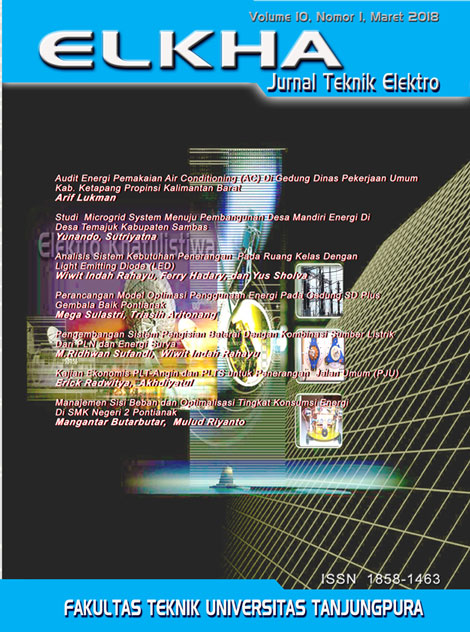
Manajemen Sisi Beban dan Optimalisasi Tingkat Konsumsi Energi Di SMK Negeri 2 Pontianak
DOI:
https://doi.org/10.26418/elkha.v10i1.25331Abstract
Abstract"“ Dalam penelitian ini dilakukan manajemen beban sebagai pendekatan sistematis dan terpadu untuk melaksanakan pemanfaatan sumber daya energi di gedung praktik SMK Negeri 2 Pontianak secara efektif, efisien dan rasional tanpa mengurangi kuantitas maupun kualitas fungsi utama gedung. Langkah pelaksanaan manajemen beban ialah dengan diawali audit penggunaan tenaga listrik. Audit beban listrik ini meliputi analisis profil penggunaan tenaga listrik, mengidentifikasi pemborosan energi dan menyusun langkah pencegahan. Audit beban dilakukan terhadap konsumsi besarnya energi listrik, sistem pencahayaan, sistem pengkondisian udara dan peralatan listrik lainnya pada gedung tersebut. Proses audit energi listrik dilakukan secara bertahap yaitu audit energi awal yang kegiatannya meliputi pengumpulan data historis gedung dan penyusunan data energi bangunan gedung tersebut. Kemudian dilanjutkan pada audit energi rinci, yaitu jika diketahui bahwa nilai Intensitas Konsumsi Energi (IKE) lebih besar dari nilai IKE standar yang telah ditetapkan oleh Badan Standarisasi Nasional (BSN). Kegiatan audit energi rinci ini meliputi penelitian dan pengukuran konsumsi energi, kemudian dilanjutkan pada identifikasi peluang hemat energi. Hasil audit energi yang telah dilakukan menunjukkan bahwa tidak terjadi pemborosan energi, tetapi ada pemakaian energi yang tidak bijak. Hal ini dapat dilihat dari nilai IKE yang masih dibawah standar yaitu 99,75 kWh/m2 per tahun berdasarkan data rekening dengan jumlah konsumsi energi 58616.50 kWh per-tahun, sedangkan standar yang ditetapkan untuk gedung perkantoran yaitu 240 kWh/m2 per tahun . Untuk penghematan disarankan dalam penyusunan penjadwalan pemakaian gedung praktik supaya disesuaikan dengan besar konsumsi energi di setiap gedung tersebut.
Keywords- Manajemen Sisi Beban, Optimalisasi Tingkat Konsumsi Energi.
Downloads
Additional Files
Published
Issue
Section
License
Copyright (c) 2018 ELKHA : Jurnal Teknik Elektro

This work is licensed under a Creative Commons Attribution-NonCommercial-NoDerivatives 4.0 International License.
1. Proposed Policy for Journals That Offer Open Access
Authors who publish with this journal agree to the following terms:
- Authors retain copyright and grant the journal right of first publication with the work simultaneously licensed under a Creative Commons Attribution License that allows others to share the work with an acknowledgement of the work's authorship and initial publication in this journal.
- Authors are able to enter into separate, additional contractual arrangements for the non-exclusive distribution of the journal's published version of the work (e.g., post it to an institutional repository or publish it in a book), with an acknowledgement of its initial publication in this journal.
- Authors are permitted and encouraged to post their work online (e.g., in institutional repositories or on their website) prior to and during the submission process, as it can lead to productive exchanges, as well as earlier and greater citation of published work (See The Effect of Open Access).
2. Proposed Policy for Journals That Offer Delayed Open Access
Authors who publish with this journal agree to the following terms:
- Authors retain copyright and grant the journal right of first publication, with the work [SPECIFY PERIOD OF TIME] after publication simultaneously licensed under a Creative Commons Attribution License that allows others to share the work with an acknowledgement of the work's authorship and initial publication in this journal.
- Authors are able to enter into separate, additional contractual arrangements for the non-exclusive distribution of the journal's published version of the work (e.g., post it to an institutional repository or publish it in a book), with an acknowledgement of its initial publication in this journal.
- Authors are permitted and encouraged to post their work online (e.g., in institutional repositories or on their website) prior to and during the submission process, as it can lead to productive exchanges, as well as earlier and greater citation of published work (See The Effect of Open Access).
