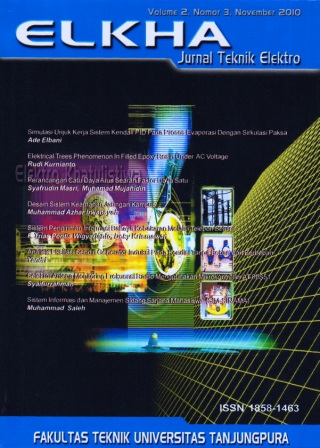
Simulasi Unjuk Kerja Sistem Kendali PID Pada Proses Evaporasi Dengan Sirkulasi Paksa
DOI:
https://doi.org/10.26418/elkha.v2i3.275Abstract
Abstract– Proses evaporasi sering sekali digunakan pada industri-industri yang berskala besar, terutama industri proses. Evaporasi adalah suatu proses kejadian fisika yang mana tidak terjadi perubahan komposisi pada struktur zat, dengan dasar proses kondensasi atau perubahan embun menjadi air. Pada penelitian ini proses akan dilakukan dengan sistem simulasi, dimana akan menggunakan simulink pada program Matlab guna merepresentasi sistem proses evaporasi yang nyata. Untuk mempercepat proses kondensasinya, hal ini dilakukan dengan metode sirkulasi paksa, yakni proses evaporasi dilakukan dengan mengalirkan air pada kolom-kolom destilasi yang tersedia. Agar hasil yang diharapkan lebih optimal, maka pada penelitian ini akan digunakan pengendali dengan jenis PID. Pada pengendali ini terdapat tiga mode pengendali, yaitu proporsional, integral dan derivatip (PID), dimana kesemua ini merupakan pengendali yang kontinyu. Pengendali ini dirasa cocok untuk diterapkan pada sistem ini, dimana pada proses evaporasi berlangsung lama. Adapun instrument yang dikendalikan pada sistem ini berupa masukan steam, cooler water serta beberapa produk akhir, yang kesemua ini menjadi suatu sistem kendali multi-input dan multi-output (MIMO). Dari hasil yang diperoleh, ternyata dengan sistem kendali lup tertutup akan memperlihatkan unjuk kerja yang lebih baik dari pada lup terbuka, serta beberapa hasil yang diperoleh proses evaporasi telah memperlihatkan performansi atau unjuk kerja yang baik dan stabil dengan menggunakan pengendali dengan mode Proportional dan Integral (PI).
Keywords– Kendali PID, Evaporasi, Metoda evaporasi sirkulasi paksa, Kondensasi.
Downloads
Additional Files
Published
Issue
Section
License
Copyright (c) 2012 ELKHA : Jurnal Teknik Elektro

This work is licensed under a Creative Commons Attribution-NonCommercial-NoDerivatives 4.0 International License.
1. Proposed Policy for Journals That Offer Open Access
Authors who publish with this journal agree to the following terms:
- Authors retain copyright and grant the journal right of first publication with the work simultaneously licensed under a Creative Commons Attribution License that allows others to share the work with an acknowledgement of the work's authorship and initial publication in this journal.
- Authors are able to enter into separate, additional contractual arrangements for the non-exclusive distribution of the journal's published version of the work (e.g., post it to an institutional repository or publish it in a book), with an acknowledgement of its initial publication in this journal.
- Authors are permitted and encouraged to post their work online (e.g., in institutional repositories or on their website) prior to and during the submission process, as it can lead to productive exchanges, as well as earlier and greater citation of published work (See The Effect of Open Access).
2. Proposed Policy for Journals That Offer Delayed Open Access
Authors who publish with this journal agree to the following terms:
- Authors retain copyright and grant the journal right of first publication, with the work [SPECIFY PERIOD OF TIME] after publication simultaneously licensed under a Creative Commons Attribution License that allows others to share the work with an acknowledgement of the work's authorship and initial publication in this journal.
- Authors are able to enter into separate, additional contractual arrangements for the non-exclusive distribution of the journal's published version of the work (e.g., post it to an institutional repository or publish it in a book), with an acknowledgement of its initial publication in this journal.
- Authors are permitted and encouraged to post their work online (e.g., in institutional repositories or on their website) prior to and during the submission process, as it can lead to productive exchanges, as well as earlier and greater citation of published work (See The Effect of Open Access).
