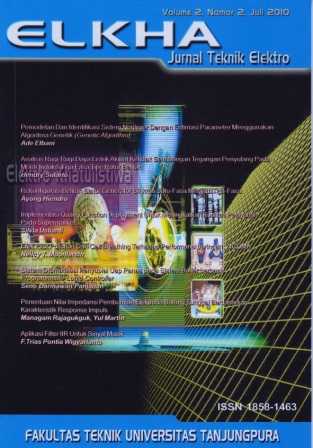
Pemodelan Dan Identifikasi Sistem Nonlinier Dengan Estimasi Parameter Menggunakan Algoritma Genetik (Genetic Algorithm)
DOI:
https://doi.org/10.26418/elkha.v2i2.276Abstract
Abstract– Penelitian ini akan menjelaskan suatu perubahan metode sistem identifikasi untuk sistem mechatronik yang mengandung beberapa elemen ketidaklinieran (nonliier). Pada penelitian ini, kejenuhan (saturasi) terdapat pada power series konverter, dan gesekan (friction) mekanis terdapat pada komponen-komponen nonlinier. Beberapa diantaranya sulit dideteksi dan atau diidentifikasi secara langsung. Pada metoda yang identifikasi ini akan bisa menentukan struktur elemen linier maupun nonlinier dari sistem secara bersama dengan Algorithma Genetik. Pada model polinomial dengan metoda ini, keteramatan variabel input/output menyatakan komponen-komponen linier, dan variabel fower series dinyatakan sebagai fungsi nonlinier. Algoritma genetik digunakan untuk mengoptimalkan gabungan dari variabel-variabel ini (linier dan nonlinier). Tingkat efektivitas dari metode yang diusulkan diuji dengan percobaan menggunakan 2-mass resonant vibration system.
Keywords– Sistem mechatronik, Friction, Identifikasi, Algorithma Genetik, 2-mass resonant vibration.
Downloads
Additional Files
Published
2012-03-14
Issue
Section
Articles
License
Copyright (c) 2012 ELKHA : Jurnal Teknik Elektro

This work is licensed under a Creative Commons Attribution-NonCommercial-NoDerivatives 4.0 International License.
1. Proposed Policy for Journals That Offer Open Access
Authors who publish with this journal agree to the following terms:
- Authors retain copyright and grant the journal right of first publication with the work simultaneously licensed under a Creative Commons Attribution License that allows others to share the work with an acknowledgement of the work's authorship and initial publication in this journal.
- Authors are able to enter into separate, additional contractual arrangements for the non-exclusive distribution of the journal's published version of the work (e.g., post it to an institutional repository or publish it in a book), with an acknowledgement of its initial publication in this journal.
- Authors are permitted and encouraged to post their work online (e.g., in institutional repositories or on their website) prior to and during the submission process, as it can lead to productive exchanges, as well as earlier and greater citation of published work (See The Effect of Open Access).
2. Proposed Policy for Journals That Offer Delayed Open Access
Authors who publish with this journal agree to the following terms:
- Authors retain copyright and grant the journal right of first publication, with the work [SPECIFY PERIOD OF TIME] after publication simultaneously licensed under a Creative Commons Attribution License that allows others to share the work with an acknowledgement of the work's authorship and initial publication in this journal.
- Authors are able to enter into separate, additional contractual arrangements for the non-exclusive distribution of the journal's published version of the work (e.g., post it to an institutional repository or publish it in a book), with an acknowledgement of its initial publication in this journal.
- Authors are permitted and encouraged to post their work online (e.g., in institutional repositories or on their website) prior to and during the submission process, as it can lead to productive exchanges, as well as earlier and greater citation of published work (See The Effect of Open Access).
