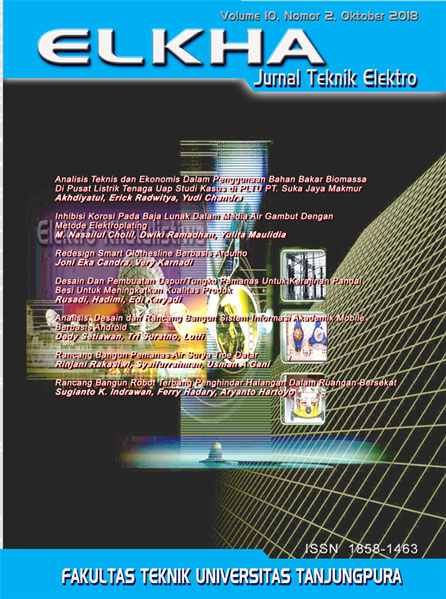
Rancang Bangun Pemanas Air Surya Tipe Datar
DOI:
https://doi.org/10.26418/elkha.v10i2.27901Keywords:
Energi terbarukan, intensita cahaya, khatulistiwa, pemanas, suryaAbstract
Kalimantan Barat dilalui Garis Khatulistiwa dimana surya menyinari selama 10-15 jam/hari. Energi surya diserap langsung oleh sistem pemanas surya. Energi panas yang dihasilkan dapat digunakan sebagai sumber panas dalam menghasilkan bahan bakar terbarukan misalnya bioetanol dan biodiesel. Implementasi untuk gagasan di atas dapat berupa teknologi pemanas surya yang sederhana, tanpa memerlukan energi listrik, biaya operasi murah dan ramah lingkungan. Tujuan penelitian ini adalah merancang dan menguji pemanas air surya. Pemanas surya dirancang bertipe datar dengan media pemanas berupa air. Pemanas surya terdiri dari kolektor panas dan tangki penampung air yang terbuat dari bahan stainlees steel dan polistiren sebagai isolator. Hasil rancang diperoleh pemanas air surya berkapasitas 50 liter yang diuji selama 3 hari dan mampu menghasilkan temperatur air maksimal sebesar 53oC pada intensitas cahaya rata-rata sebesar 1426 lux.
References
Bradke, C. Doetsch, H. Huhn, dkk., Researching: energi, brochure, Aliance of Scientific Organizations, Germany, 2011.
SSI, “Pembangkit Listrik Tenaga Surya: Solar Surya Indonesiaâ€, Ditjen Listrik dan Pengembangan Energi, Jakarta, 2015.
Verma, Abhishek, Kumar dan Vishal, “Solar Water Heating Systemâ€, IJRAME. Vol 3 Issue 1, pp 53-63, 2015.
Weiss W, “Solar Thermal, State of the art, Application Areas and Preview of Technology Developmentâ€, IEA Solar Heating and Cooling Roadmap Workshop, 28-29 April, Paris. 2015
Okafor dan Basil, “Thermo Siphon Solar Water Heaterâ€. IJET, vol.3 no.3, 2013.
Gangane, S.D, Bhere, S.H, dkk, “Economical Solar Water Heater,†IOSR- JMCE, pp 68-71, 2017.
Ogie dkk,“ Design and construction of Solar water heater based on the thermo siphon principle, JFREA, vol. 3. 2013.
C. Homola, “Solar Domestic Hot Water Heating Systems Design, Installation and Maintenance’, Solar Rating and Certification Corporation, 2014.
C. Philibert, “Solar Energi Perspectives, Renewable Energi Technologiesâ€, French: International Energi Agency, 2014.
Tarquini, Pietro, “Hydrogen and Fuels Production by Solar Thermochemical Cycleâ€, Energy and Sustainable Economic Development, Itali, 2011.
Downloads
Additional Files
Published
Issue
Section
License
Copyright (c) 2018 ELKHA : Jurnal Teknik Elektro

This work is licensed under a Creative Commons Attribution-NonCommercial-NoDerivatives 4.0 International License.
1. Proposed Policy for Journals That Offer Open Access
Authors who publish with this journal agree to the following terms:
- Authors retain copyright and grant the journal right of first publication with the work simultaneously licensed under a Creative Commons Attribution License that allows others to share the work with an acknowledgement of the work's authorship and initial publication in this journal.
- Authors are able to enter into separate, additional contractual arrangements for the non-exclusive distribution of the journal's published version of the work (e.g., post it to an institutional repository or publish it in a book), with an acknowledgement of its initial publication in this journal.
- Authors are permitted and encouraged to post their work online (e.g., in institutional repositories or on their website) prior to and during the submission process, as it can lead to productive exchanges, as well as earlier and greater citation of published work (See The Effect of Open Access).
2. Proposed Policy for Journals That Offer Delayed Open Access
Authors who publish with this journal agree to the following terms:
- Authors retain copyright and grant the journal right of first publication, with the work [SPECIFY PERIOD OF TIME] after publication simultaneously licensed under a Creative Commons Attribution License that allows others to share the work with an acknowledgement of the work's authorship and initial publication in this journal.
- Authors are able to enter into separate, additional contractual arrangements for the non-exclusive distribution of the journal's published version of the work (e.g., post it to an institutional repository or publish it in a book), with an acknowledgement of its initial publication in this journal.
- Authors are permitted and encouraged to post their work online (e.g., in institutional repositories or on their website) prior to and during the submission process, as it can lead to productive exchanges, as well as earlier and greater citation of published work (See The Effect of Open Access).
