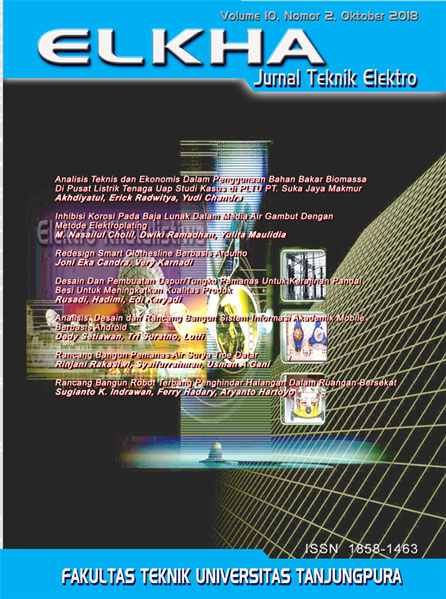
Analisis, Desain dan Rancang Bangun Sistem Informasi Akademik Mobile Berbasis Android
DOI:
https://doi.org/10.26418/elkha.v10i2.28272Keywords:
Sistem Informasi Akademik, Android, Metode WaterfallAbstract
Abstract The purpose of this study was to analyze and to design an Android-based academic information system at Jambi University. This information system would be able to help the activities of the civitas academica at Jambi University. This information system has important facilities in the form of course contract features, view study results, input courses, input grades, lecture schedules and class schedule information. When developed this system, researcher used the Java programming language, where Java programming is used to build android-based applications, while for this database information system used MySQL. Analysis method and system design in this research used the Waterfall method. The Waterfall method has several stages: Analysis, System Design, Implementation, Integration, Operation and Maintenance. In the process of data collection, researcher used methods of observation, interview and literature studies. The output of this research is an Android-based academic information system.
Keyword - Academic Information System, Android, Waterfall
References
S. Harpiyan and M. Teddy, “Pembuatan Aplikasi Pendukung Sistim Akademik Terpadu di Universitas Kristen Maranatha dengan mengunakan Mono For Android,†J. Sistim Inf., vol. 8, no. 2, 2013.
M. Athoillah and M. I. Irawan, “Perancangan Sistem Informasi Mobile Berbasis Android Untuk Kontrol Persedia Barang Di Gudang,†J. SAINS DAN SENI POMITS, vol. 1, no. 1, pp. 1–6, 2013.
J. Hartono, Analisis dan Desain System Informasi. Yogyakarta: Andi OFFSET, 2009.
G. B. Davis, Kerangka Dasar Sistem Informasi Manajemen, Terjemahan. Jakarta: Pustaka Binaman Pressindo, 1991.
J. A. O’Brien and G. M. Marakas, Management information systems-10th ed. New York City: McGraw-Hill Higher Education, 2011.
E. Hardcastle, Business Information Systems. Denmark: Ventus publishing ApS, 2011.
M. Fowler, UML Distilled Edisi 3, Terjemahan. Yogyakarta: Andi OFFSET, 2005.
P. Kimmel, UML Demystified. California: McGraw-Hill, 2005.
R. S. Pressman, Software Engineering: a Practioner’s Approach 7th Edition. New York City: McGraw-Hill, 2010.
I. Binanto, “Analisa Metode Classic Life Cycle (Waterfall) Untuk Pengembangan Perangkat Lunak Multimedia,†in Seminar Nasional Sains dan Teknologi Informasi (SeNASTI), 2014, pp. 33–38.
M. Huo, J. Verner, L. Zhu, and M. A. Babar, “Software Quality and Agile Methods,†in Proceedings of the 28th Annual International Computer Software and Applications Conference (COMPSAC’04), 2004.
S. J. Khalaf and M. N. Al-Jedaiah, “Software Quality and Assurance in Waterfall model and XP – A Comparative Study,†WSEAS Trans. Comput., vol. 7, no. 12, pp. 1968–1976, 2008.
K. Petersen, C. Wohlin, and D. Baca, “The Waterfall Model in Large-Scale Development,†in Proceedings of 10th International Conference, PROFES 2009, 2009, pp. 386–400.
I. Sommerville, Software Engineering 9th Edition. Boston: Addison-Wesley, 2011.
R. A. Sukamto and M. Shalahuddin, Modul Pembelajaran Rekayasa Perangkat Lunak (Terstruktur dan Berorientasi Objek). Bandung: Modula, 2011.
T. Wahyunningrum and D. Januarita, “Implementasi dan Pengujian Web E-commerce untuk Produk Unggulan Desa,†J. Komput. Terap., vol. 1, no. 1, pp. 57–66, 2015.
Downloads
Additional Files
Published
Issue
Section
License
Copyright (c) 2018 ELKHA : Jurnal Teknik Elektro

This work is licensed under a Creative Commons Attribution-NonCommercial-NoDerivatives 4.0 International License.
1. Proposed Policy for Journals That Offer Open Access
Authors who publish with this journal agree to the following terms:
- Authors retain copyright and grant the journal right of first publication with the work simultaneously licensed under a Creative Commons Attribution License that allows others to share the work with an acknowledgement of the work's authorship and initial publication in this journal.
- Authors are able to enter into separate, additional contractual arrangements for the non-exclusive distribution of the journal's published version of the work (e.g., post it to an institutional repository or publish it in a book), with an acknowledgement of its initial publication in this journal.
- Authors are permitted and encouraged to post their work online (e.g., in institutional repositories or on their website) prior to and during the submission process, as it can lead to productive exchanges, as well as earlier and greater citation of published work (See The Effect of Open Access).
2. Proposed Policy for Journals That Offer Delayed Open Access
Authors who publish with this journal agree to the following terms:
- Authors retain copyright and grant the journal right of first publication, with the work [SPECIFY PERIOD OF TIME] after publication simultaneously licensed under a Creative Commons Attribution License that allows others to share the work with an acknowledgement of the work's authorship and initial publication in this journal.
- Authors are able to enter into separate, additional contractual arrangements for the non-exclusive distribution of the journal's published version of the work (e.g., post it to an institutional repository or publish it in a book), with an acknowledgement of its initial publication in this journal.
- Authors are permitted and encouraged to post their work online (e.g., in institutional repositories or on their website) prior to and during the submission process, as it can lead to productive exchanges, as well as earlier and greater citation of published work (See The Effect of Open Access).
