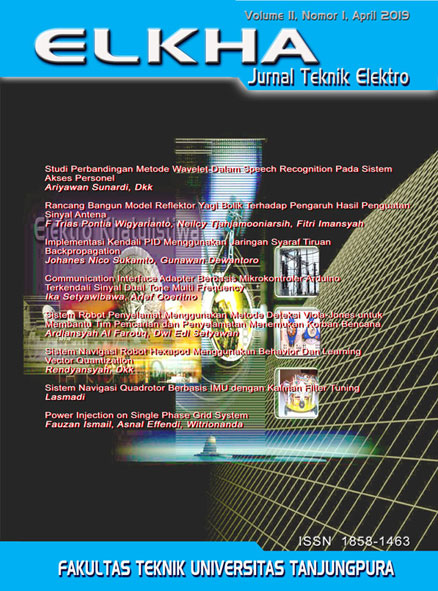
Studi Perbandingan Metode Wavelet Dalam Speech Recognition Pada Sistem Akses Personel
DOI:
https://doi.org/10.26418/elkha.v11i1.29343Keywords:
Speech Recognition, wavelet, coiflet, symlet, daubechies.Abstract
Penelitian tentang speech recognition terus berkembang terkait identifikasi personel. Pada penelitian ini, kami melakukan studi perbandingan metode wavelet dalam speech recognition. Pada penelitian ini teknologi speech recognition berbasiskan wavelett dan neuro fuzzy. Beberapa parameter yang digunakan dalam penelitian ini adalah sampel suara dengan frekuensi sampling 8000 Hz dan 8 bit per sampel dengan filter wavelet High Pass Filter (HPF). Level dekomposisi menggunakan wavelet daubechies, symlet dan coiflet. Nilai thereshold filter wavelet identifikasi personel 57,72%, False Rejection Rate (FRR) 40% dan running time 1,97 detik. Untuk nilai thereshold identifikasi personel 100%, False Rejection Rate (FRR) 0% dan running time 5,43 detik didapatkan pada level dekomposisi 5 pada wavelet db1. Identifikasi tipe wavelet dari yang terbaik adalah coiflet, symlet dan daubechies karena coif2 level 2 memberikan identifikasi 60,00%, FRR 40,00% dan running time 1,97 detikReferences
A. Tandyo And A. Widyatmoko, “Speaker Identification Menggunakan Transformasi Wavelet Diskrit Dan Jaringan Saraf Tiruan Back-Propagation Metode Tinjauan Pustaka,†Pp. 1–7.
W. Kurniawan, “Identifikasi Speech Recognition Manusia Dengan Menggunakan Average Energy Dan Silent Ratio Sebagai Feature Extraction Suara Pada Komputer,†Biospecies, Vol. 9, No. 1, Pp. 1–6, 2016.
Sutarno, C. Wajah, F. I. Komputer, And U. Sriwijaya, “Analisis Perbandingan Transformasi Wavelet,†J. Generic, Vol. 5, No. 2, Pp. 15–21, 2010.
S. Hidayat, H. R. P. Negara, And D. T. Kumoro, “Penentuan Fungsi Basis Wavelet Terbaik Untuk Sinyal Suara,†Sntt Fgdt, Vol. 3, No. November, Pp. 247–252, 2017.
Yohanes, Thiang, And S. Chandra, “Aplikasi Sistem Neuro-Fuzzy Untuk Pengenalan Kata,†Tek. Elektro, Vol. 2, No. 2, Pp. 73–77, 2002.
E. L. Utari, “Pengolahan Sinyal Kardiografi Dengan Menggunakan Alihragam Gelombang Singkat,†Proc. Univ. Respati Yogyakarta, Pp. 90–96, 2014.
M. M. Hidayat, “Pendahuluan Penggunaan,†No. C, Pp. 233–240, 2014.
C. E. Bire And B. Cahyono, “Denoising Pada Citra Menggunakan Transformasi Wavelet,†Semin. Nas. Teknol. Inf. Dan Komun. Terap., Vol. 2012, No. Semantik, Pp. 487–493, 2012.
B. Fatkhurrozi, M. A. Muslim, And D. R. Santoso, “Penggunaan Artificial Neuro Network System Dalam Penentuan Aktivitas Gunung Merapi,†Vol. 6, No. 2, Pp. 113–118, 2012.
B. Robi’in, “Analisis Dekomposisi Wavelet Pada Pengenalan Pola Lurik Dengan Metode Learning Vector Quantization,†Ilk. J. Ilm., Vol. 9, Pp. 153–160, 2017.
Downloads
Additional Files
Published
Issue
Section
License
Copyright (c) 2019 ELKHA : Jurnal Teknik Elektro

This work is licensed under a Creative Commons Attribution-NonCommercial-NoDerivatives 4.0 International License.
1. Proposed Policy for Journals That Offer Open Access
Authors who publish with this journal agree to the following terms:
- Authors retain copyright and grant the journal right of first publication with the work simultaneously licensed under a Creative Commons Attribution License that allows others to share the work with an acknowledgement of the work's authorship and initial publication in this journal.
- Authors are able to enter into separate, additional contractual arrangements for the non-exclusive distribution of the journal's published version of the work (e.g., post it to an institutional repository or publish it in a book), with an acknowledgement of its initial publication in this journal.
- Authors are permitted and encouraged to post their work online (e.g., in institutional repositories or on their website) prior to and during the submission process, as it can lead to productive exchanges, as well as earlier and greater citation of published work (See The Effect of Open Access).
2. Proposed Policy for Journals That Offer Delayed Open Access
Authors who publish with this journal agree to the following terms:
- Authors retain copyright and grant the journal right of first publication, with the work [SPECIFY PERIOD OF TIME] after publication simultaneously licensed under a Creative Commons Attribution License that allows others to share the work with an acknowledgement of the work's authorship and initial publication in this journal.
- Authors are able to enter into separate, additional contractual arrangements for the non-exclusive distribution of the journal's published version of the work (e.g., post it to an institutional repository or publish it in a book), with an acknowledgement of its initial publication in this journal.
- Authors are permitted and encouraged to post their work online (e.g., in institutional repositories or on their website) prior to and during the submission process, as it can lead to productive exchanges, as well as earlier and greater citation of published work (See The Effect of Open Access).
