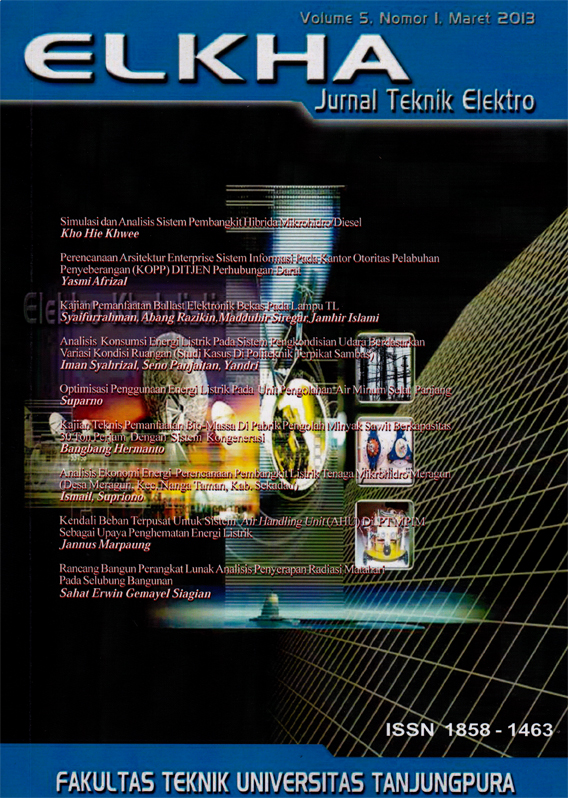
Kajian Teknis Pemanfaatan Bio-Massa Di Pabrik Pengolah Minyak Sawit Berkapasitas 30 Ton Perjam Dengan Sistem Kongenerasi
DOI:
https://doi.org/10.26418/elkha.v5i1.3003Abstract
Abstract– This thesis examines the potential of bio-mass waste generated from palm oil mills with a capacity of 30 tonnes which will be converted into heat energy for process and electrical energy to drive the motors, in which the two energy sources is a major requirement in the processing of palm oil. Number of factories operating in West Kalimantan is 28 mills with a total capacity of processing fresh fruit bunches by 1,190 tons / hour. Potential sources of renewable energy from waste bio-mass produced: 21.5% empty fruit bunches, fiber 12.5%, and 5.1% shell. From the calculation and field studies, the potential of solid waste are: fibers and fibers using super heat boiler obtained at 44.02% thermal efficiency, power output of 2,064 MW, and the power can be used for external plant of 1,464 mW.Steam for the process, is obtained from the steam turbine output, which should be above one atm pressure then used non-condensing turbine one level, with the required generator capacity of 2.58 kVA.
Keywords– cogeneration, super heat, thermal efficiency, type of turbine and generator capacity, fiber, shell.
Downloads
Additional Files
Published
Issue
Section
License
Copyright (c) 2013 ELKHA : Jurnal Teknik Elektro

This work is licensed under a Creative Commons Attribution-NonCommercial-NoDerivatives 4.0 International License.
1. Proposed Policy for Journals That Offer Open Access
Authors who publish with this journal agree to the following terms:
- Authors retain copyright and grant the journal right of first publication with the work simultaneously licensed under a Creative Commons Attribution License that allows others to share the work with an acknowledgement of the work's authorship and initial publication in this journal.
- Authors are able to enter into separate, additional contractual arrangements for the non-exclusive distribution of the journal's published version of the work (e.g., post it to an institutional repository or publish it in a book), with an acknowledgement of its initial publication in this journal.
- Authors are permitted and encouraged to post their work online (e.g., in institutional repositories or on their website) prior to and during the submission process, as it can lead to productive exchanges, as well as earlier and greater citation of published work (See The Effect of Open Access).
2. Proposed Policy for Journals That Offer Delayed Open Access
Authors who publish with this journal agree to the following terms:
- Authors retain copyright and grant the journal right of first publication, with the work [SPECIFY PERIOD OF TIME] after publication simultaneously licensed under a Creative Commons Attribution License that allows others to share the work with an acknowledgement of the work's authorship and initial publication in this journal.
- Authors are able to enter into separate, additional contractual arrangements for the non-exclusive distribution of the journal's published version of the work (e.g., post it to an institutional repository or publish it in a book), with an acknowledgement of its initial publication in this journal.
- Authors are permitted and encouraged to post their work online (e.g., in institutional repositories or on their website) prior to and during the submission process, as it can lead to productive exchanges, as well as earlier and greater citation of published work (See The Effect of Open Access).
