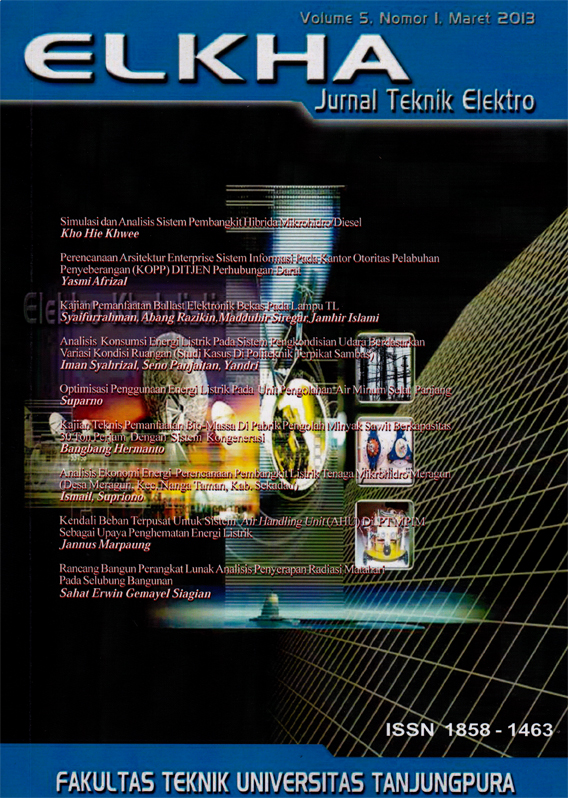
Kajian Pemanfaatan Ballast Elektronik Bekas Pada Lampu TL
DOI:
https://doi.org/10.26418/elkha.v5i1.3005Abstract
Abstract– Penggunaan lampu hemat energi (LHE) untuk penerangan semakin diminati masyarakat, hal ini dikarenakan LHE memiliki cahaya yang lembut, intensitas cahaya lebih terang serta pemakaian daya yang lebih sedikit. Salah satu LHE yang di jual di pasaran adalah LHE yang meggunakan Tabung Fluoresence (Tube Luminescent/TL) yang penyalaannya dilakukan secara elektronik (Ballas elektronik). LHE terbagi menjadi dua kategori, yaitu LHE bergaransi dengan harga lebih mahal dan LHE tidak bergaransi harganya lebih murah. Umumya LHE bergaransi menjamin lama pemakaian lebih dari satu tahun (8000 jam) dibanding LHE tidak bergaransi. Lebih dari masa pakai, kinerja LHE bergaransi mulai menurun dan akhirnya rusak. Kerusakan yang paling sering terjadi pada LHE adalah pada tabung Fluoresecent yaitu menjadi hitam. LHE yang rusak oleh masyarakat sering dibuang dan tidak dimanfaatkan lagi padahal dengan sedikit modifiksi LHE rusak dapat gunakan. Berdasarkan data hasil pengukuran diperoleh adanya kesesuaian hasil antara intensitas cahaya dengan pemakaian daya. Penggunan lampu TL pada ballas elektronik bergaransi memiliki intensitas cahaya lebih terang dibanding dengan ballas elektronik tidak bergaransi. Namun ballas elektronik bergaransi mengkonsumsi daya lebih tinggi dibanding yang tidak bergaransi.
Keywords– Lampu TL, ballas elektronik
Downloads
Additional Files
Published
Issue
Section
License
Copyright (c) 2013 ELKHA : Jurnal Teknik Elektro

This work is licensed under a Creative Commons Attribution-NonCommercial-NoDerivatives 4.0 International License.
1. Proposed Policy for Journals That Offer Open Access
Authors who publish with this journal agree to the following terms:
- Authors retain copyright and grant the journal right of first publication with the work simultaneously licensed under a Creative Commons Attribution License that allows others to share the work with an acknowledgement of the work's authorship and initial publication in this journal.
- Authors are able to enter into separate, additional contractual arrangements for the non-exclusive distribution of the journal's published version of the work (e.g., post it to an institutional repository or publish it in a book), with an acknowledgement of its initial publication in this journal.
- Authors are permitted and encouraged to post their work online (e.g., in institutional repositories or on their website) prior to and during the submission process, as it can lead to productive exchanges, as well as earlier and greater citation of published work (See The Effect of Open Access).
2. Proposed Policy for Journals That Offer Delayed Open Access
Authors who publish with this journal agree to the following terms:
- Authors retain copyright and grant the journal right of first publication, with the work [SPECIFY PERIOD OF TIME] after publication simultaneously licensed under a Creative Commons Attribution License that allows others to share the work with an acknowledgement of the work's authorship and initial publication in this journal.
- Authors are able to enter into separate, additional contractual arrangements for the non-exclusive distribution of the journal's published version of the work (e.g., post it to an institutional repository or publish it in a book), with an acknowledgement of its initial publication in this journal.
- Authors are permitted and encouraged to post their work online (e.g., in institutional repositories or on their website) prior to and during the submission process, as it can lead to productive exchanges, as well as earlier and greater citation of published work (See The Effect of Open Access).
