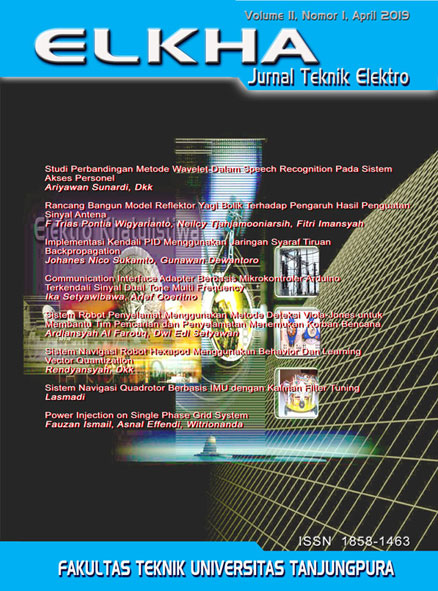
Sistem Navigasi Robot Hexapod Menggunakan Behavior Dan Learning Vector Quantization
DOI:
https://doi.org/10.26418/elkha.v11i1.31147Keywords:
Behavior based, Learning Vector Quantization, Navigasi, Robot haxapodAbstract
Robot banyak digunakan dalam berbagai bidang pekerjaan, salah satunya seperti pada mobile robot jenis berkaki untuk navigasi di dalam lingkungan yang kompleks. Robot berkaki atau dikenal dengan robot hexapod merupakan robot yang meniru pola gerak makhluk hidup. Pada penelitian ini telah dirancang robot hexapod yang dilengkapi dengan lima buah sensor jarak ultrasonik untuk bernavigasi di dalam lingkungan. Adapun tujuan robot hexapod ini bernavigasi untuk aplikasi robot patroli yang bekerja di lingkungan yang sulit diprediksi. Sistem navigasi pada robot hexapod menggunakan metode behavior based dan Learning Vector Quantization (LVQ). Pada robot hexapod memliki lima behavior, diantaranya behavior bergerak maju, mengikuti dinding kiri, mengikuti dinding kanan, mengikuti jalur koridor dan menghindar halangan. Pada masing-masing behavior tersebut untuk bernavigasi menggunakan LVQ. Salah satu behavior akan diaktifkan jika robot menerima masukan (stimuli) nilai jarak tertentu dari sensor jarak. Percobaan dilakukan dalam arena dengan kondisi yang telah ditentukan. Pada percobaan pertama, posisi robot dalam kondisi tanpa ada halangan, dan aksi robot tersebut berjalan maju sampai mendeteksi dinding atau halangan, dan selanjutnya robot melakukan aksi manuver kiri atau kanan berdasarkan behavior yang aktif. Pada percobaan kedua, posisi robot berada pada jalur koridor dan bernavigasi mengikuti jalur koridor tersebut. Selanjutnya pada percobaan ketiga, robot berada dalam lingkungan kompleks dimana robot tersebut ditempatkan pada posisi yang berbeda-beda, dan robot dapat bernavigasi dengan baik tanpa menabrak objek atau dinding.References
A. A. A. Emhemed, Investigation in Two Wheels Mobile Robot Movement: Stability and Motion Paths, International Journal of Robotics and Automation (IJRA), vol. 2, no. 2, pp. 45-49, 2013.
K. Joni, M. Ulum dan Z. Abidin, Robot Line Follower Berbasis Kendali Proportional-Integral-Derivative (PID) Untuk Lintasan Dengan Sudut Ekstrim, Jurnal Infotel, vol. 8, No. 2, pp. 138-142, 2016.
M. A. Putra, B. Yudho dan P. Kurniasari, Pengendali Laju Kecepatan dan Sudut Steering Pada Mobile Robot Dengan Menggunakan Accelerometer Pada Smartphone Android, Mikrotiga, vol. 1, no. 2, pp. 19-24, 2014.
H. Wicaksono, Prihastono, K. Anam, R. Effendi, I. A. Sulistijono, S. Kuswadi, A. jazidie, dan M. Sampei, Perancangan Sistem Navigasi Otonom Pada Behavior Based Hexapod Robot, Jurnal Teknik Elektro, vol. 8, no. 2, pp. 70-78, 2008.
Darwison dan R. Wahyudi, Kontrol Kecepatan Robot Hexapod Pemadam Api Menggunakan Metoda Logika Fuzzy, Jurnal Nasional Teknik Elektro, Vol. 4, No. 2, pp. 227-234, 2015.
Y. R. Wahyudi, M. S. Hadi, A. n. Handayani dan S. Sendari, Implementasi Sistem Kendali PD (Proportional Derivative) Pada Navigasi Wall Follower Robot Berkaki Enam (Hexapod), 5th Indonesian Symposium on Robotic Systems And Control, pp. 33-38, 2017.
Rendyansyah, K. Exaudi, dan A. P. P. Prasetyo, Navigasi Berbasis Behavior Dan Fuzzy Logic Pada Simulasi Robot Bergerak Otonom, Jurnal Nasional Teknik Elektro, vol. 5, no. 1, pp. 135-144, 2016.
A. Yulianto dan H. P. Handoyo, Penerapan Behavior-Based Control dan Fuzzy Logic Controller pada Sistem Navigasi Robot Soccer, CENTRE, Civil and Electrical Engineering Journal, vol. 7, no. 1, pp. 16-23, 2012.
M. Gouko, C. H. Kim, dan Y. Kobayashi, Active Perception Model Extracting Object Features From Unlabeled Data, International Conference on Advanced Robotics (ICAR), pp. 518-523, 2017.
Sutarno, R. F. Abdullah, R. Passarella. Identifikasi Tanaman Buah Berdasarkan Fitur Bentuk, Warna dan Tekstur Daun Berbasis Pengolahan Citra dan Learning Vector Quantization (LVQ), Prosiding Annual Research Seminar, vol. 3, No. 1, pp. 65-70, 2017.
S. Kusumadewi, Artificial Intelligence (Teknik dan Aplikasinya), Penerbit Graha Ilmu, Yogyakarta, 2013.
Downloads
Published
Issue
Section
License
Copyright (c) 2019 ELKHA : Jurnal Teknik Elektro

This work is licensed under a Creative Commons Attribution-NonCommercial-NoDerivatives 4.0 International License.
1. Proposed Policy for Journals That Offer Open Access
Authors who publish with this journal agree to the following terms:
- Authors retain copyright and grant the journal right of first publication with the work simultaneously licensed under a Creative Commons Attribution License that allows others to share the work with an acknowledgement of the work's authorship and initial publication in this journal.
- Authors are able to enter into separate, additional contractual arrangements for the non-exclusive distribution of the journal's published version of the work (e.g., post it to an institutional repository or publish it in a book), with an acknowledgement of its initial publication in this journal.
- Authors are permitted and encouraged to post their work online (e.g., in institutional repositories or on their website) prior to and during the submission process, as it can lead to productive exchanges, as well as earlier and greater citation of published work (See The Effect of Open Access).
2. Proposed Policy for Journals That Offer Delayed Open Access
Authors who publish with this journal agree to the following terms:
- Authors retain copyright and grant the journal right of first publication, with the work [SPECIFY PERIOD OF TIME] after publication simultaneously licensed under a Creative Commons Attribution License that allows others to share the work with an acknowledgement of the work's authorship and initial publication in this journal.
- Authors are able to enter into separate, additional contractual arrangements for the non-exclusive distribution of the journal's published version of the work (e.g., post it to an institutional repository or publish it in a book), with an acknowledgement of its initial publication in this journal.
- Authors are permitted and encouraged to post their work online (e.g., in institutional repositories or on their website) prior to and during the submission process, as it can lead to productive exchanges, as well as earlier and greater citation of published work (See The Effect of Open Access).
