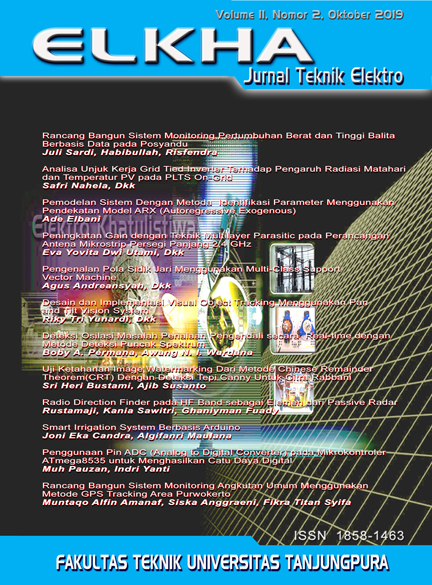
SMART IRRIGATION SYSTEM BERBASIS ARDUINO
DOI:
https://doi.org/10.26418/elkha.v11i2.34500Keywords:
Arduino, Soil Moisture Sensor, Water Level SensorAbstract
Based on the Batam City government program to increase the food security of Batam City so as not to depend on other regions where Batam City has been fulfilling its basic needs such as rice, fruit and vegetables, import from West Sumatra and North Sumatra, the success of its food security program will specifically choose an island to develop agriculture because each island in the Batam Islands is not suitable to be designed as an industrial area so that the specificity of an island developed for agriculture is needed. To participate in supporting the Batam City government program in developing food security in agriculture, a good irrigation or irrigation system is needed. The problem of irrigation water distribution occurs when the amount of water available is smaller than the needs of irrigation water, especially during the dry season. So that efficient use of irrigation water is needed. The uneven distribution of water due to poor management of irrigation water sources will greatly affect the success of the production of an agricultural product. to build a smart irrigation system using soil moiture sensors and Arudino-based water level sensors, it can be seen that the prototype system can function because the components used work in the order, and the results are obtained when the sensor water level is greater than 600 then the LED lights live red and buzzer will sound loudly indicating water tank below the level, when the value of soil moisture sensor is greater or equal to 700 then the red LED light is on and the buzzer sounds low indicating dray soil conditions and the water pump / selenoid valve will be on and green LED lights will live, when the value of soil moisture sensor is smaller 700 then the live yellow LED lights show moist soil and water pump / selenoid valve conditions, and when the value of soil moisture sensor is smaller than 300 then the blue LED light will live shows Soggy soil and water pump / selenoid valve off, the prototype of the smart irrigation system has the same design as it has been made.References
Marlina Sari, Gunawan, "Rancang Bangun Alat Penyiram Tanaman Otomatis Menggunakan Sensor Kelembaban Tanah," Journal of Electrical Technology, vol. III, no. 2, 2018.
Gendrawan Hoendarto, Lina, Dean Hansen, "PERANCANAGAN PERANGKAT PENYIRAM TANAMAN OTOMATIS MENGGUNAKAN MIKROKONTROLER ARDUINO UNO," Jurnal InTekSis, vol. IV, no. 2, pp. 64-75.
Dedi Trianto. Yulrio, Brianorman, Viktorianus Ryan Juniardy, "PROTOTYPE ALAT PENYEMPROT AIR OTOMATIS PADA KEBUN PEMBIBITAN SAWIT BERBASIS SENSOR KELEMBABAN DAN MIKROKONTROLER AVR ATMEGA8," Jurnal Coding Sistem Komputer Universitas Tanjungpura , vol. II, no. 3, pp. 1-10, 2014.
Muhammad Taufik, Hendriko. Made Rahmawaty, "Robot Penyiram Tanaman," Jurnal ELEMENTER, vol. 4, no. 2, 2018.
Elia Kendek Allo, Dringhuzen J. Mahamit, Erricson Zet Kafiar, "Rancang Bangun Penyiram Tanaman Berbasis Arduino Uno Menggunakan Sensor Kelembaban YL-39 Dan YL-69," Jurnal Teknik Elektro dan Komputer , vol. 7, no. 3, 2018.
Novian Chandra Suseno, Roberth Ricky Y Manaha. Jacquline M.S. Waworundeng, "Perancangan Alat Penyiram Tanaman Otomatis berbasis Sensor dan Mikrokontroler," in Seminar Nasional Multi Disiplin Ilmu, Klabat, 2017.
Widodo, Chusniati Dhonny, "RANCANG BANGUN SISTEM PENYIRAMAN TANAMAN ANGGREK DENDROBIUM MENGGUNAKAN SENSOR SHT11 PADA FASE PEMBUNGAAN," Jurnal Teknik WAKTU , vol. 15, no. 01, 2017.
Mastura, Abdullah, "SISTEM PEMBERIAN NUTRISI DAN PENYIRAMAN TANAMAN OTOMATIS BERDASARKAN REAL TIME CLOCK DAN TINGKAT KELEMBABAN TANAH BERBASIS MIKROKONTROLER ATMEGA32," FISITEK: Jurnal Ilmu Fisika dan Teknologi, vol. 2, no. 2, pp. 33-41, 2018.
Suroso, Nasron, Astriana Rahma Putri, "Perancangan Alat Penyiram Tanaman Otomatis pada Miniatur Greenhouse Berbasis IOT," in Seminar Nasional Inovasi dan Aplikasi Teknologi di Industri (SENIATI), MALANG, 2019 .
Downloads
Additional Files
Published
Issue
Section
License
Copyright (c) 2020 ELKHA : Jurnal Teknik Elektro

This work is licensed under a Creative Commons Attribution-NonCommercial-NoDerivatives 4.0 International License.
1. Proposed Policy for Journals That Offer Open Access
Authors who publish with this journal agree to the following terms:
- Authors retain copyright and grant the journal right of first publication with the work simultaneously licensed under a Creative Commons Attribution License that allows others to share the work with an acknowledgement of the work's authorship and initial publication in this journal.
- Authors are able to enter into separate, additional contractual arrangements for the non-exclusive distribution of the journal's published version of the work (e.g., post it to an institutional repository or publish it in a book), with an acknowledgement of its initial publication in this journal.
- Authors are permitted and encouraged to post their work online (e.g., in institutional repositories or on their website) prior to and during the submission process, as it can lead to productive exchanges, as well as earlier and greater citation of published work (See The Effect of Open Access).
2. Proposed Policy for Journals That Offer Delayed Open Access
Authors who publish with this journal agree to the following terms:
- Authors retain copyright and grant the journal right of first publication, with the work [SPECIFY PERIOD OF TIME] after publication simultaneously licensed under a Creative Commons Attribution License that allows others to share the work with an acknowledgement of the work's authorship and initial publication in this journal.
- Authors are able to enter into separate, additional contractual arrangements for the non-exclusive distribution of the journal's published version of the work (e.g., post it to an institutional repository or publish it in a book), with an acknowledgement of its initial publication in this journal.
- Authors are permitted and encouraged to post their work online (e.g., in institutional repositories or on their website) prior to and during the submission process, as it can lead to productive exchanges, as well as earlier and greater citation of published work (See The Effect of Open Access).
