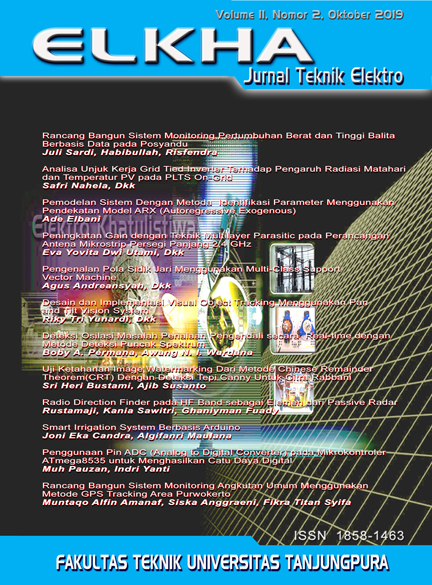
Radio Direction Finder pada HF Band sebagai Elemen dari Passive Radar
DOI:
https://doi.org/10.26418/elkha.v11i2.34733Keywords:
AM detector, antenna, audio amplifier, passive radar, RDF, tuning.Abstract
A Radio detection and ranging (radar) is used to detect and track objects in the air and on land, one type of the radar that is known is a passive radar. The radio direction finder (RDF) as an element of a passive radar is used to determine the direction angle, based on a radio waves that emitted by an object. The purpose of this study is to produce a RDF that works on HF bands as passive radar elements. In this study a RDF has been produced, which consists: a receive antenna in the form of a dipole λ/8 and a yagi 5 elements with horizontal polarization, a tuning circuit, an AM signal detector, an audio amplifier, and equipped with a level signal display in the form of a S meter and a loudspeaker. The test results for outside and inside the room at a certain time, the RDF can detect the angle of direction of horizontal plane of an object or AM transmitter from 0 ° to 360 ° in the frequency range between 4.02 to 10.76 MHz. The results of detecting the angle of direction of an object or a transmitting radio waves in the HF band, in the form of a signal level are then plotted on the polar diagram of the horizontal plane, and the sound can be heard through the loudspeaker. Furthermore, the results of this study can be used for the development of a RDF independently, and its implementation in the passive radar.References
Passive Radar Group, Detection of Aircraft using Passive Radar, ECE4007 Senior Project Section L01. L02. & L03, 2008.
W. Ross, “Fundamental problems in radio direction-finding at high frequencies (3–30 Mc/s),â€Journal of the Institution of Electrical Engineers, vol. 94. iss. 11, pp. 154 – 165, March-April 1947.
Radio Regulations Articles, ITU, Edition of 2012
K.W. Gurgel, H.H. Essen and S. P. Kingsley. HF radars: Physical limitations and recent developments. Physical-Limits-2000. Preprint submitted to Elsevier Preprint. June 20, 2000. the University of Hamburg HF-radar group
Digital Direction Finder (R&S®DDF205), Rohde & Schwarz, 2011
J. W. A. Brown, “FM Airborne Passive Radar,†Thesis, Electronic Engineering Departement of Electronic and Electrical Engineering University College, London, 2013
B. Dong, G. Yang, and T. Liang, “Research and realization of handheld radio direction finding communication system,†Computer Modelling and New Technologies, vol. 18(5), pp. 283-287, 2014.
Sukemi, “Rancangan Perangkat Electronic Support Measure (ESM) untuk Peperangan Elektronik,†Jurnal Generic, vol. 1 (1), hal. 10-14, 2010
M. Păun, R. Tamas, and I. Marghescu, “A Software Defined Radio Approach for Direction Finding,†U.P.B. Sci. Bull., Series C, vol. 77. iss. 4, 2015.
D. P. Quinot, “Design of a Radio Direction Finder for Search and Rescue Operations Estimation, Sonification, and Virtual Prototyping,†A Thesis, Science Pierre and Marie Curie University, 2015
M. J. Jakpar, et al, “Exploitation of Radio Direction Finder in the design of a UHF Transmitter Locator System,â€Indian Journal of Science and Technology, vol. 9(25), pp. 1-5. 2016
D. P. Dutra, H. M. Paiva, and K. H. Kienitz, “3D Localization by Arithmetic Mean Triangulation,†Anais do XIX Congresso Brasileiro de Automática. CBA, 2012.
S. Kristiyana, A. Susanto, Sunarno, and R. Hidayat, “The Radio Frequency Source Position Finder Based on The Triangle-Centroid-Algorithm,†IJITEE, vol. 1 (1), hal. 13-18. 2017
V. Straser, D. Cataldi, and G. Cataldi, “Radio Direction Finding System, a new perspective for global crust diagnosis,†New Concepts in Global Tectonics Journal, vol. 6, no. 2, June 2018.
C. Ziółkowski and J. M. Kelner, “Radio bearing of sources with directional antennas in urban environment,â€International Journal of Microwave and Wireless Technologies, vol. 10, Special Issue 7 (Electronic Warfare), pp. 759-771, September 2018.
J. D. Krauss, Antennas, Second Edition. McGraw-Hill Book, 2001
J. Markus, Modern Electronic Circuit Reference Manual Guidebook of Electronic Circuits, 1980
Rustamaji, Elektronika Komunikasi, edisi ke-1, Bandung, Penerbit Itenas, 1997.
R. F. Coughlin and F. F. Driscoll, Operational Amplifiers and Linear Integrated Circuits, 6th Edition, Prentice-Hall International, 2000.
Downloads
Additional Files
Published
Issue
Section
License
Copyright (c) 2020 ELKHA : Jurnal Teknik Elektro

This work is licensed under a Creative Commons Attribution-NonCommercial-NoDerivatives 4.0 International License.
1. Proposed Policy for Journals That Offer Open Access
Authors who publish with this journal agree to the following terms:
- Authors retain copyright and grant the journal right of first publication with the work simultaneously licensed under a Creative Commons Attribution License that allows others to share the work with an acknowledgement of the work's authorship and initial publication in this journal.
- Authors are able to enter into separate, additional contractual arrangements for the non-exclusive distribution of the journal's published version of the work (e.g., post it to an institutional repository or publish it in a book), with an acknowledgement of its initial publication in this journal.
- Authors are permitted and encouraged to post their work online (e.g., in institutional repositories or on their website) prior to and during the submission process, as it can lead to productive exchanges, as well as earlier and greater citation of published work (See The Effect of Open Access).
2. Proposed Policy for Journals That Offer Delayed Open Access
Authors who publish with this journal agree to the following terms:
- Authors retain copyright and grant the journal right of first publication, with the work [SPECIFY PERIOD OF TIME] after publication simultaneously licensed under a Creative Commons Attribution License that allows others to share the work with an acknowledgement of the work's authorship and initial publication in this journal.
- Authors are able to enter into separate, additional contractual arrangements for the non-exclusive distribution of the journal's published version of the work (e.g., post it to an institutional repository or publish it in a book), with an acknowledgement of its initial publication in this journal.
- Authors are permitted and encouraged to post their work online (e.g., in institutional repositories or on their website) prior to and during the submission process, as it can lead to productive exchanges, as well as earlier and greater citation of published work (See The Effect of Open Access).
