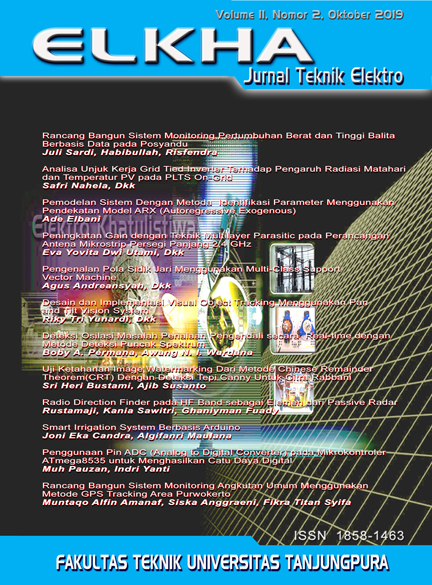
Penggunaan Pin ADC (Analog to Digital Converter) pada Mikrokontroler ATmega8535 untuk Menghasilkan Catu Daya Digital
DOI:
https://doi.org/10.26418/elkha.v11i2.35036Keywords:
digital power supply, ADC, LM317, AC-DC conversion, ATmega8535Abstract
Digital power supply with LM317 regulator have been built. The output voltage of LM317 regulator is digitalized by means of ADC pins in ATmega8535 microcontroller. 128 prescaler is used to make the microcontroller"™s frequency in the region of ADC"™s frequency, therefore ADPS0, ADPS1 and ADPS2 must be high (1). AVcc (5V) is used as voltage reference, it is means that REFS0, REFS1 is set to high (1) and low(0) respectively. LCD 16x2 is used to display the voltage output of LM317. The research divided into three stages: theoretical study, simulation and implementation. Theoretical study consists of AC-DC conversion and digitalizing the output voltage of LM317. Aim of the study of AC-DC conversion is to know the specification of elements to build 30 V, 1 A power supply. Circuits and coding in ATmgea8535 for converting analog to digital is studied. Proteus software is used for designing the circuits and simulation while Atmel Studio for compiling the coding. The difference of voltage measurements is found between digital voltmeter and LCD in the implementation stage, the range is 0.2-3.19 V. After callibration, same voltage values both on voltmeter and LCD is displayed. It is concluded that minimum-maximum output voltage of power supply is 1.2-27.10 V.References
J. Williams, High efficiency linear regulators. Elsevier Inc., 2013.
S. Kumar, T. Verma, A. Dwivedi, and R. K. Srivastava, “Fabrication and comparison of linear power supplies for low-moderate voltage applications,†2014 Power Energy Syst. Conf. Towar. Sustain. Energy, PESTSE 2014, no. Pestse, pp. 1–4, 2014.
P. Rahardjo, “Catu Daya DC Tetap +5V dan +12V / 10A untuk Laboratorium Elektronika,†Badung.
Zubaidi, “ImplementasiPembuatan Catu Daya Terprogram Berbasis Komputer,†J. Inform., vol. 3, no. 1, pp. 278–290, 2009.
Y. M. Lai, Power Supplies, 4th ed., vol. 48, no. 4. Elsevier Inc., 1969.
Y. S. Lee and M. H. L. Chow, Diode rectifiers, 4th ed. Elsevier Inc., 2018.
N. Tohir, “Rancang Bangun Catu Daya Digital Menggunakan Buck Converter Berbasis Mikrokontroler Arduino,†Universitas Lampung, 2016.
N. C. Makasenggehe, B. Narasiang, S. R. U. . Sompie, and Bahrun, “Perancangan Power Supplay Digital Berbasis Mikrokontroler Menggunakan Keypad Sebagai Pemilih Tegangan,†J. Tek. Elektro dan Komput., vol. 1, no. 1, pp. 1–6, 2012.
B. Hamid, F. Agustiyanto, and Yulkifli, “Pengembangan Catu Daya Presisi Display Digital untuk Praktikum Fisika Listrik Dinamis,†J. Sainstek, vol. 8, no. 2, pp. 193–202, 2016.
ON Semiconductor, “LM317, NCV317 1.5 A Adjustable Output, Positive Voltage Regulator,†Semicond. Components Ind., vol. Rev. 16, no. LM317/D, pp. 1–4, 2019.
ON Semiconductor, “1N4001, 1N4002, 1N4003, 1N4004, 1N4005, 1N4006, 1N4007,†Semicond. Components Ind., pp. 1–6, 2005.
M. Score, “Ceramic or electrolytic output capacitors in DC / DC converters — Why not both ?,†Analog Appl. J., no. Texas Instruments, pp. 16–20, 2015.
Atmel Corp., “ATmega8535-8535L,†2006.
Downloads
Additional Files
Published
Issue
Section
License
Copyright (c) 2020 ELKHA : Jurnal Teknik Elektro

This work is licensed under a Creative Commons Attribution-NonCommercial-NoDerivatives 4.0 International License.
1. Proposed Policy for Journals That Offer Open Access
Authors who publish with this journal agree to the following terms:
- Authors retain copyright and grant the journal right of first publication with the work simultaneously licensed under a Creative Commons Attribution License that allows others to share the work with an acknowledgement of the work's authorship and initial publication in this journal.
- Authors are able to enter into separate, additional contractual arrangements for the non-exclusive distribution of the journal's published version of the work (e.g., post it to an institutional repository or publish it in a book), with an acknowledgement of its initial publication in this journal.
- Authors are permitted and encouraged to post their work online (e.g., in institutional repositories or on their website) prior to and during the submission process, as it can lead to productive exchanges, as well as earlier and greater citation of published work (See The Effect of Open Access).
2. Proposed Policy for Journals That Offer Delayed Open Access
Authors who publish with this journal agree to the following terms:
- Authors retain copyright and grant the journal right of first publication, with the work [SPECIFY PERIOD OF TIME] after publication simultaneously licensed under a Creative Commons Attribution License that allows others to share the work with an acknowledgement of the work's authorship and initial publication in this journal.
- Authors are able to enter into separate, additional contractual arrangements for the non-exclusive distribution of the journal's published version of the work (e.g., post it to an institutional repository or publish it in a book), with an acknowledgement of its initial publication in this journal.
- Authors are permitted and encouraged to post their work online (e.g., in institutional repositories or on their website) prior to and during the submission process, as it can lead to productive exchanges, as well as earlier and greater citation of published work (See The Effect of Open Access).
