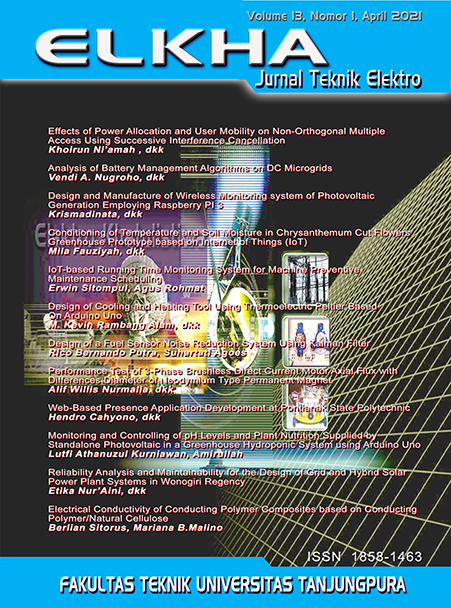
Performance Test of Three-Phase Brushless Direct Current Motor Axial Flux with Different Diameter of Neodymium Type Permanent Magnet
DOI:
https://doi.org/10.26418/elkha.v13i1.41693Keywords:
Motor, BLDC, Neodymium, DiameterAbstract
Technology that is growing rapidly and innovations that have sprung up in the electrical field today are driving the use of electricity as a source of energy to do work. Electric motor is one component that is very popular in the industrial world and households that are useful to human life. In addition to DC motors and induction motors, there are also 3 phase brushless direct current (BLDC) motors which are a type of synchronous motor where magnetic fields are produced by rotor and stator at the same frequency. The rotor is a moving part of the brushless direct current motor which is a place of permanent magnet called a pole. This paper discusses the performance of brushless direct current 3 phase axial flux motors with different diameters of neodymium type permanent magnets. Tests carried out using neodymium permanent magnets with diameters of 15mm x 2mm and 20mm x 2mm were tested without using a load and using load. The parameters used in testing motor performance include speed, torque, and motor power with a source voltage of 12V, 16V, 20V, and 24V. The test results shows that the speed value of a BLDC motor using permanent magnets with a size of 20mm x 2mm is greater than that of permanent magnets of 15mm x 2mm. The same thing applies to the value of the power produced while, for the value of torque when the motor uses a permanent magnet of 15mm x 2mm will be greater than that of a motor using a permanent magnet of 20mm x 2mm.
References
Z. Abidin, T. Priangkoso, and D. Darmanto, “Pengujian Performance Motor Listrik Ac 3 Fasa Dengan Daya 3 Hp Menggunakan Pembebanan Generator Listrik,†J. Momentum UNWAHAS, vol. 9, no. 1, pp. 30-34, 2013.
A. Kurniawan Rizky, “Rancang Bangun Motor Searah Tanpa Sikat Satu Fasa,†University of Jember, 2016.
M. Reqzy, “Rancang Bangun Motor Brushless Direct Current 3 Phase Fluks Axial,†University of Jember, 2020.
W.B. Pramono, H. P. Pratama, and Warindi, “Perancangan Motor Litrik BLDC 10KW Untuk sepeda Motor Listrik,†Semin. Nas. Teknol. dan Inform., vol. 3, pp. 113–120, 2016.
R. Afif, “Analisis Frekuensi Terhadap Kecepatan Motor BLDC ( Brushless Direct Current ) Satu Fasa Kontruksi Axial Flux Celah Udara Tunggal,†pp. 1–4, 2020.
A. Nurtriartono, “Rancang Bangun Dan Uji Peforma Axial Brushless DC Motor Dengan Daya Output 2000 Watt,†Inst. Teknol. Sepuluh Nop., 2014.
M. Gussow, Theory and Problems of Basic Electricity. 1983.
T. KenjÅ and S. Nagamori, Permanent-magnet and brushless DC motors. 1985.
E. Prasetyo, “Analisis Pengaruh Jatuh Tegangan Jala-Jala Terhadap Unjuk Kerja Motor Induksi Tiga Fasa", 2016.
Downloads
Additional Files
Published
Issue
Section
License
Copyright (c) 2021 ELKHA : Jurnal Teknik Elektro

This work is licensed under a Creative Commons Attribution-NonCommercial-NoDerivatives 4.0 International License.
1. Proposed Policy for Journals That Offer Open Access
Authors who publish with this journal agree to the following terms:
- Authors retain copyright and grant the journal right of first publication with the work simultaneously licensed under a Creative Commons Attribution License that allows others to share the work with an acknowledgement of the work's authorship and initial publication in this journal.
- Authors are able to enter into separate, additional contractual arrangements for the non-exclusive distribution of the journal's published version of the work (e.g., post it to an institutional repository or publish it in a book), with an acknowledgement of its initial publication in this journal.
- Authors are permitted and encouraged to post their work online (e.g., in institutional repositories or on their website) prior to and during the submission process, as it can lead to productive exchanges, as well as earlier and greater citation of published work (See The Effect of Open Access).
2. Proposed Policy for Journals That Offer Delayed Open Access
Authors who publish with this journal agree to the following terms:
- Authors retain copyright and grant the journal right of first publication, with the work [SPECIFY PERIOD OF TIME] after publication simultaneously licensed under a Creative Commons Attribution License that allows others to share the work with an acknowledgement of the work's authorship and initial publication in this journal.
- Authors are able to enter into separate, additional contractual arrangements for the non-exclusive distribution of the journal's published version of the work (e.g., post it to an institutional repository or publish it in a book), with an acknowledgement of its initial publication in this journal.
- Authors are permitted and encouraged to post their work online (e.g., in institutional repositories or on their website) prior to and during the submission process, as it can lead to productive exchanges, as well as earlier and greater citation of published work (See The Effect of Open Access).
