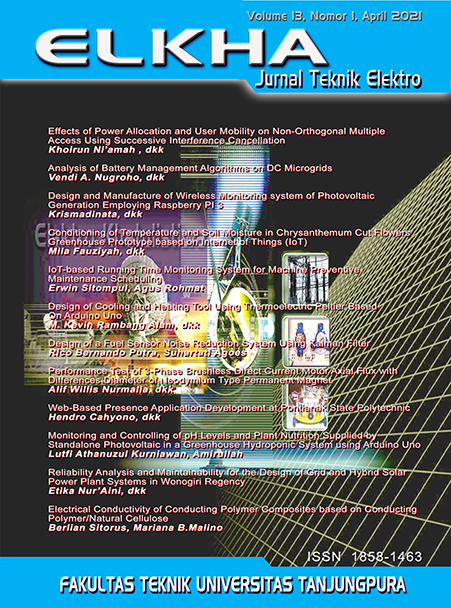
Conditioning of Temperature and Soil Moisture in Chrysanthemum Cut Flowers Greenhouse Prototype based on Internet of Things (IoT)
DOI:
https://doi.org/10.26418/elkha.v13i1.43078Keywords:
Chrysanthemum, Greenhouse, Internet of Things Temperature, Soil Moisture.Abstract
Currently, cut chrysanthemum cultivation in a greenhouse is still using a conventional system. Temperature and soil moisture are the most important factors in the growth process. If the temperature and humidity of the soil are not conditioned, the roots will quickly rot and slow the growth process of chrysanthemums. Internet of Things is an integrated system with a data-based server that stores data in the cloud from sensors so that the system can be monitored remotely in real-time. Based on this, an integrated system was designed to make it easier for farmers to condition the temperature and humidity of the chrysanthemum flower soil. In temperature conditioning, if the temperature of cut chrysanthemum is detected <24 ℃ then the heater will be "on" by adjusting the fan rotation and vice versa. Meanwhile, soil moisture conditioning is carried out by distributing water if the detected soil moisture is <50%, then the water pump is in the "on" state. The data on the degree of temperature and the percent of soil moisture will be recorded into the cloud which will then be displayed in the form of graphs and history data on the webserver and Android. By using this system, it is found that the growth process of cut chrysanthemums can grow 7 days faster than the standard harvest time of 30 days.
References
O.K. Sulaiman dan A. Widarma, “Sistem Internet of Things (IoT) Berbasis Cloud Computing dalam Campus Area Network,†Seminar Nasional Fakultas Teknik UISU, hal. 9-12, 2017.
S. Sukardihoto, “Internet of Things & Big dataâ€, hal 10-45, 2016.
R.A. Atmoko, R Riantinim, and M K Hasin, “IoT real time data acquisition using MQTTT protocol,†Internasional Conference on Physical Instrumentation and Advanced Materials, 2017.
Y. Gadade and R Vatti, “Data Logger for Greenhouse using Cloud Computing,†IJSRD, vol. 5, pp. 608-610, 2017.
D. Liu, X. Cao, and C Huang, “Intelligent Agriculture Greenhouse Environment Monitoring System Based on IoT Technology†International Conference on Intelligent Transportation, Big Data & Smart City, 2015.
T. Widyastuti, “Teknologi Budidaya Tanaman Hias Agribisnis,†pp. 140-201, 2018.
F.A. Rafi., “Design of Orchid Monitoring System Based on IoT,†ICIC, 2018.
Nasron, “Sistem Kendali Temperatur, Kelembaban Tanah dan Cahaya Otomatis Menggunakan Raspberry Pi Pada Smart Greenhouse,†EECCIS, Vol 13, No.3 pp. 114-119, 2019.
R. A. Firmansyah dan D. Junianto, “Rancang Bangun Farming Box Dengan Pengaturan Suhu Menggunakan Fuzzy Logic Controller,†ELKHA, Vol. 12, No. 2, pp. 92-98, 2020.
Hendro, D. Rahmawati, F. Herawati dan G. Saputra, “Karakterisasi Sensor Kelembaban Tanah (YL-69) Untuk Otomasi Penyiraman Tanaman Berbasis Arduino Uno,†Prosiding SKF, pp. 92-97, 2017.
X Zhang, J Zhang, L Li, Y Zhang, and G Yang, “Monitoring Citrus Soil Moisture and Nutrients Using an IoT Based System,†MDPI Journal, 2017.
R Ginanjar, “Kendali dan Pemantauan Kelembaban Tanah, Suhu Ruangan, Cahaya Untuk Tanaman Tomat,†JIIK, Vol 23, No.3 pp. 166-174, 2018.
C.H. Tien and N.D. Can, “Environment Monitoring System for Agricultural Applications Based on Wireless Sensor Network,†Seventh International Conference on Information Science and Technology, 2017.
K. Lia, C. Liberty, and M. Rina, “Design of Smart Greenhouse Control System for Chrysanthemum Sp. Cultivation Based on Humidity, Light, and Temperature Sensors,†Asean Forum on ICT for Sustainable Development, 2015
C.S. Ok, K.Y. Jong, and L.K. Ho, “Growth Characteristics of Chrysanthemum According to Planting Density,†KJOS, 2017.
Downloads
Additional Files
Published
Issue
Section
License
Copyright (c) 2021 ELKHA : Jurnal Teknik Elektro

This work is licensed under a Creative Commons Attribution-NonCommercial-NoDerivatives 4.0 International License.
1. Proposed Policy for Journals That Offer Open Access
Authors who publish with this journal agree to the following terms:
- Authors retain copyright and grant the journal right of first publication with the work simultaneously licensed under a Creative Commons Attribution License that allows others to share the work with an acknowledgement of the work's authorship and initial publication in this journal.
- Authors are able to enter into separate, additional contractual arrangements for the non-exclusive distribution of the journal's published version of the work (e.g., post it to an institutional repository or publish it in a book), with an acknowledgement of its initial publication in this journal.
- Authors are permitted and encouraged to post their work online (e.g., in institutional repositories or on their website) prior to and during the submission process, as it can lead to productive exchanges, as well as earlier and greater citation of published work (See The Effect of Open Access).
2. Proposed Policy for Journals That Offer Delayed Open Access
Authors who publish with this journal agree to the following terms:
- Authors retain copyright and grant the journal right of first publication, with the work [SPECIFY PERIOD OF TIME] after publication simultaneously licensed under a Creative Commons Attribution License that allows others to share the work with an acknowledgement of the work's authorship and initial publication in this journal.
- Authors are able to enter into separate, additional contractual arrangements for the non-exclusive distribution of the journal's published version of the work (e.g., post it to an institutional repository or publish it in a book), with an acknowledgement of its initial publication in this journal.
- Authors are permitted and encouraged to post their work online (e.g., in institutional repositories or on their website) prior to and during the submission process, as it can lead to productive exchanges, as well as earlier and greater citation of published work (See The Effect of Open Access).
