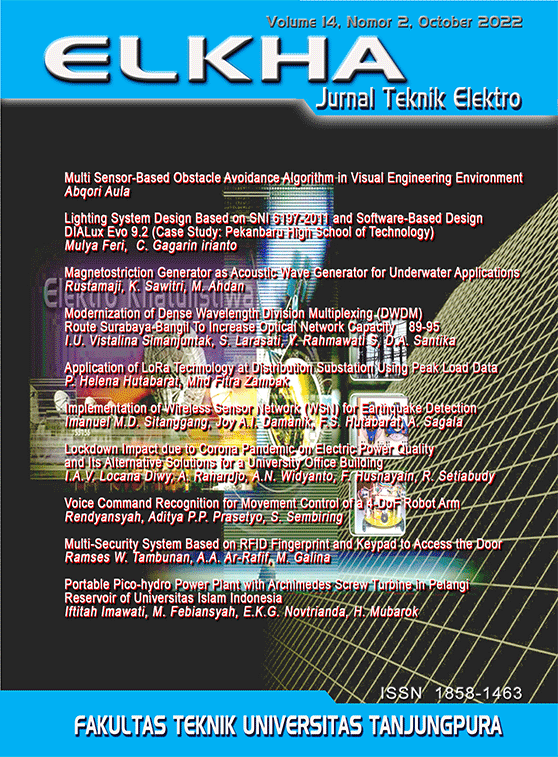
Lighting System Design Based on SNI 6197-2011 and Software-Based Design DIALux Evo 9.2 (Case Study: Pekanbaru High School of Technology)
DOI:
https://doi.org/10.26418/elkha.v14i2.50278Keywords:
DIALux evo 9.2 software, LED, lumen, lumen methodAbstract
Lighting is one of the important factors in a room design. The intensity of lighting that does not meet the standards can affect eye health and work activities. In this study, measurements of the lighting intensity were carried out at Pekanbaru College of Technology (STTP) i.e., in classroom 01A and library. Lumen method is one of the calculation methods to determine the number of luminaires required to improve the lighting quality in the room. For the lighting in classroom 01A, the mathematical calculations result in 363.23 lux while the DIALux evo 9.2 software obtained 375 lux. There is 3.1% difference in these results This might occur because the condition of the room, supporting equipment, and color has an influence on the results of calculations and the spread of light, while the effect of color is not considered. However, in calculations using DIALux evo 9.2 software, surface color has an influence on the results obtained.by changing the specifications of the lamp using the type of LED lamp. The lighting standard to improve the lighting system refers to SNI 6197:2011.
References
I. Fernaldy, Karnoto, and Hermawan, “Redesain Sistem Pencahayaan Gedung Inspektorat Provinsi Jawa Tengah Menggunakan Software Dialux Evo 8.0,†Transient, vol. 8, no. 1, pp. 48–56, 2019.
M. A. Kamaruddin, Y. Z. Arief, and M. H. Ahmad, “Energy Analysis of Efficient Lighting System Design for Lecturing Room Using DIAlux Evo 3,†Appl. Mech. Mater., vol. 818, no. January, pp. 174–178, 2016, doi: 10.4028/www.scientific.net/amm.818.174.
R. Rohadi and I. Yulianti, “Uji Efektifitas Pencahayaan Ruang Kuliah Menggunakan Software Calculux Indoor 4.12,†Unnes Phys. J., vol. 6, no. 1, pp. 50–53, 2017.
G. S. B. Ganandran, T. M. I. Mahlia, H. C. Ong, B. Rismanchi, and W. T. Chong, “Cost-benefit analysis and emission reduction of energy efficient lighting at the universiti tenaga nasional,†Sci. World J., vol. 2014, 2014, doi: 10.1155/2014/745894.
Badan Standardisasi Nasional, “SNI 6197: 2011 Konservasi Energi pada Sistem Pencahayaan,†Standar Nas. Indones., p. 34, 2011.
A. Mathew and N. R. Mahanta, “Artificial Intelligence for Smart Interiors - Colours, Lighting and Domotics,†ICRITO 2020 - IEEE 8th Int. Conf. Reliab. Infocom Technol. Optim. (Trends Futur. Dir., pp. 1335–1338, 2020, doi: 10.1109/ICRITO48877.2020.9197890.
Badan Standarisari Nasional, “Sni 16-7062-2004 tentang Pengukuran Intensitas Penerangan di Tempat Kerja,†Sni 16-7062-2004, pp. 1–14, 2004, [Online]. Available: http://xa.yimg.com/kq/groups/1051902/291755103/name/Pengukuran+Intensitas+Penerangan+Tempat+kerja.pdf.
A. Chumaidy, “Analisa Perbandingan Penggunaan Lampu TL , CFL Dan Lampu LED,†Sinusoida, vol. XIX, no. 1, pp. 1–8, 2017.
O. Rahman, P. Mahajan, and R. Garg, “Modeling of LED using piecewise linear approximation and maclaurin series expansion,†2018 2nd IEEE Int. Conf. Power Electron. Intell. Control Energy Syst. ICPEICES 2018, pp. 717–721, 2018, doi: 10.1109/ICPEICES.2018.8897357.
N. Makaremi, S. Schiavoni, A. L. Pisello, F. Asdrubali, and F. Cotana, “Quantifying the effects of interior surface reflectance on indoor lighting,†Energy Procedia, vol. 134, pp. 306–316, 2017, doi: 10.1016/j.egypro.2017.09.531.
K. R. Wagiman and M. N. Abdullah, “Lighting system design according to different standards in office building: A technical and economic evaluations,†J. Phys. Conf. Ser., vol. 1049, no. 1, 2018, doi: 10.1088/1742-6596/1049/1/012010.
S. Ledbulb and E. Ledbulb, “Lighting Standard LED bulbs,†pp. 5–6, 2019.
Downloads
Additional Files
Published
Issue
Section
License
Copyright (c) 2022 ELKHA : Jurnal Teknik Elektro

This work is licensed under a Creative Commons Attribution-NonCommercial-NoDerivatives 4.0 International License.
1. Proposed Policy for Journals That Offer Open Access
Authors who publish with this journal agree to the following terms:
- Authors retain copyright and grant the journal right of first publication with the work simultaneously licensed under a Creative Commons Attribution License that allows others to share the work with an acknowledgement of the work's authorship and initial publication in this journal.
- Authors are able to enter into separate, additional contractual arrangements for the non-exclusive distribution of the journal's published version of the work (e.g., post it to an institutional repository or publish it in a book), with an acknowledgement of its initial publication in this journal.
- Authors are permitted and encouraged to post their work online (e.g., in institutional repositories or on their website) prior to and during the submission process, as it can lead to productive exchanges, as well as earlier and greater citation of published work (See The Effect of Open Access).
2. Proposed Policy for Journals That Offer Delayed Open Access
Authors who publish with this journal agree to the following terms:
- Authors retain copyright and grant the journal right of first publication, with the work [SPECIFY PERIOD OF TIME] after publication simultaneously licensed under a Creative Commons Attribution License that allows others to share the work with an acknowledgement of the work's authorship and initial publication in this journal.
- Authors are able to enter into separate, additional contractual arrangements for the non-exclusive distribution of the journal's published version of the work (e.g., post it to an institutional repository or publish it in a book), with an acknowledgement of its initial publication in this journal.
- Authors are permitted and encouraged to post their work online (e.g., in institutional repositories or on their website) prior to and during the submission process, as it can lead to productive exchanges, as well as earlier and greater citation of published work (See The Effect of Open Access).
