Fuzzy-PI Control for Buck Converter Output Voltage Stabilizer
DOI:
https://doi.org/10.26418/elkha.v14i1.50703Keywords:
Buck Converter, Fuzzy, Fuzzy-PI Control, PI control, output voltageAbstract
This paper presents a hybrid control between Fuzzy and PI to solve the problem of stability of the output voltage on the Buck Converter, especially in small power applications. This paper makes two main contributions. The first is the design of a simple Fuzzy-PI output voltage control design of a buck converter in Matlab. The second is the result of comparing the response of the traditional PI control system with the designed Fuzzy-PI hybrid control. The method used is a simulation with 3 stages. This process starts from the design of the Fuzzy-PI controller, simulation test with 3 scenarios, and verification with a comparison, namely the PI controller. The purpose of the simulation is to see the response of the system to changes in input voltage, reference voltage, and load resistance. Based on the test results, it is known that the Fuzzy-PI control is better than the PI control in maintaining the stability of the buck converter output voltage at every parameter change.
References
O. okba, M.H.; Saied, M.H.; Mostafa, M. Z.; Abdel-Moneim, T.M., “High voltage direct current transmission - A Review, Part II - Converter technologies,†Energytech, 2012 IEEE ,vol., no.,pp.1,7, 29-31 May 2012
J. Jenkins, N., “Overvoltage protection fof low voltage systems†Power Engineering Journal, vol.15,no.3,pp.124,124,Jun 2001
K. Katsuhiko, O.â€Modern control engineering†.2010
M. Ikhsan and Y. Away, “Studi dan Penerapan PID pada Kontrol Buck Converter Berbasis Mikrokontroler ATmega328P,†Semin. Nas. dan Expo Tek. Elektro, 2014.
N. Shinde, S. Sankad, and S. L. Patil, “Design and Study Voltage Characteristics of Buck Converter by Matlab Simulink,†Proc. 2nd Int. Conf. Trends Electron. Informatics, ICOEI 2018, no. ICOEI, pp. 680–683, 2018, doi: 10.1109/ICOEI.2018.8553695.
K. Swathy, S. Jantre, Y. Jadhav, S. M. Labde, and P. Kadam, “Design and Hardware Implementation of Closed Loop Buck Converter Using Fuzzy Logic Controller,†in Proceedings of the 2nd International Conference on Electronics, Communication and Aerospace Technology, ICECA 2018, 2018, no. Iceca, pp. 175–180, doi: 10.1109/ICECA.2018.8474570.
I. Al Faruqi, H. Purnomo, and R. K. Subroto, “Pengendali PID Self-Tuning Menggunakan Fuzzy Untuk Pengaturan Tegangan Pada SEPIC Converter,†pp. 1–8.
P. Padmanaban, S., Grandi, G., Blaabjerg, F., Wheeler, P., Siano, P., & Hammami, M.. (2017). A Comprehensive Analysis and Hardware Implementation of Control Strategies for High Output Voltage DC-DC Boost Power Converter. International Journal of Computational Intelligence Systems, 10(1), pp. 140.
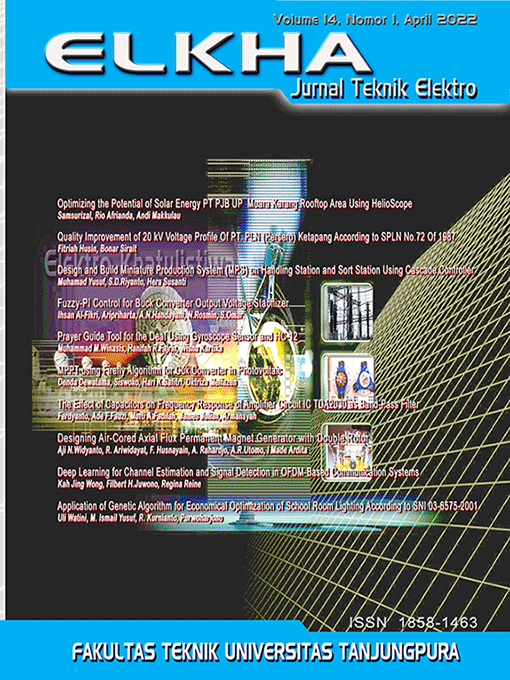
Downloads
Additional Files
Published
Issue
Section
License
Copyright (c) 2022 ELKHA

This work is licensed under a Creative Commons Attribution-NonCommercial-NoDerivatives 4.0 International License.
1. Proposed Policy for Journals That Offer Open Access
Authors who publish with this journal agree to the following terms:
- Authors retain copyright and grant the journal right of first publication with the work simultaneously licensed under a Creative Commons Attribution License that allows others to share the work with an acknowledgement of the work's authorship and initial publication in this journal.
- Authors are able to enter into separate, additional contractual arrangements for the non-exclusive distribution of the journal's published version of the work (e.g., post it to an institutional repository or publish it in a book), with an acknowledgement of its initial publication in this journal.
- Authors are permitted and encouraged to post their work online (e.g., in institutional repositories or on their website) prior to and during the submission process, as it can lead to productive exchanges, as well as earlier and greater citation of published work (See The Effect of Open Access).
2. Proposed Policy for Journals That Offer Delayed Open Access
Authors who publish with this journal agree to the following terms:
- Authors retain copyright and grant the journal right of first publication, with the work [SPECIFY PERIOD OF TIME] after publication simultaneously licensed under a Creative Commons Attribution License that allows others to share the work with an acknowledgement of the work's authorship and initial publication in this journal.
- Authors are able to enter into separate, additional contractual arrangements for the non-exclusive distribution of the journal's published version of the work (e.g., post it to an institutional repository or publish it in a book), with an acknowledgement of its initial publication in this journal.
- Authors are permitted and encouraged to post their work online (e.g., in institutional repositories or on their website) prior to and during the submission process, as it can lead to productive exchanges, as well as earlier and greater citation of published work (See The Effect of Open Access).
