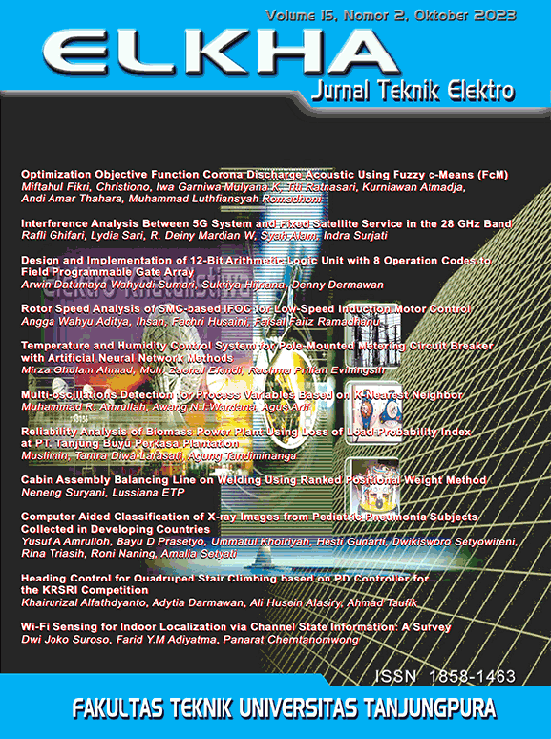
Interference Analysis Between 5G System and Fixed Satellite Service in the 28 GHz Band
DOI:
https://doi.org/10.26418/elkha.v15i2.51040Keywords:
Interference, 5G, Fixed Satellite System, SEAMCATAbstract
One of the most favorable frequency bands for 5G technology is the 27.5 - 28.5 GHz band which has been used by Fixed Satellite System (FSS) service in the uplink direction. This potentially causes interference between the two systems. This study aims to analyze the interference that occurs between satellite earth stations and 5G access points (AP), and between 5G AP and satellite sky stations. The analysis is carried out based on simulations using the Spectrum Engineering Advanced Monte Carlo Analysis Tool (SEAMCAT) software, with two scenarios. The first scenario is to analyze interference between the 5G AP and the FSS sky station. With the C/I interference criterion of 40.2 dB, the simulation results show that the 5G AP will not interfere with the FSS sky station. The second scenario is the interference simulation between FSS earth station and 5G AP. The simulation is carried out by varying the distance between the earth station and the 5G AP, the height of the earth station, and the height of the 5G AP. Based on the simulations, it is shown that the FSS earth station can interfere with 5G AP with a probability of up to 60%, so it is necessary to adjust the distance between systems and the height of the antenna to minimize the interference. The shortest distance needed to minimize interference is 36 km with an earth station height of 5 meters.
References
G. Ancans and V. Bobrovs, “Spectrum Usage for 5G Mobile Communication Systems and Electromagnetic Compatibility with Existent Technologies,†in Broadband Communications Networks - Recent Advances and Lessons from Practice, InTech, 2018.
E. Lagunas, C. G. Tsinos, S. K. Sharma, and S. Chatzinotas, “5G cellular and fixed satellite service spectrum coexistence in C-band,†IEEE Access, vol. 8, pp. 72078–72094, 2020.
Y. Huo, X. Dong, and W. Xu, “5G cellular user equipment: From theory to practical hardware design,â€
IEEE Access, vol. 5, pp. 13992–14010, Jul. 2017.
V. Bioglio, C. Condo, and I. Land, “Design of polar codes in 5G new radio,†ArXiv, pp. 1–11, 2018.
S. Kim, E. Visotsky, P. Moorut, K. Bechta, A. Ghosh, and C. Dietrich, “Coexistence of 5G with the incumbents in the 28 and 70 GHz bands,†IEEE Journal on Selected Areas in Communications, vol. 35, no. 6, pp. 1254–1268, Jun. 2017.
A. A.-A. Abdallah and R. H. Iskandar, “Evaluation of 5G NR Link Efficiency in 28 GHz Spectrum Sharing,†in 2020 6th International Conference on Wireless and Telematics (ICWT), Yogyakarta: IEEE, Sep. 2013.
European Communications Office, “SEAMCAT Handbook Edition 2,†Copenhagen, 2016.
L. F. Abdulrazak, Z. A. Shamsan, A. K. Aswad, and T. A. Rahman, “Novel computation of expecting interference between FSS and IMT-Advanced for Malaysia,†in 2008 IEEE International RF and Microwave Conference, RFM 2008, 2008, pp. 367–371.
T. Wang, Z. Qian, L. Kang, S. Geng, and X. Zhao, “Coexistence Interference Analysis of 28 GHz IMT and Fixed-Satellite Service Systems,†in 2017 IEEE 2nd Advanced Information Technology, Electronic and Automation Control Conference (IAEAC), 2017.
Y. Cho, H. K. Kim, M. Nekovee, and H. S. Jo, “Coexistence of 5G with satellite services in the millimeter-wave band,†IEEE Access, vol. 8, pp. 163618–163636, 2020.
ITU Radio communication Sector, “ITU-R P.525-4 Calculation of free-space attenuation.†[Online]. Available: http://www.itu.int/ITU-R/go/patents/en
ITU Radio communication Bureau, “Recommendation ITU-R P.452-17(Prediction procedure for the evaluation of interference between stations on the surface of the Earth at frequencies above about 0.1 GHz,†2022. Available: http://www.itu.int/ITU-R/go/patents/en
K.J.Wong, F.H. Juwono, R.Reine, “ Deep Learning for Channel Estimation and Signal Detection in OFDM-Based Communication Systemsâ€, ELKHA,vol.14 No.1 April 2022, pp 52-59.
Global Satellite Association, “GSA-FSS Protection Criteria for Fixed Satellite Service (FSS) Stations,†2018.
Downloads
Additional Files
Published
Issue
Section
License
Copyright (c) 2023 ELKHA : Jurnal Teknik Elektro

This work is licensed under a Creative Commons Attribution-NonCommercial-NoDerivatives 4.0 International License.
1. Proposed Policy for Journals That Offer Open Access
Authors who publish with this journal agree to the following terms:
- Authors retain copyright and grant the journal right of first publication with the work simultaneously licensed under a Creative Commons Attribution License that allows others to share the work with an acknowledgement of the work's authorship and initial publication in this journal.
- Authors are able to enter into separate, additional contractual arrangements for the non-exclusive distribution of the journal's published version of the work (e.g., post it to an institutional repository or publish it in a book), with an acknowledgement of its initial publication in this journal.
- Authors are permitted and encouraged to post their work online (e.g., in institutional repositories or on their website) prior to and during the submission process, as it can lead to productive exchanges, as well as earlier and greater citation of published work (See The Effect of Open Access).
2. Proposed Policy for Journals That Offer Delayed Open Access
Authors who publish with this journal agree to the following terms:
- Authors retain copyright and grant the journal right of first publication, with the work [SPECIFY PERIOD OF TIME] after publication simultaneously licensed under a Creative Commons Attribution License that allows others to share the work with an acknowledgement of the work's authorship and initial publication in this journal.
- Authors are able to enter into separate, additional contractual arrangements for the non-exclusive distribution of the journal's published version of the work (e.g., post it to an institutional repository or publish it in a book), with an acknowledgement of its initial publication in this journal.
- Authors are permitted and encouraged to post their work online (e.g., in institutional repositories or on their website) prior to and during the submission process, as it can lead to productive exchanges, as well as earlier and greater citation of published work (See The Effect of Open Access).
