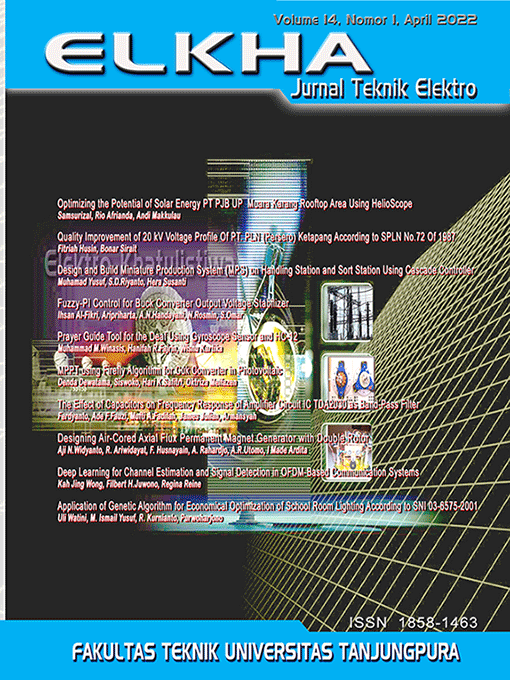
Application of Genetic Algorithm for Economical Optimization of School Room Lighting According to SNI 03-6575-2001
DOI:
https://doi.org/10.26418/elkha.v14i1.53979Keywords:
Luminaire, TL, LED, Optimization, GA, MATLAB, DialuxAbstract
The use of 24 and 30 FL for classrooms (9×8 m) and libraries (10×8 m), respectively, at SMP Negeri 25 Pontianak has not satisfied the lumen standard according to SNI 03-6575-2001. Replacing FL with LED requires calculation of budgets and lumen, including optimization of lamp distance configuration. Thus, replacing FL with LED through an adapted lumen of SNI 03-6575-2001 standard will need 15 and 20 lamps for classrooms and library, respectively. Later, the position of the LED placement has been optimized with the help of a genetic algorithm (GA) and drawing the lamp configuration using Dialux. Before optimization, the calculation result of luminaires for the classroom is 262 lux with a distance of x1 = 1.8 m and x2 = 2.67 m. After optimization, it is obtained that Eav = 283.513 lux and the distance between lamps x1 = 1.586 m and x2 = 2.67 m. The luminaire of library room before optimization is 322 lux, with a distance of x1 = 2 m and x2 = 2 m. After optimization the Eav is 384.9569 lux with x1 = 1.9119 m and x2 = 1.9 m. The lumen standard of replacing FL with LED has complied with SNI with cheaper procurement costs, i.e., for FL Rp.45,152,860.80 and for LED Rp.41,778,528.00 (saving Rp. 3,374,332.80).
References
J. T. Seni Herlina dan As’ari, “Analisis Tingkat Pencahayaan Ruang Kuliah dengan Memanfaatkan Pencahayaan Alami dan Pencahayaan Buatanâ€, Jurnal MIPA UNSRAT Online, vol. 5(2), pp.108-112, 2016.
A. Samsudin, J. Nurul dan L. Jacklyn, “Analisis Pencahayaan Alami pada Ruang Kuliah Fakultas Teknik Universitas Hasanuddinâ€, Prosiding Temu Ilmiah IPLBI, 2016.
M. I. Adil, B. Andik dan S. Muhammad, “Perancangan dan Perhitungan Ulang Penerangan Buatan pada Pustaka Gedung A Fakultas Pertanian Universitas Malikussalehâ€, Jurnal Energi Elektrik, vol. 7, no. 2, pp.6-10, 2018.
I. Irnawaty, H. Baharuddin dan M. Rosady, “Intensitas Pencahayaan Alami Ruang Kelas Sekolah Dasar di Kota Makassarâ€, Prosiding Simposium Nasional RAPI XV, FT UMS, 2016.
Atman dan Zulfahri, “Analisis Intensitas Penerangan dan Penggunaan Energi Lstrik di Laboratorium Komupter Sekolah Dasar Negeri 150 Pekanbaruâ€, Jurnal Sains, Teknologi dan Industri, vol. 13, no.1, pp.1-8, Desember 2015.
SNI, “Standar Tata Cara Perancangan Sistem Pencahayaan Buatan pada bangunan Gedungâ€, SNI 03-6575-2001.
B. P. Yogie dan H. Muhammad, “Analisis Tingkat Pencahayaan Ruang Kelas Studi Kasus: Ruang Kelas Bagian Control Room pada Subbidang Sarana dan Prasarana Pengembangan Sumber Daya Manusia dan Informasi Pusat Pengembangan Sumber Daya Manusia, Minyak dan Gas Bumi (PPSDM MIGAS)â€, Jurnal SIMETRIS, vol. 9, no. 1, pp. 139-146, April 2018.
B. A. Bima, Yushardi dan P. Trapsilo, “Pengaruh Jenis dan Bentuk Lampu Terhadap Intensitas Pencahayaan dan Energi Buangan Melalui Perhitungan Nilai Efikasi Luminusâ€. Jurnal Pendidikan Fisika, vol. 3, no. 4, pp.384-389, Maret 2015.
C. Adib, “Analisis Perbandingan Penggunaan Lampu TL, CFL dan Lampu LEDâ€, Sinusoida, vol. XIX No. 1, pp. 1-8, April 2017.
A. M. Rizki dan A. S. Mohd. Akbar, “Optimasi Perletakan Pecahayaan Ruang Industri dengan Menggunakan Algoritma Genetikaâ€, Jurnal TESLA, vol. 19, no. 1, pp.1-8, Maret 2017.
J. Yastuti, W. Agung dan H. Fanny, “Optimasi Kinerja Pencahayaan Buatan untuk Efisiensi PemakYaian Energi Listrik pada Ruangan dengan Metode Algoritma Genetikaâ€, Jurnal Momentum, vol. 13, no. 2, pp.40-48, Agustus 2012.
Muhaimin, Teknologi Pencahayaan, Refika Aditama, Malang, 2001.
I. R. Wiwit, H. Ferry dan S. Yus, “Analisis Sistem Kebutuhan Penerangan pada Ruang Kelas dengan Light Emitting Diode (LED)â€, Jurnal ELKHA, vol. 10, no. 1, pp.15-22, Maret 2018.
A. Nurhaini, “Optimasi Sistem Pencahayaan dengan Memanfaatkan Cahaya Alami (Studi kasus Lab. Elektronika dan Mikroprosesor UNTAD)â€, Jurnal Ilmiah Forensik, vol. 1, no. 1, pp.43-50, Maret 2011.
I. Lailatul, H. S. Hari dan K. W. Erna, “Optimasi Sistem Pencahayaan Buatan pada Gedung Olahraga Hoki di Kota Administrasi Jakarta Selatanâ€, Jurnal Ilmiah GIGA, vol. 22(1), pp. 33-42, Juni 2019.
Downloads
Additional Files
Published
Issue
Section
License
Copyright (c) 2022 ELKHA

This work is licensed under a Creative Commons Attribution-NonCommercial-NoDerivatives 4.0 International License.
1. Proposed Policy for Journals That Offer Open Access
Authors who publish with this journal agree to the following terms:
- Authors retain copyright and grant the journal right of first publication with the work simultaneously licensed under a Creative Commons Attribution License that allows others to share the work with an acknowledgement of the work's authorship and initial publication in this journal.
- Authors are able to enter into separate, additional contractual arrangements for the non-exclusive distribution of the journal's published version of the work (e.g., post it to an institutional repository or publish it in a book), with an acknowledgement of its initial publication in this journal.
- Authors are permitted and encouraged to post their work online (e.g., in institutional repositories or on their website) prior to and during the submission process, as it can lead to productive exchanges, as well as earlier and greater citation of published work (See The Effect of Open Access).
2. Proposed Policy for Journals That Offer Delayed Open Access
Authors who publish with this journal agree to the following terms:
- Authors retain copyright and grant the journal right of first publication, with the work [SPECIFY PERIOD OF TIME] after publication simultaneously licensed under a Creative Commons Attribution License that allows others to share the work with an acknowledgement of the work's authorship and initial publication in this journal.
- Authors are able to enter into separate, additional contractual arrangements for the non-exclusive distribution of the journal's published version of the work (e.g., post it to an institutional repository or publish it in a book), with an acknowledgement of its initial publication in this journal.
- Authors are permitted and encouraged to post their work online (e.g., in institutional repositories or on their website) prior to and during the submission process, as it can lead to productive exchanges, as well as earlier and greater citation of published work (See The Effect of Open Access).
