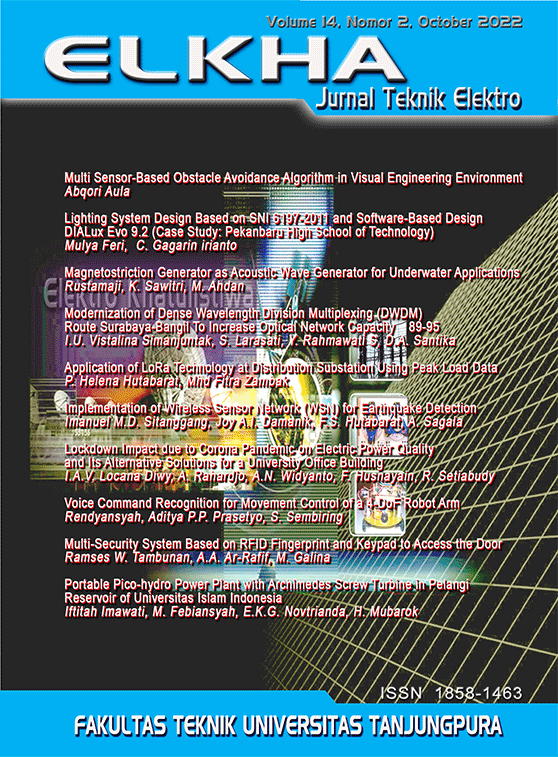
Magnetostriction Generator as Acoustic Wave Generator for Underwater Applications
DOI:
https://doi.org/10.26418/elkha.v14i2.54404Keywords:
Acoustic waves, magnetostriction effect, magnetostriction generator, underwaterAbstract
At this time the research related to the effect of magnetostriction for underwater applications is still limited. Acoustic or sound waves are more easily propagated underwater than electromagnetic waves or light. An acoustic wave or sound can be generated by utilizing the magnetostriction effect, where this effect occurs when a rod of ferromagnetic material such as iron or nickel is magnetized and interacts with another magnetic field, resulting in vibration of the metal rod. This research aims to design and realize a magnetostriction generator as an acoustic wave generator at a frequency of 1 to 10 kHz for underwater applications, consisting of: a tuned LC oscillator circuit, and a ferromagnetic metal rod which is magnetized using a dc voltage. The results of measurements and testing of the magnetostriction generator show: (1) if it is equipped with a membrane, can work to emit an acoustic wave or sound at a frequency of ± 8.62 kHz in the air up to a distance of 15 cm without distortion with an average amplitude decrease of ± 0.648 dB for each the distance increased by 1 cm, and (2) if equipped with a membrane and enclosed in a waterproof casing, capable of transmitting the acoustic waves at a frequency of ± 8.31 kHz underwater up to a distance of 7 cm without distortion with an average amplitude decrease of ± 4.217 dB for each the distance up 1 cm. Overall the magnetostriction generator designed can work to generate and transmit the acoustic waves or sound underwater, as expected.
References
H. F. Olson, Acoustical Engineering. Toronto: D. Van Nostrand Company. Inc, 1957.
Rustamaji, P. Rahmiati, & N. Saputra, “Perancangan Prototipe Penguat dan Tranducer untuk Komunikasi Bawah Air,†REKA ELKOMIKA, vol. 5, no. 2, pp. 1-13, 2017.
K. Sivaprasath, & R. Murugeshan, Properties of Matter and Acoustic: Production of Ultrasonic Waves - Magnetostriction Method. New Delhi: S. Chand Publishing, 2012.
A. G. Olabi, & A. Grunwald, “Design and Application of Magnetostrictive Materials,†Material & Design, vol. 29, no. 2, pp. 469-483, 2008.
M. J. Dapino, R. C. Smith, & A. B. Flatau, “Structural Magnetic Strain Model for Magnetostrictive Tranducers,†IEEE Transaction on Magnetic, vol. 36, no. 3, pp. 545-556, 2000.
M. J. Dapino, “On magnetostrictive materials and their use in adaptive structures,†Structural Engineering and Mechanics, vol. 17, no. (3-4), pp. 303-330, 2004.
F. Bohn, A. Gündel, F. J. G. Landgraf, A. M. Severino, & R. L. Sommer, “Magnetostriction, Barkhausen noise and magnetization processes in E110 grade non-oriented electrical steels,†Journal of magnetism and magnetic materials, vol. 317, no. (1-2), pp. 20-28, Oct. 2007.
X. Dong, J. Ou, & X. Guan, “Applications of Magnetostrictive Materials in Civil Structures: A Review,†presented at The 6th International Workshop on Advanced Smart Materials and Smart Structures Technology, Dalian, 2011.
W. McHugh, “Properties of nickel as a magnetostrictive material for ultrasonic conditions,†dissertation, University of Southern Queensland, On Australia, 2011.
H. Andrés-Mayor, M. J. Prieto, P. J. Villegas, F. Nuño, J. A. MartÃn-Ramos, & A. M. PernÃa, “Development of Magnetostrictive Transducer Prototype for Blockage Detection on Molten Salt Pipes,†Energies, vol. 11, no. 3, p. 587, Mar. 2018.
J. Xu, Y. Li, & G. Chen, “ Effect of tensile force on magnetostrictive sensors for generating and receiving longitudinal mode guided waves in steel wires,†Journal of Sensors, vol. 2019, pp. 1-8, 2019.
J. Gou, T. Ma, X. Liu, C. Zhang, L. Sun, G. Sun, ... & X. Ren, “Large and sensitive magnetostriction in ferromagnetic composites with nanodispersive precipitates,†NPG Asia Materials, vol. 13, no. 1, pp. 1-13. 2021.
A. del Moral, “Magnetostriction: fundamental principles and novel magnetostrictive materials,†europhysics news, November-December 2003. Available: http://www.europhysicsnews.org or http://dx.doi.org/10.1051/epn:2003603
F. T. Calkins, A. B. Flatau, & M. J. Dapino, “Overview of magnetostrictive sensor technology,†Journal of Intelligent Material Systems and Structures, vol. 18, no. 10, pp. 1057-1066, 2007.
S. Fang, Q. Zhang, H. Zhao, J. Yu, & Y. Chu, “The design of rare-earth giant magnetostrictive ultrasonic transducer and experimental study on its application of ultrasonic surface strengthening,†Micromachines, vol. 9, no. 3, p.98, 2018.
Rustamaji, Elektronika Komunikasi. Bandung: Penerbit Itenas, 2017.
A. Helmenstine, “Density of Elements of the Periodic Table,†sciencenotes,†October 24, 2016. [Online]. Available: https://sciencenotes.org/density-elements-periodic-table/.
R. Rustamaji, K. Sawitri, & N. W. Hidayat, “Prototipe Hydrophone untuk Komunikasi Bawah Air,†ELKOMIKA: Jurnal Teknik Energi Elektrik, Teknik Telekomunikasi, & Teknik Elektronika, vol. 6, no. 1, p. 49, 2018.
H. P. Monner, Smart materials for active noise and vibration reduction. Presented at Novem-Noise and Vibration Emerging Methods, Saint Raphael, France, 2005, pp. 18-21.
X. Wang, “Piezoelectric nanogenerators - Harvesting ambient mechanical energy at the nanometer scale. Nano Energy, vol. 1, no. 1, pp. 13-24, 2012.
A. Manbachi, & R. S. Cobbold, “Development and application of piezoelectric materials for ultrasound generation and detection,†Ultrasound, vol. 19, no. 4, pp. 187-196, 2011.
K. Sawitri, R. Rustamaji, & R. M. Putra, “ Perancangan Transmitter Gelombang Akustik pada VLF Band untuk Bawah Air,†TELKA-Jurnal Telekomunikasi, Elektronika, Komputasi dan Kontrol, vol. 4, no. 1, pp. 11-23, 2018.
O. O. Ogunsote, Propagation of sound: Its travel path, travel mediums and behavior in the mediums. Akure: Federal University of Technology, 2007, p. 15.
Downloads
Additional Files
Published
Issue
Section
License
Copyright (c) 2022 ELKHA : Jurnal Teknik Elektro

This work is licensed under a Creative Commons Attribution-NonCommercial-NoDerivatives 4.0 International License.
1. Proposed Policy for Journals That Offer Open Access
Authors who publish with this journal agree to the following terms:
- Authors retain copyright and grant the journal right of first publication with the work simultaneously licensed under a Creative Commons Attribution License that allows others to share the work with an acknowledgement of the work's authorship and initial publication in this journal.
- Authors are able to enter into separate, additional contractual arrangements for the non-exclusive distribution of the journal's published version of the work (e.g., post it to an institutional repository or publish it in a book), with an acknowledgement of its initial publication in this journal.
- Authors are permitted and encouraged to post their work online (e.g., in institutional repositories or on their website) prior to and during the submission process, as it can lead to productive exchanges, as well as earlier and greater citation of published work (See The Effect of Open Access).
2. Proposed Policy for Journals That Offer Delayed Open Access
Authors who publish with this journal agree to the following terms:
- Authors retain copyright and grant the journal right of first publication, with the work [SPECIFY PERIOD OF TIME] after publication simultaneously licensed under a Creative Commons Attribution License that allows others to share the work with an acknowledgement of the work's authorship and initial publication in this journal.
- Authors are able to enter into separate, additional contractual arrangements for the non-exclusive distribution of the journal's published version of the work (e.g., post it to an institutional repository or publish it in a book), with an acknowledgement of its initial publication in this journal.
- Authors are permitted and encouraged to post their work online (e.g., in institutional repositories or on their website) prior to and during the submission process, as it can lead to productive exchanges, as well as earlier and greater citation of published work (See The Effect of Open Access).
