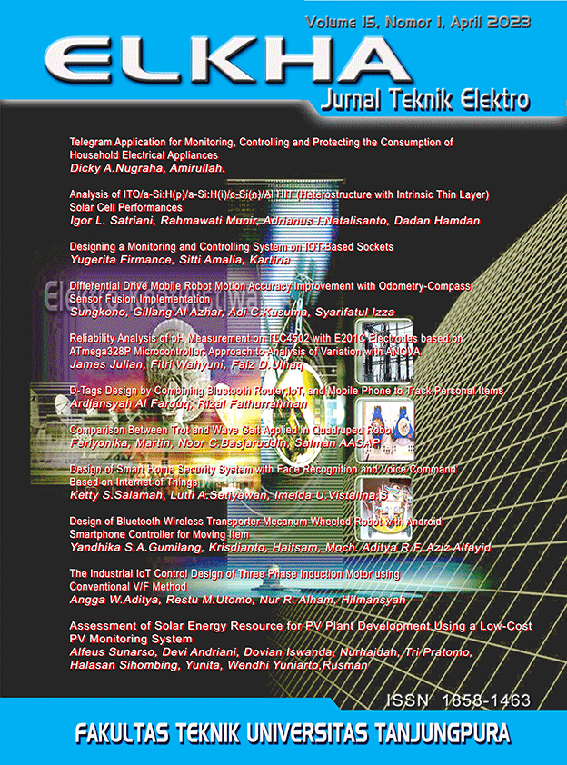
Telegram Application for Monitoring, Controlling and Protecting the Consumption of Household Electrical Appliances
DOI:
https://doi.org/10.26418/elkha.v15i1.61245Keywords:
Internet of Things, Monitoring, Controlling, Protecting, Timer, Arduino Uno, NodeMCU, TelegramAbstract
Nominal electricity rates always increase, so it is necessary to take steps to save electricity consumption. One of the steps to save electricity consumption is taken by implementing a remote electrical equipment control system based on the Smart Home Internet of Things (IoT) system. Besides being able to save money, IoT systems are also able to help simplify work and human activities. This research aims to implement Internet of Things (IoT) equipment to monitor, control, protect, and On/Off timers for household electrical appliances monitored by the Telegram application and 16×2 LCD. Monitored system parameters i.e. voltage, current, frequency, power, energy, and electricity rates for each device. Device hardware i.e. Arduino Uno, 1 Channel Relay, PZEM-004t Voltage Sensor, NodeMCU ESP8266, and Current Sensor (Current Transformer). The equipment has been successfully tested on 10 different household appliances i.e. charged cellphones, fans, charged laptops, solder, iron, fluorescent lamp 36 W, television (TV), set-top box (STB)-TV, printer, and 5 W bulb lamp. The results showed that the prototype is capable of monitoring, controlling, protecting, and On/Off timer settings as well as being able to be monitored from home electric appliances both near and far using the 16×2 LCD and the Telegram application, respectively. The sensor tool using the Telegram application is able to measure/monitor the parameters of voltage, current and frequency at 10 loads with an average error value of 0.32%, 12.83% and 0.1% respectively compared to measurements using a Multimeter. The IoT prototype is also able to provide more complete, faster (4-5 sec) monitoring, control, protection, timer On/Off parameters and superior performance compared to devices designed by a number of previous researchers.
References
A. Pangestu, A.Z. Iftikhor, Damayanti, M. Bakri, and M. Alfarizi, “Sistem Rumah Cerdas Berbasis IoT dengan Mikrokontroler Nodemcu dan Aplikasi Telegramâ€, Jurnal Teknik Informatika dan Komputer (JTIKOM), Universitas Teknokrat, Bandar Lampung, Vol. 1, No. 1, pp. 8-14, June 2020.
K.A. Santoso and D.A. Prasetya, “Rancang Bangun KWh Digital Berbasis IoTâ€, Simposium Nasional RAPI XIX FT Universitas Muhammadiyah Surakarta, pp. 39-46, 2020.
G.D. Ramady, C.R. Apriandi, G.K. Sukandi, R.Budi, Resmana, and S. Santoso, “Rancang Bangun Sistem Sistem Monotoring Pintu Rumah dan Kontrol Lampu Berbasis Telegramâ€, Jurnal Isu Teknologi, Sekolah Tinggi Teknologi Mandala, Bandung, Vol. 16, No. 2, pp. 52-58, December 2021.
Ratna, S.W. Sidehabi, and Muslimin, “Rancang Bangun Penyiraman Otomatis dan Monitoring Menggunakan Notifikasi Telegram dan Kamera pada Tanaman Cabaiâ€, Final Project, Politeknik ATI Makassar, Kementrian Perindutrian, pp. 1-39, 2021.
A. Baharuddin, H. Nirwana, and Rahmania, “Perancangan Lampu Pintar Menggunakan Kontroller Jarak Jauh Berbasis Telegramâ€, Final Project, Program Studi Teknik Elektro, Fakultas Teknik, Universitas Muhammadiyah Makassa, pp. 1-42, 2019,
M.I. Kamil, R. Ardianto P, and Ig P.D. Wibawa, “Prototype of IoT Based Home Light Monitoring and Control Systemsâ€, e-Proceeding of Engineering : Vol.6, No.2, pp. 2974-2981, August 2019.
A.T. Cahyadi, P. Susanto, and W.I. Kusumadewi, Rancang Bangun Sistem Monitoring Kendaraan pada Persewaan Motor Listrik, Final Project, Program Studi Teknik Komputer, Fakultas Teknologi dan Informatika, Universitas Dinamika Surabaya, pp. 1-26, 2022.
Jatmiko, F.N. Alwi, and R.N. Rohmah, “Alat Monitoring dan Pengendalian Konsumsi Listrik Rumah Tangga untuk Rumah Pintar Berbasis IoTâ€, EMITOR: Jurnal Teknik Elektro, Universitas Muhammadiyah Surakarta, Vol 22, No 1, pp. 34-38, February 2022.
S. Abdurrahman, Z. Tharo, and S. Anisah, “Rancang Bangun Sistem Penggunaan Daya Listrik Berbasis Aplikasi Telegramâ€, Program Studi Teknik Elektro, Fakultas Sains dan Teknologi, Universitas Pembangunan Panca Budi, Medan, pp. 1-67, 2019.
D. Wijayanto, S.I. Haryudo, T. Wrahatnolo, and Nurhayati, “Rancang Bangun Monitoring Arus dan Tegangan Pada PLTS Sistem On Grid Berbasis Internet of Things (IoT) Menggunakan Aplikasi Telegramâ€, Jurnal Teknik Elektro (JTE), Universitas Negeri Surabaya, Vol. 11, No. 3, pp. 447-453, September 2022.
A.Z. Iftikhor and C. Bella, “Rancang bangun Rumah Cerdas Menggunakan Internet of Things (IoT0 dengan Aplikasi Telegram dan Mikrokontlroler Nodemcuâ€, Portaldata.org, Vol. 2, No. 1, pp. 1-20, 2022.
I. Fitriyanto and F. Amri, “Rancang Bangun Alat Kontrol Saklar Listrik Jarak Jauh Berbasis Nodemcu dan Telegram, Jurnal Rekayasa Energi, Politeknik Negeri Indramayu, Vol. 1, No. 1, pp. 36-42, 2022.
M.F. Pratama, M. Haddin, and A. Marwanto, “Sistem Monitoring dan Kontrol Daya PLTS Menggunakan IoT Berbasis Fuzzy Logicâ€, Thesis, Program Magister Teknik Elektro, Universitas Islam Sultan Agung Semarang, pp. 1-62, 2021.
A. Riantiarto, D. Suryadi, and Saifurrahman, “Rancang Bangun, Alat Monitoring Arus pada Beban Listrik Rumah Tangga Menggunakan Web Berbasis Arduino Uno R3â€, ELKHA : Jurnal Teknik Elektro Universitas Tanjungpura Pontianak, Vol. 12, No. 1, pp. 1-9, 2019.
A. Fitriandi, E. Komalasari, and H. Gusmedi, Rancang Bangun Alat Monitoring Arus dan Tegangan Berbasis Mikrokontroler dengan SMS Gateway, ELECTRICIAN – Jurnal Rekayasa dan Teknologi Elektro, Vol. 10, No. 2, pp. 87-98, May 2016.
Downloads
Additional Files
Published
Issue
Section
License
Copyright (c) 2023 ELKHA : Jurnal Teknik Elektro

This work is licensed under a Creative Commons Attribution-NonCommercial-NoDerivatives 4.0 International License.
1. Proposed Policy for Journals That Offer Open Access
Authors who publish with this journal agree to the following terms:
- Authors retain copyright and grant the journal right of first publication with the work simultaneously licensed under a Creative Commons Attribution License that allows others to share the work with an acknowledgement of the work's authorship and initial publication in this journal.
- Authors are able to enter into separate, additional contractual arrangements for the non-exclusive distribution of the journal's published version of the work (e.g., post it to an institutional repository or publish it in a book), with an acknowledgement of its initial publication in this journal.
- Authors are permitted and encouraged to post their work online (e.g., in institutional repositories or on their website) prior to and during the submission process, as it can lead to productive exchanges, as well as earlier and greater citation of published work (See The Effect of Open Access).
2. Proposed Policy for Journals That Offer Delayed Open Access
Authors who publish with this journal agree to the following terms:
- Authors retain copyright and grant the journal right of first publication, with the work [SPECIFY PERIOD OF TIME] after publication simultaneously licensed under a Creative Commons Attribution License that allows others to share the work with an acknowledgement of the work's authorship and initial publication in this journal.
- Authors are able to enter into separate, additional contractual arrangements for the non-exclusive distribution of the journal's published version of the work (e.g., post it to an institutional repository or publish it in a book), with an acknowledgement of its initial publication in this journal.
- Authors are permitted and encouraged to post their work online (e.g., in institutional repositories or on their website) prior to and during the submission process, as it can lead to productive exchanges, as well as earlier and greater citation of published work (See The Effect of Open Access).
