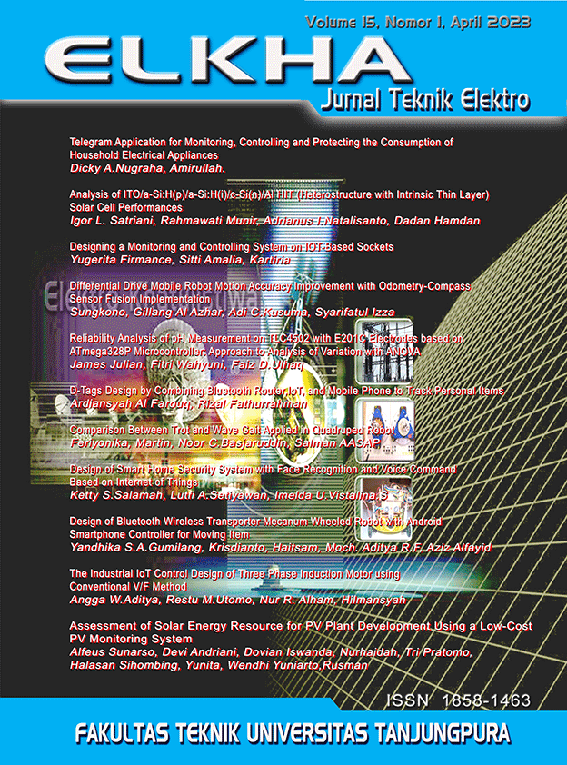
The Industrial IoT Control Design of Three Phase Induction Motor using Conventional V/F Method
DOI:
https://doi.org/10.26418/elkha.v15i1.63817Keywords:
Scalar Control, IIoT, IM Control, Speed ControlAbstract
Nowadays, the Internet of Things (IoT) is inseparable from the industrial revolution 4.0 and society 5.0. IoT allows all aspects to be connected at the same time. In industrial processes, the IoT controls the actuator and monitors the behavior system. Industrial IoT (IIoT) connected the Human Machine Interface (HMI) Haiwell C7S with the actuator (Schneider Altivar 12) and the controller (OMRON CP1E-NA20DRA). The communication between the variable speed drive and Haiwell C7S using Modbus protocol is connected with RS485. Schneider Altivar 12 is a variable-speed drive that controls the Induction Motor (IM) rotor speed using the conventional V/F method. The scalar control of IM controls supply frequency and voltage simultaneously. The success parameter of the proposed systems is a rotor speed response and voltage in various supply frequencies. The results show that the 5 Hz supply frequency makes the absolute error of rotor speed response 11.43% for tachometer measurement, 0.67% from VSD data, and 12.67% for rotary encoder measurement. This absolute error will decrease significantly when the supply frequency exceeds 20 Hz, or the rotor speed response exceeds 1200 rpm. The changes in the supply frequency change the voltage's magnitude. The voltage will increase proportionally, along with the increase in supply frequency.References
A. W. Aditya, Ihsan, R. M. Utomo and Hilmansyah, "Evaluasi Motor Listrik Sebagai Penggerak Mobil Listrik," JRST (Jurnal Riset Sains dan Teknologi), vol. 3, no. 2, pp. 55 - 59, 2019.
K. Rai, S. B. L. Seksena and A. N. Thakur, "Economic Efficiency Measure of Induction Motors for Industrial Applications," International Journal of Electrical and Computer Engineering (IJECE), vol. 7, no. 4, pp. 1661 - 1670, 2017.
A. F. Abouzeid, J. M. Guerrero, A. Endemaño, I. Muniategui, D. Ortega, I. Larrazabal and F. Briz, "Control Strategies for Induction Motors in Railway Traction Applications," Energies, vol. 13, no. 3, pp. 1 - 22, 2020.
G. Sieklucki, "An Investigation into the Induction Motor of Tesla Model S Vehicle," in 2018 International Symposium on Electrical Machines (SME), Andrychow, Poland, 2018.
O. M. Meetei, "Advanced Control Methods of Induction Motor: A Review," ADBU Journal of Electrical and Electronics Engineering (AJEEE), vol. 1, no. 1, pp. 34 - 40, 2017.
A. M. Prasetia and H. Santoso, "IMPLEMENTATION OF SCALAR CONTROL METHOD FOR 3 PHASE INDUCTION MOTOR SPEED CONTROL," ELINVO(Electronics, Informatics, and Vocational Education), vol. 3, no. 1, pp. 63 - 69, 2018.
X. Liang and O. Ilochonwu, "Induction Motor Starting in Practical Industrial Applications," IEEE Transactions on Industry Applications, vol. 47, no. 1, pp. 271 - 280, 2011.
Ö. OTKUN, "Scalar Speed Control of Induction Motors with Difference Frequency," Journal of Polytechnic, vol. 23, no. 2, pp. 267 - 276, 2020.
Ö. Otkun, F. Demir and S. Otkun, "Scalar speed control of induction motor with curve-fitting method," AUTOMATIKA, vol. 63, no. 4, pp. 618 - 626, 2022.
G.Kohlrusz and D. Fodor, "Comparison of Scalar Control and Vector Control Strategies of Induction Motors," Hungarian Journal Industrial Chemistry Veszprem, vol. 39, no. 2, pp. 265 - 270, 2011.
A. W. Aditya, M. R. Rusli, B. Praharsena, E. Purwanto and D. C. Happyanto, "The Performance of FOSMC and Boundary – SMC in Speed Controller and Current Regulator for IFOC-Based Induction Motor Drive," in 2018 International Seminar on Application for Technology of Information and Communication (iSemantic), Semarang, Indonesia, 2018.
S. N. Deshpande and R. M. Jogdand, "A Survey on Internet of Things (IoT), Industrial IoT (IIoT) and Industry 4.0," International Journal of Computer Applications, vol. 175, no. 27, pp. 20 - 27, 2020.
K. H. Shakib and F. F. Neha, "A Study for taking an approach in Industrial IoT based Solutions," in International Conference on Robotics and Artificial Intelligence (RoAI) 2020, Chennai, 2020.
G. Lampropoulos, K. Siakas and T. Anastasiadis, "INTERNET OF THINGS IN THE CONTEXT OF INDUSTRY 4.0: AN OVERVIEW," International Journal of Entrepreneurial Knowledge, vol. 7, no. 1, pp. 4 - 19, 2019.
S. K. Dwivedi, P. Roy, C. Karda, S. Agrawal and R. Amin, "Blockchain-Based Internet of Things and Industrial IoT: A Comprehensive Survey," Hindawi Security and Communication Networks, vol. 2021, pp. 1-21, 2021.
A. Kurniawan, "A Survey Paper: Implementation of the Internet of Things in Industry," Information Technology Engineering Journals, vol. 5, no. 1, pp. 37 - 50, 2020.
C. H. B. Apribowo, M. H. Adhiguna, F. Adriyanto and H. Maghfiroh, "Performance Analysis of Three Phase Induction Motor based on ATV12HU15M2 Inverter for Control System Practicum Module," Journal of Electrical, Electronic, Information, and Communication Technology (JEEICT), vol. 2, no. 1, pp. 9 - 13, 2020.
W. M. Priyashan and N. N. Thilakarathne, "IIoT Framework for SME level Injection Molding Industry in the Context of Industry 4.0," International Journal of Engineering and Management Research, vol. 10, no. 6, pp. 61 - 68, 2020.
P. K. Behera, M. K. Behera and A. K. Sahoo, "Speed Control of Induction Motor using Scalar Control Technique," in International Conference on Emergent Trends in Computing and Communication (ETCC-2014), 2014.
K. A. M. Annuar, M. R. M. Sapiee, R. M. Nor, M. S. M. Azali, M. Shah and S. M. Rozali, "Squirrel cage induction motor scalar control constant V/F analysis," TELKOMNIKA, vol. 17, no. 1, pp. 417 - 424, 2019.
R. V. R, G. F. S and V. K, "Enhanced space vector modulated scalar control of induction motor," Indonesian Journal of Electrical Engineering and Computer Science, vol. 21, no. 2, pp. 707 - 713, 2021.
H. M. Soliman, "Sinusoidal PWM to Drive the Induction Motor with Reducing the Torque Ripple and THD," International Journal of Engineering and Advanced Technology (IJEAT), vol. 5, no. 6, pp. 26 - 33, 2016.
J. C. Travieso-Torres, C. Contreras-Jara, M. Diaz and N. Aguila-Camacho, "New Adaptive Starting Scalar Control Scheme for Induction Motor Variable Speed Drives," IEEE Transactions on Energy Conversion, vol. 37, no. 1, pp. 729 - 736, 2022.
A. Nasser and P. T. Szemes, "Speed Control of Three Phase Induction Motor Using Scalar Method and PID Controller," Recent Innovations in Mechatronics, vol. 5, no. 1, pp. 1 - 5, 2018.
R. Y. Affandi, B. A. Kindhi and J. Priambodo, "Sistem Kendali Mesin Boiler dengan Metode Networked Control Systems Menggunakan Aplikasi Haiwell Cloud," JURNAL TEKNIK ITS, vol. 11, no. 1, pp. A8 - A14, 2022.
M. A. Z. Fikri, M. S. Zayyan, J. E. Mikrado, I. B. Sulistiawati, A. Soetedjo, I. K. Somawirata and Sotyohadi, "Sistem SCADA pada miniatur Smart Home Bertenaga Surya," Jurnal FORTECH, vol. 3, no. 1, pp. 93 - 98, 2023.
Downloads
Additional Files
Published
Issue
Section
License
Copyright (c) 2023 ELKHA : Jurnal Teknik Elektro

This work is licensed under a Creative Commons Attribution-NonCommercial-NoDerivatives 4.0 International License.
1. Proposed Policy for Journals That Offer Open Access
Authors who publish with this journal agree to the following terms:
- Authors retain copyright and grant the journal right of first publication with the work simultaneously licensed under a Creative Commons Attribution License that allows others to share the work with an acknowledgement of the work's authorship and initial publication in this journal.
- Authors are able to enter into separate, additional contractual arrangements for the non-exclusive distribution of the journal's published version of the work (e.g., post it to an institutional repository or publish it in a book), with an acknowledgement of its initial publication in this journal.
- Authors are permitted and encouraged to post their work online (e.g., in institutional repositories or on their website) prior to and during the submission process, as it can lead to productive exchanges, as well as earlier and greater citation of published work (See The Effect of Open Access).
2. Proposed Policy for Journals That Offer Delayed Open Access
Authors who publish with this journal agree to the following terms:
- Authors retain copyright and grant the journal right of first publication, with the work [SPECIFY PERIOD OF TIME] after publication simultaneously licensed under a Creative Commons Attribution License that allows others to share the work with an acknowledgement of the work's authorship and initial publication in this journal.
- Authors are able to enter into separate, additional contractual arrangements for the non-exclusive distribution of the journal's published version of the work (e.g., post it to an institutional repository or publish it in a book), with an acknowledgement of its initial publication in this journal.
- Authors are permitted and encouraged to post their work online (e.g., in institutional repositories or on their website) prior to and during the submission process, as it can lead to productive exchanges, as well as earlier and greater citation of published work (See The Effect of Open Access).
