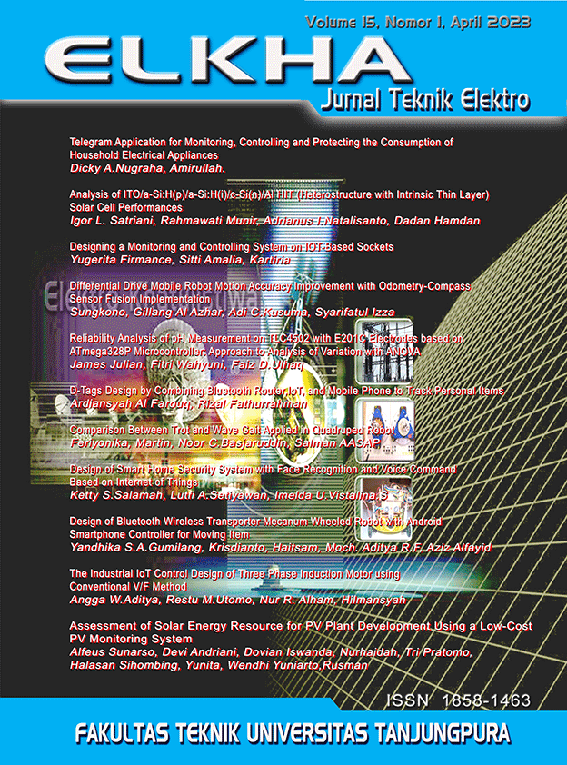
Assessment of Solar Energy Resource for PV Plant Development Using a Low-cost PV Monitoring System
DOI:
https://doi.org/10.26418/elkha.v15i1.63847Keywords:
automatic data acquisition, monitoring system, solar energy resource, PV plant development, performance of solar panel,Abstract
In this work, we propose the use of a low-cost PV monitoring system for providing accurate and comprehensive data required in the development of efficient and reliable solar PV plants. The system is developed based on an open-source Arduino platform with the capability to monitor solar irradiance, and electric outputs and temperature of multiple solar panels, which should enable the accurate assessment of solar energy resource, as well as electrical energy produced by PV plant under real operating conditions. To demonstrate its applicability, the system has been installed at the campus of Politeknik Negeri Pontianak in Pontianak City, and the data collected by the system is used to assess solar energy resource at the location. Data collected by the system from August 2020 to September 2021 shows that the values of solar irradiation are in the range of 2.9"“4.1 kWh/m2 per day, and electric energy produced by commercial solar panels are in the range of 0.30"“0.46 kWh/m2 per day, correspond to the monthly averaged efficiencies of 8"“13%. The values of solar irradiation are 15"“40 % lower than those obtained from the space-averaged satellite data which are in the range of 4.1"“5.8 kWh/m2 per day. This shows the significant effects of local conditions, and confirms the advantage of assessment using the low-cost monitoring system that directly accounts for the effects of local conditions without the need of simulation using complex model and sophisticated software that required in the assessment using satellite-derived data.
References
IRENA, Global Energy Transformation: A Roadmap to 2050. Abu Dhabi: International Renewable Energy Agency, 2018.
REN21, Renewables 2019 Global Status Report, vol. 8, no. 3. Paris: REN21 Secretariat, 2019.
DNV-GL, Energy transition outlook 2019: a global and regional forecast to 2050. Høvik, Norway: DNV GL AS, 2019.
United Nations, “Transforming our world: the 2030 agenda for sustainable development,†2016. doi: 10.1201/b20466-7.
IEA, Solar Energy: Mapping the Road Ahead, no. October. France: International Energy Agency, 2019.
NASA, “Prediction Of Worldwide Energy Resource,†2017. https://power.larc.nasa.gov/ (accessed May 01, 2020).
World Bank, “Solar Resource and Photovoltaic Potential in Indonesia,†Washington, D.C., 2017. [Online]. Available: https://www.esmap.org/node/58032.
European Commission, “Copernicus Atmosphere Monitoring Service,†2017. https://atmosphere.copernicus.eu/ (accessed May 17, 2017).
M. L. Sabo, N. Mariun, H. Hizam, M. A. Mohd Radzi, and A. Zakaria, “Spatial energy predictions from large-scale photovoltaic power plants located in optimal sites and connected to a smart grid in Peninsular Malaysia,†Renew. Sustain. Energy Rev., vol. 66, pp. 79–94, 2016, doi: 10.1016/j.rser.2016.07.045.
A. Alami Merrouni, F. Elwali Elalaoui, A. Ghennioui, A. Mezrhab, and A. Mezrhab, “A GIS-AHP combination for the sites assessment of large-scale CSP plants with dry and wet cooling systems. Case study: Eastern Morocco,†Sol. Energy, vol. 166, no. March, pp. 2–12, 2018, doi: 10.1016/j.solener.2018.03.038.
Y. Zhang, J. Ren, Y. Pu, and P. Wang, “Solar energy potential assessment: A framework to integrate geographic, technological, and economic indices for a potential analysis,†Renew. Energy, vol. 149, pp. 577–586, 2020, doi: 10.1016/j.renene.2019.12.071.
A. Sunarso, K. Ibrahim-Bathis, S. A. Murti, I. Budiarto, and H. S. Ruiz, “GIS-based assessment of the technical and economic feasibility of utility-scale solar PV plants: Case study in West Kalimantan province,†Sustainability, vol. 12, no. 15, pp. 1–12, 2020, doi: 10.3390/su12156283.
H. S. Ruiz Rondan, A. Sunarso, K. Ibrahim-Bathis, S. A. Murti, and I. Budiarto, “GIS-AHP Multi Criteria Decision Analysis for the optimal location of solar energy plants at Indonesia,†Energy Reports, vol. 6, pp. 3249–3263, 2020, doi: 10.1016/j.egyr.2020.11.198.
IFC, Utility-Scale Solar Photovoltaic Power Plants: A Project Developer’s Guide. Washington: International Finance Corporation, 2015.
P. W. Stackhouse et al., “POWER Release 8.0.1 (with GIS Applications) Methodology,†2018.
A. G. Siraki and P. Pillay, “Comparison of PV System Design Software Packages for Urban applications,†in 21st World Energy Congress (WEC) 2010, 2010, p. 12, [Online]. Available: https://www.osti.gov/etdeweb/servlets/purl/21390280.
G. Blaesser, “PV system measurements and monitoring the European experience,†Sol. Energy Mater. Sol. Cells, vol. 47, no. 1–4, pp. 167–176, Oct. 1997, doi: 10.1016/S0927-0248(97)80008-6.
N. Forero, J. Hernández, and G. Gordillo, “Development of a monitoring system for a PV solar plant,†Energy Convers. Manag., vol. 47, no. 15–16, pp. 2329–2336, 2006, doi: 10.1016/j.enconman.2005.11.012.
A. G. Imenes, G. H. Yordanov, O. M. Midtgård, and T. O. Saetre, “Development of a test station for accurate in situ I-V curve measurements of photovoltaic modules in Southern Norway,†in 37th IEEE Photovoltaic Specialists Conference (PVSC) 2011, 2011, pp. 003153–003158, doi: 10.1109/PVSC.2011.6186610.
M. Fuentes, M. Vivar, J. M. Burgos, J. Aguilera, and J. A. Vacas, “Design of an accurate, low-cost autonomous data logger for PV system monitoring using ArduinoTM that complies with IEC standards,†Sol. Energy Mater. Sol. Cells, vol. 130, 2014, doi: 10.1016/j.solmat.2014.08.008.
J. Meydbray, K. Emery, and S. Kurtz, “Pyranometers and reference cells, the difference,†PV Mag., no. March, pp. 108–110, 2012.
J. Meydbray, E. Riley, L. Dunn, K. Emery, and S. Kurtz, “Pyranometers and Reference Cells : Part 2 : What Makes the Most Sense for PV Power Plants,†2012. doi: https://doi.org/10.2172/1059158.
L. Dunn, M. Gostein, and K. Emery, “Comparison of pyranometers vs. PV reference cells for evaluation of PV array performance,†Conf. Rec. IEEE Photovolt. Spec. Conf., pp. 2899–2904, 2012, doi: 10.1109/PVSC.2012.6318193.
J. Polo, W. G. Fernandez-Neira, and M. C. Alonso-GarcÃa, “On the use of reference modules as irradiance sensor for monitoring and modelling rooftop PV systems,†Renew. Energy, vol. 106, pp. 186–191, 2017, doi: 10.1016/j.renene.2017.01.026.
M. Green, E. Dunlop, J. Hohl-Ebinger, M. Yoshita, N. Kopidakis, and X. Hao, “Solar cell efficiency tables (version 57),†Prog. Photovoltaics Res. Appl., vol. 29, no. 1, pp. 3–15, 2021, doi: 10.1002/pip.3371.
G. Makrides, B. Zinsser, M. Norton, and G. E., “Performance of Photovoltaics Under Actual Operating Conditions,†in Third Generation Photovoltaics, 2012.
G. Makrides, B. Zinsser, A. Phinikarides, M. Schubert, and G. E. Georghiou, “Temperature and thermal annealing effects on different photovoltaic technologies,†Renew. Energy, vol. 43, no. June 2006, pp. 407–417, 2012, doi: 10.1016/j.renene.2011.11.046.
J. K. Kaldellis, M. Kapsali, and K. A. Kavadias, “Temperature and wind speed impact on the efficiency of PV installations. Experience obtained from outdoor measurements in Greece,†Renew. Energy, vol. 66, pp. 612–624, 2014, doi: 10.1016/j.renene.2013.12.041.
I. M. Peters, H. Liu, T. Reindl, and T. Buonassisi, “Global Prediction of Photovoltaic Field Performance Differences Using Open-Source Satellite Data,†Joule, vol. 2, pp. 1–16, 2017, doi: 10.1016/j.joule.2017.11.012.
C. Schwingshackl et al., “Wind effect on PV module temperature: Analysis of different techniques for an accurate estimation,†Energy Procedia, vol. 40, pp. 77–86, 2013, doi: 10.1016/j.egypro.2013.08.010.
A. G. Imenes, H. G. Beyer, K. Boysen, J. O. Odden, and R. E. Grundt, “Performance of grid-connected PV system in Southern Norway,†in 42nd IEEE Photovoltaic Specialist Conference (PVSC) 2015, 2015, doi: 10.1109/PVSC.2015.7355823.
H. Pedersen, J. Strauss, and J. Selj, “Effect of Soiling on Photovoltaic Modules in Norway,†Energy Procedia, vol. 92, no. 1876, pp. 585–589, 2016, doi: 10.1016/j.egypro.2016.07.023.
M. R. Maghami, H. Hizam, C. Gomes, M. A. Radzi, M. I. Rezadad, and S. Hajighorbani, “Power loss due to soiling on solar panel: A review,†Renew. Sustain. Energy Rev., vol. 59, pp. 1307–1316, 2016, doi: 10.1016/j.rser.2016.01.044.
L. R. do Nascimento, M. Braga, R. A. Campos, H. F. Naspolini, and R. Rüther, “Performance assessment of solar photovoltaic technologies under different climatic conditions in Brazil,†Renew. Energy, vol. 146, pp. 1070–1082, 2020, doi: 10.1016/j.renene.2019.06.160.
IEC 61724, Photovoltaic System Performance Monitoring-Guidelines for Measurement, Data Exchange, and Analysis, 1st ed. Switzerland, Geneva: International Electrotechnical Commission (IEC), 1998.
A. Jagomägi et al., “European Network of PV Outdoor Testing - Steps towards Harmonized Procedures,†in 24th EUPVSEC, 2009, no. September 2016, pp. 3432–3438, doi: 10.4229/24thEUPVSEC2009-4AV.3.44.
N. Erraissi, M. Raoufi, N. Aarich, M. Akhsassi, and A. Bennouna, “Implementation of a low-cost data acquisition system for ‘PROPRE.MA’ project,†Meas. J. Int. Meas. Confed., vol. 117, no. March, pp. 21–40, 2018, doi: 10.1016/j.measurement.2017.11.058.
S. Hamou, S. Zine, and R. Abdellah, “Efficiency of PV module under real working conditions,†Energy Procedia, vol. 50, pp. 553–558, 2014, doi: 10.1016/j.egypro.2014.06.067.
Downloads
Additional Files
Published
Issue
Section
License
Copyright (c) 2023 ELKHA

This work is licensed under a Creative Commons Attribution-NonCommercial-NoDerivatives 4.0 International License.
1. Proposed Policy for Journals That Offer Open Access
Authors who publish with this journal agree to the following terms:
- Authors retain copyright and grant the journal right of first publication with the work simultaneously licensed under a Creative Commons Attribution License that allows others to share the work with an acknowledgement of the work's authorship and initial publication in this journal.
- Authors are able to enter into separate, additional contractual arrangements for the non-exclusive distribution of the journal's published version of the work (e.g., post it to an institutional repository or publish it in a book), with an acknowledgement of its initial publication in this journal.
- Authors are permitted and encouraged to post their work online (e.g., in institutional repositories or on their website) prior to and during the submission process, as it can lead to productive exchanges, as well as earlier and greater citation of published work (See The Effect of Open Access).
2. Proposed Policy for Journals That Offer Delayed Open Access
Authors who publish with this journal agree to the following terms:
- Authors retain copyright and grant the journal right of first publication, with the work [SPECIFY PERIOD OF TIME] after publication simultaneously licensed under a Creative Commons Attribution License that allows others to share the work with an acknowledgement of the work's authorship and initial publication in this journal.
- Authors are able to enter into separate, additional contractual arrangements for the non-exclusive distribution of the journal's published version of the work (e.g., post it to an institutional repository or publish it in a book), with an acknowledgement of its initial publication in this journal.
- Authors are permitted and encouraged to post their work online (e.g., in institutional repositories or on their website) prior to and during the submission process, as it can lead to productive exchanges, as well as earlier and greater citation of published work (See The Effect of Open Access).
