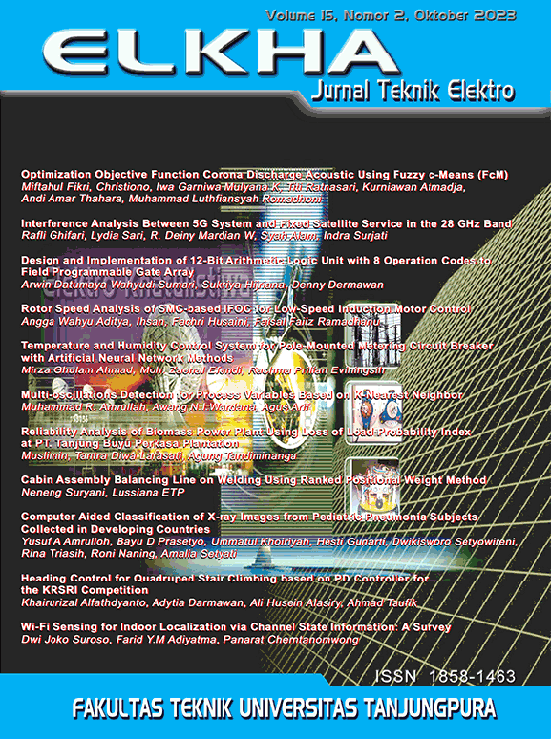
Cabin Assembly Balancing Line on Welding Using Ranked Positional Weight Method
DOI:
https://doi.org/10.26418/elkha.v15i2.68714Keywords:
Computational efficiency, line balancing, line production, manufacturing, ranked positional weightAbstract
The Indonesian automotive industry has become an essential pillar in the country's manufacturing sector. As production capacity increases, problems will also increase, including disparities in the level of efficiency and productivity of each sub-sector of the manufacturing industry in Indonesia. This problem occurs due to the need for a good process path, such as the uneven distribution of work tasks machines in the work process so that it is possible to harm the company, so a solution is needed to increase the efficiency of the production line. This research aims to improve production efficiency, particularly concerning the use of electricity costs and operator wages on the cabin type S L assembly line, by applying the Ranked Positional Weight (RPW) method. The research phases include data collection, analysis, processing, and evaluation. Based on the SL-type cabin calculations using the RPW method, the track efficiency improved by 4.69% from the initial conditions, while the track effectiveness increased by 75.02% to 79.71%. Increased the production line efficiency has impacted on the decrease in production costs Rp. 13,827,249/month.
References
E. Supriyanto, “Manufaktur Dalam Dunia Teknik Industri,†vol. 3, no. 3, 2013.
S. Sinulingga, Perencanaan dan Pengendalian Produksi. Yogyakarta: Graha Ilmu, 2009.
M. C. Bonney, “A Review Of: ‘ Integrated Production Control Systems ’. By David D. Bedworth And James E. Bailey. (John Wiley & Sons, Inc., 1982.) [Pp. 433.],†International Journal Of Production Research, Vol. 21, No. 3, Pp. 443–443, May 1983.
Md. M. Rahman, F. Nur, And S. Talapatra, “Anintegrated Frame Work Of Applying Line Balancing In Apparel Manufacturing Organization: A Case Study,†J. Mech. Eng., Vol. 44, No. 2, Pp. 117–123, Jan. 2015.
T. Rachman, “Penentuan Keseimbangan Lintasan Optimal Dengan Menggunakan Metode Heuristik,†Vol. 11, 2015.
W. P. Febriani and M. A. Saputra, “Penerapan Konsep Line Balancing Dalam Proses Produksi Pintu Dengan Metode Ranked Position Weight Di CV Indah Jati Permana,†vol. 1, 2020.
R. Fatmawati and M. L. Singgih, “Evaluasi dan Peningkatan Performansi Lini Perakitan Speaker dengan Menggunakan Ekonomi Gerakan dan Line Balancing,†JTITS, vol. 8, no. 1, pp. F35–F40, Jun. 2019.
S. P. Yudha And I. P. Tama, “Meningkatkan Efisiensi Lintasan Perakitan Plastic Box 260 Menggunakan Pendekatan Metode Heuristik,†2017.
M. Afifuddin, “Penerapan Line Balancing Menggunakan Metode Ranked Position Weight (RPW) untuk Meningkatkan Output Produksi pada Home Industri Pembuatan Sepatu Bola,†JIEM, vol. 4, no. 1, p. 38, Apr. 2019.
I. Purnamasari And A. S. Cahyana, “Line Balancing Dengan Metode Ranked Position Weight ( Rpw),†Spek Ind, Vol. 13, No. 2, P. 157, Oct. 2015.
R. Ginting And William, “Assembly Line Balancing With Method Ranking Positional Weight (Case Study: Xyz Company),†Iop Conf. Ser.: Mater. Sci. Eng., Vol. 1003, No. 1, P. 012032, Dec. 2020.
I. Z. Sutalaksana, Teknik Perancangan Sistem Kerja. Bandung: ITB Bandung, 2006.
S. Hartini, Teknik Mencapai Produksi Optima. Bandung: Lubuk Agung, 2011.
V. A. Deshpande and A. Y. Joshi, “Application of Ranked Positional Weight Method for Assembly Line Balancing – A Case Study,†2007.
Downloads
Additional Files
Published
Issue
Section
License
Copyright (c) 2023 ELKHA : Jurnal Teknik Elektro

This work is licensed under a Creative Commons Attribution-NonCommercial-NoDerivatives 4.0 International License.
1. Proposed Policy for Journals That Offer Open Access
Authors who publish with this journal agree to the following terms:
- Authors retain copyright and grant the journal right of first publication with the work simultaneously licensed under a Creative Commons Attribution License that allows others to share the work with an acknowledgement of the work's authorship and initial publication in this journal.
- Authors are able to enter into separate, additional contractual arrangements for the non-exclusive distribution of the journal's published version of the work (e.g., post it to an institutional repository or publish it in a book), with an acknowledgement of its initial publication in this journal.
- Authors are permitted and encouraged to post their work online (e.g., in institutional repositories or on their website) prior to and during the submission process, as it can lead to productive exchanges, as well as earlier and greater citation of published work (See The Effect of Open Access).
2. Proposed Policy for Journals That Offer Delayed Open Access
Authors who publish with this journal agree to the following terms:
- Authors retain copyright and grant the journal right of first publication, with the work [SPECIFY PERIOD OF TIME] after publication simultaneously licensed under a Creative Commons Attribution License that allows others to share the work with an acknowledgement of the work's authorship and initial publication in this journal.
- Authors are able to enter into separate, additional contractual arrangements for the non-exclusive distribution of the journal's published version of the work (e.g., post it to an institutional repository or publish it in a book), with an acknowledgement of its initial publication in this journal.
- Authors are permitted and encouraged to post their work online (e.g., in institutional repositories or on their website) prior to and during the submission process, as it can lead to productive exchanges, as well as earlier and greater citation of published work (See The Effect of Open Access).
