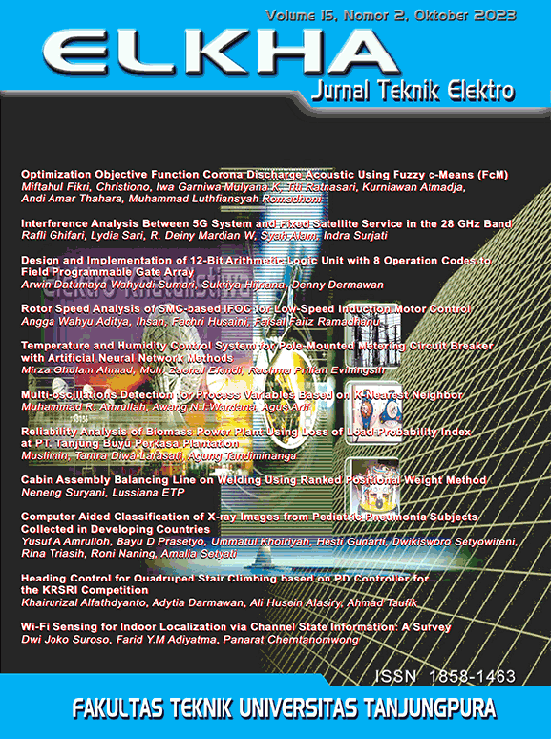
Wi-Fi Sensing for Indoor Localization via Channel State Information: A Survey
DOI:
https://doi.org/10.26418/elkha.v15i2.70830Keywords:
wifi sensing, indoor localization, csiAbstract
Wireless Fidelity (Wi-Fi) sensing utilization has been widespread, especially for human behavior/activity recognition. It provides high flexibility since it does not require the person/object to carry any device known as device-free. This "passive" concept is also helpful for another application of Wi-Fi sensing, i.e., indoor localization. The "sensing" is conducted using particular parameters extracted from communication links of Wi-Fi devices, i.e., channel state information (CSI). This paper explores the recent trends in CSI-based indoor localization with Wi-Fi technology as its core, including their advantages, challenges, and future directions. We found tremendous benefits can be gained by employing Wi-Fi sensing in localization supported by its performance and integrability for other intelligent systems for activity recognition.
References
F. Zafari, A. Gkelias, and K. K. Leung, “A Survey of Indoor Localization Systems and Technologies,†IEEE Communications Surveys and Tutorials, vol. 21, no. 3, pp. 2568–2599, 2019.
T. K. Geok et al., “Review of indoor positioning: Radio wave technology,†Applied Sciences (Switzerland), vol. 11, no. 1. MDPI AG, pp. 1–44, Jan. 01, 2021.
S. M. Hernandez and E. Bulut, “WiFi Sensing on the Edge: Signal Processing Techniques and Challenges for Real-World Systems,†IEEE Communications Surveys and Tutorials, vol. 25, no. 1, pp. 46–76, 2023.
H. Jiang, C. Cai, X. Ma, Y. Yang, and J. Liu, “Smart Home Based on WiFi Sensing: A Survey,†IEEE Access, vol. 6. Institute of Electrical and Electronics Engineers Inc., pp. 13317–13325, Mar. 06, 2018.
S. Tan, Y. Ren, J. Yang, and Y. Chen, “Commodity WiFi Sensing in 10 Years: Status, Challenges, and Opportunities,†IEEE Internet Things J, 2022.
Z. Wang, B. Guo, Z. Yu, and X. Zhou, “Wi-Fi CSI-Based Behavior Recognition: From Signals and Actions to Activities,†IEEE Communications Magazine, vol. 56, no. 5, pp. 109–115, May 2018.
C. Yang and H.-R. Shao, “WiFi-based Indoor Positioning,†IEEE Communication Magazine, 2015.
D. J. Suroso, P. Cherntanomwong, and P. Sooraksa, “Indoor Device-free Localization Using Received Signal Strength Indicator and Illuminance Sensor for Random-forest-based Fingerprint Technique,†Sensors and Materials, vol. 33, no. 12, pp. 4331–4345, 2021.
X. Wang, L. Gao, S. Mao, and S. Pandey, “CSI-Based Fingerprinting for Indoor Localization: A Deep Learning Approach,†in IEEE Transactions on Vehicular Technology, Institute of Electrical and Electronics Engineers Inc., Jan. 2017, pp. 763–776.
S. Shi, S. Sigg, L. Chen, and Y. Ji, “Accurate Location Tracking from CSI-Based Passive Device-Free Probabilistic Fingerprinting,†IEEE Trans Veh Technol, vol. 67, no. 6, pp. 5217–5230, Jun. 2018.
A. Yassin et al., “Recent Advances in Indoor Localization: A Survey on Theoretical Approaches and Applications,†IEEE Communications Surveys and Tutorials, vol. 19, no. 2, pp. 1327–1346, 2017.
F. Alam, N. Faulkner, and B. Parr, “Device-Free Localization: A Review of Non-RF Techniques for Unobtrusive Indoor Positioning,†IEEE Internet of Things Journal, vol. 8, no. 6. Institute of Electrical and Electronics Engineers Inc., pp. 4228–4249, Mar. 15, 2021.
A. Khalili, A. Soliman, M. Asaduzzaman, and A. Griffiths, “Wiâ€Fi sensing: applications and challenges,†The Journal of Engineering, vol. 2020, no. 3, pp. 87–97, Mar. 2020.
F. Adib, Z. Kabelac, and D. Katabi, “Multi-Person Localization via RF Body Reflections,†in Proceedings of the general track : 2004 USENIX Annual Technical Conference, USENIX Association, 2004, pp. 272–279.
M. Youssef, M. Mah, and A. Agrawala, “Challenges: device-free passive localization for wireless environments,†in MobiCom ’07: Proceedings of the 13th annual ACM international conference on Mobile computing and networking, ACM, Sep. 2007, pp. 222–229.
M. Youssef and A. Agrawala, “The Horus WLAN Location Determination System.â€
Z. Yang, Z. Zhou, and Y. Liu, “From RSSI to CSI: Indoor localization via channel response,†ACM Comput Surv, vol. 46, no. 2, 2013.
L. Zhang, E. Ding, Y. Hu, and Y. Liu, “A novel CSI-based fingerprinting for localization with a single AP,†EURASIP J Wirel Commun Netw, 2019.
Z. Wu, Q. Xu, J. Li, C. Fu, Q. Xuan, and Y. Xiang, “Passive Indoor Localization Based on CSI and Naive Bayes Classification,†IEEE Trans Syst Man Cybern Syst, vol. 48, no. 9, pp. 1566–1577, 2018.
G. Li, “Device-Free Indoor Localization of CSI Based on Limited Penetrable Horizontal Visibility Graph,†IEEE Access, vol. 10, no. June, pp. 71120–71132, 2022.
Z. Zhang, W. E. I. Nie, and Y. Wang, “Channel State Information Based Indoor Localization Error Bound Leveraging Pedestrian Random Motion,†IEEE Access, vol. 8, pp. 153311–153321, 2020.
C. Chen et al., “Achieving Centimeter-Accuracy Indoor Localization on WiFi Platforms : A Multi-Antenna Approach,†IEEE Internet Things J, vol. 4, no. 1, pp. 122–134, 2017.
C. Chen et al., “Achieving Centimeter-Accuracy Indoor Localization on WiFi Platforms : A Frequency Hopping
Approach,†IEEE Internet Things J, vol. 4, no. 1, pp. 111–121, 2017.
Z. Wu et al., “A Time-Reversal Paradigm for Indoor Positioning System,†IEEE Trans Veh Technol, vol. 64, no. 4, pp. 1331–1339, 2015.
X. Chen, H. Li, C. Zhou, X. Liu, D. Wu, and G. Dudek, “Fidora: Robust WiFi-Based Indoor Localization via Unsupervised Domain Adaptation,†IEEE Internet Things J, vol. 9, no. 12, pp. 9872–9888, Jun. 2022.
P. S. Farahsari, A. Farahzadi, J. Rezazadeh, and A. Bagheri, “A Survey on Indoor Positioning Systems for IoT-Based Applications,†IEEE Internet Things J, vol. 9, no. 10, pp. 7680–7699, 2022.
T. Yang, A. Cabani, and H. Chafouk, “A Survey of Recent Indoor Localization Scenarios and Methodologies,†2021.
N. Singh, S. Choe, S. Member, and R. Punmiya, “Machine Learning Based Indoor Localization Using Wi-Fi RSSI Fingerprints : An Overview,†IEEE Access, vol. 9, pp. 127150–127174, 2021.
F. Zafari, A. Gkelias, and K. K. Leung, “A Survey of Indoor Localization Systems and Technologies,†IEEE Communications Surveys and Tutorials, vol. 21, no. 3, pp. 2568–2599, 2019.
M. T. Hoang et al., “Recurrent Neural Networks for Accurate RSSI Indoor Localization,†IEEE Internet Things J, vol. 6, no. 6, pp. 10639–10651, 2019.
J. M. Rocamora, I. W. Ho, W. Mak, and A. P. Lau, “Survey of CSI fingerprinting-based indoor positioning and mobility tracking systems,†IET Signal Processing, vol. 14, pp. 407–419, 2020.
A. Gassner, C. Musat, A. Rusu, and A. Burg, “OpenCSI : An Open-Source Dataset for Indoor Localization Using,†ArXiv, 2022.
B. Berruet, O. Baala, A. Caminada, and V. Guillet, “An evaluation method of channel state information fingerprinting for single gateway indoor localization,†Journal of Network and Computer Applications, vol. 159, no. February, 2020.
J. Conrat, P. Pajusco, and J. Thiriet, “A Multibands Wideband Propagation Channel Sounder from 2 to 60 GHz,†Instrumentation and Measurement Technology Conference, no. April, pp. 6–11, 2006.
L. Wang and S. Pasricha, “A Framework for CSI-Based Indoor Localization with 1D Convolutional Neural Networks,†2022 IEEE 12th International Conference on Indoor Positioning and Indoor Navigation (IPIN), pp. 1–8, 2022.
A. Olejniczak, O. Blaszkiewicz, K. K. Cwalina, P. Rajchowski, and J. Sadowski, “LOS and NLOS Identification in Real Indoor Environment Using Deep Learning Approach,†Digital Communications and Networks, 2023.
W. Platforms, F. Gringoli, M. Cominelli, and A. Blanco, “AX-CSI : Enabling CSI Extraction on Commercialâ€.
W. Liu et al., “Survey on CSI-based Indoor Positioning Systems and Recent Advances,†2019 International Conference on Indoor Positioning and Indoor Navigation (IPIN), no. 61871054, pp. 1–8, 2019.
X. Zhu, T. Qiu, S. Member, W. Qu, X. Zhou, and S. Member, “Path Planning for Adaptive CSI Map Construction With A3C in Dynamic Environments,†IEEE Trans Mob Comput, vol. 22, no. 5, pp. 2925–2937, 2023.
Downloads
Additional Files
Published
Issue
Section
License
Copyright (c) 2023 ELKHA : Jurnal Teknik Elektro

This work is licensed under a Creative Commons Attribution-NonCommercial-NoDerivatives 4.0 International License.
1. Proposed Policy for Journals That Offer Open Access
Authors who publish with this journal agree to the following terms:
- Authors retain copyright and grant the journal right of first publication with the work simultaneously licensed under a Creative Commons Attribution License that allows others to share the work with an acknowledgement of the work's authorship and initial publication in this journal.
- Authors are able to enter into separate, additional contractual arrangements for the non-exclusive distribution of the journal's published version of the work (e.g., post it to an institutional repository or publish it in a book), with an acknowledgement of its initial publication in this journal.
- Authors are permitted and encouraged to post their work online (e.g., in institutional repositories or on their website) prior to and during the submission process, as it can lead to productive exchanges, as well as earlier and greater citation of published work (See The Effect of Open Access).
2. Proposed Policy for Journals That Offer Delayed Open Access
Authors who publish with this journal agree to the following terms:
- Authors retain copyright and grant the journal right of first publication, with the work [SPECIFY PERIOD OF TIME] after publication simultaneously licensed under a Creative Commons Attribution License that allows others to share the work with an acknowledgement of the work's authorship and initial publication in this journal.
- Authors are able to enter into separate, additional contractual arrangements for the non-exclusive distribution of the journal's published version of the work (e.g., post it to an institutional repository or publish it in a book), with an acknowledgement of its initial publication in this journal.
- Authors are permitted and encouraged to post their work online (e.g., in institutional repositories or on their website) prior to and during the submission process, as it can lead to productive exchanges, as well as earlier and greater citation of published work (See The Effect of Open Access).
