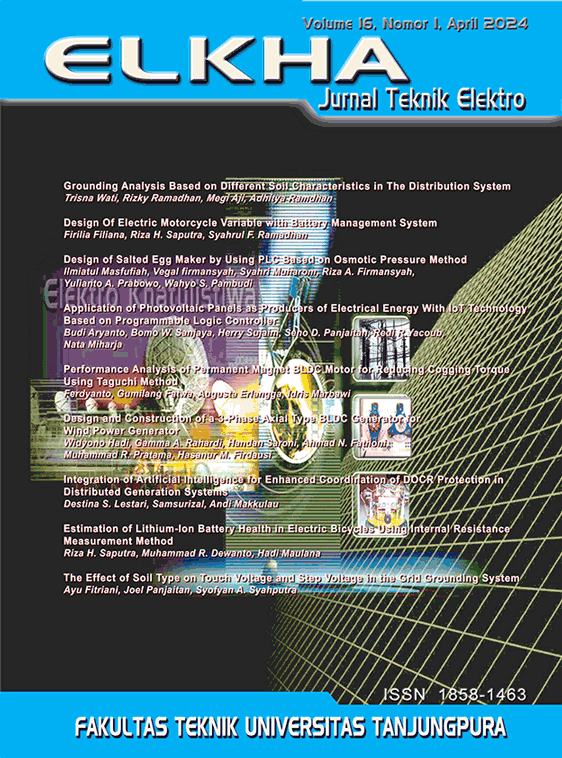
Design of Electric Motorcycle Variable with Battery Management System
DOI:
https://doi.org/10.26418/elkha.v16i1.75922Keywords:
Battery, Battery Management System, Coulumb Counting, Electric Motorcycle, Open Circuit Voltage,Abstract
This study focuses on conceptualization and development of a battery management system (BMS) with two main functions, battery monitoring and management, in the context of brushless direct current motors (BLDCs). The main challenge in variable estimation is to protect the battery from potential risks during the charge and discharge cycle. The new proposed resolution combines a comprehensive BMS with monitoring capabilities for charge (SoC), health (SoH), voltage, current and battery temperature. In addition, a protective mechanism is incorporated to prevent variables from overshooting safety parameters. This research uses two different methodologies for estimating SOC, coulomb counting and open circuit voltage. In experimental tests, resistance potentiometers of 1,650, 3,300 and 0 were used, with SoC estimates of 37%, 19% and 65%, while coulomb counting method has a marginal error of 1.13%. On the contrary, the open-circuit voltage method generated a SoC estimate of 0% for all potentiometer resistance, with an error rate of 0.64 %. As a result, the open circuit voltage method is chosen because of its superior accuracy compared to the coulomb counting method. The state assessment of the battery showed a value of 100% after seven cycles. In addition, a protective system has been implemented to ensure that battery variables remain within the safe thresholds throughout the charge and discharge process. Consequently, the implementation of this BMS is expected to significantly improve overall performance and extend battery life.References
M. F. Ng, J. Zhao, Q. Yan, G. J. Conduit, and Z. W. Seh, “Predicting the state of charge and health of batteries using data-driven machine learning,†Nature Machine Intelligence, vol. 2, no. 3. pp. 161–170, 2020. doi: 10.1038/s42256-020-0156-7.
Y. Wu, Z. Liu, J. Liu, H. Xiao, R. Liu, and L. Zhang, “Optimal battery capacity of grid-connected PV-battery systems considering battery degradation,†Renew. Energy, vol. 181, pp. 10–23, 2022, doi: 10.1016/j.renene.2021.09.036.
R. H. Saputra, A. Mahmud, J. Marindra, M. A. Nursyeha, D. Kurnia, and A. Fariyani, “Performance Degradation Evaluation of a Lithium- Ion Battery from Multiple SoC Measurements,†J. Tek. Elektro, vol. 14, no. 2, 2023, doi: 10.15294/jte.v14i2.40226.
S. Ma et al., “Temperature effect and thermal impact in lithium-ion batteries: A review,†Progress in Natural Science: Materials International, vol. 28, no. 6. pp. 653–666, 2018. doi: 10.1016/j.pnsc.2018.11.002.
A. Sarkar, I. C. Nlebedim, and P. Shrotriya, “Performance degradation due to anodic failure mechanisms in lithium-ion batteries,†J. Power Sources, vol. 502, p. 229145, Aug. 2021, doi: 10.1016/J.JPOWSOUR.2020.229145.
K. Movassagh, S. A. Raihan, and B. Balasingam, “Performance analysis of coulomb counting approach for state of charge estimation,†in 2019 IEEE Electrical Power and Energy Conference, EPEC 2019, 2019. doi: 10.1109/EPEC47565.2019.9074781.
M. Danko, J. Adamec, M. Taraba, and P. Drgona, “Overview of batteries State of Charge estimation methods,†in Transportation Research Procedia, 2019, vol. 40, pp. 186–192. doi: 10.1016/j.trpro.2019.07.029.
X. Du, J. Meng, J. Peng, Y. Zhang, T. Liu, and R. Teodorescu, “Sensorless Temperature Estimation of Lithium-Ion Battery Based on Broadband Impedance Measurements,†IEEE Trans. Power Electron., vol. 37, no. 9, pp. 10101–10105, 2022, doi: 10.1109/TPEL.2022.3166170.
A. Samanta, S. Chowdhuri, and S. S. Williamson, “Machine learning-based data-driven fault detection/diagnosis of lithium-ion battery: A critical review,†Electronics (Switzerland), vol. 10, no. 11. MDPI AG, Jun. 01, 2021. doi: 10.3390/electronics10111309.
Y. Mekonnen, H. Aburbu, and A. Sarwat, “Life cycle prediction of Sealed Lead Acid batteries based on a Weibull model,†J. Energy Storage, vol. 18, pp. 467–475, Aug. 2018, doi: 10.1016/j.est.2018.06.005.
C. Zhang et al., “An Adaptive Battery Capacity Estimation Method Suitable for Random Charging Voltage Range in Electric Vehicles,†IEEE Trans. Ind. Electron., vol. 69, no. 9, pp. 9121–9132, 2022, doi: 10.1109/TIE.2021.3111585.
G. Erlangga, A. Perwira, and A. Widyotriatmo, “State of charge and state of health estimation of lithium battery using dual Kalman filter method,†in 2018 International Conference on Signals and Systems, ICSigSys 2018 - Proceedings, 2018, pp. 243–248. doi: 10.1109/ICSIGSYS.2018.8372765.
A. I. Stroe, V. Knap, and D. I. Stroe, “Comparison of lithium-ion battery performance at beginning-of-life and end-of-life,†Microelectron. Reliab., vol. 88–90, pp. 1251–1255, 2018, doi: 10.1016/j.microrel.2018.07.077.
A. Fotouhi, D. J. Auger, K. Propp, and S. Longo, “Lithium-Sulfur Battery State-of-Charge Observability Analysis and Estimation,†IEEE Trans. Power Electron., vol. 33, no. 7, pp. 5847–5859, 2018, doi: 10.1109/TPEL.2017.2740223.
S. V. Pandey, J. Patel, and H. S. Dhiman, “Battery Stateâ€ofâ€Charge Modeling for Solar PV Array Using Polynomial Regression,†in Artificial Intelligence for Renewable Energy Systems, Wiley, 2022, pp. 115–128. doi: 10.1002/9781119761686.ch5.
Y. Zhang, Q. Tang, Y. Zhang, J. Wang, U. Stimming, and A. A. Lee, “Identifying degradation patterns of lithium ion batteries from impedance spectroscopy using machine learning,†Nat. Commun., vol. 11, no. 1, pp. 13–21, 2020, doi: 10.1038/s41467-020-15235-7.
X. Xin, S. L. Wang, C. M. Yu, J. Cong, and J. Coffie-Ken, “A novel state of charge estimation method for ternary lithium batteries based on system function and extended kalman filter,†Int. J. Electrochem. Sci., vol. 15, no. 3, pp. 2226–2242, 2020, doi: 10.20964/2020.03.47.
J. Sun, Y. Qiu, Y. Shang, and G. Lu, “A multi-fault advanced diagnosis method based on sparse data observers for lithium-ion batteries,†J. Energy Storage, vol. 50, 2022, doi: 10.1016/j.est.2022.104694.
S. Mian Qaisar, “A Proficient Li-Ion Battery State of Charge Estimation Based on Event-Driven Processing,†J. Electr. Eng. Technol., vol. 15, no. 4, pp. 1871–1877, Jul. 2020, doi: 10.1007/s42835-020-00458-x.
P. Sivaraman and C. Sharmeela, “IoT-Based Battery Management System for Hybrid Electric Vehicle,†in Artificial Intelligent Techniques for Electric and Hybrid Electric Vehicles, wiley, 2020, pp. 1–16. doi: 10.1002/9781119682035.ch1.
Y. Wang et al., “A comprehensive review of battery modeling and state estimation approaches for advanced battery management systems,†Renewable and Sustainable Energy Reviews, vol. 131. 2020. doi: 10.1016/j.rser.2020.110015.
Downloads
Additional Files
Published
Issue
Section
License
Copyright (c) 2024 ELKHA : Jurnal Teknik Elektro

This work is licensed under a Creative Commons Attribution-NonCommercial-ShareAlike 4.0 International License.
1. Proposed Policy for Journals That Offer Open Access
Authors who publish with this journal agree to the following terms:
- Authors retain copyright and grant the journal right of first publication with the work simultaneously licensed under a Creative Commons Attribution License that allows others to share the work with an acknowledgement of the work's authorship and initial publication in this journal.
- Authors are able to enter into separate, additional contractual arrangements for the non-exclusive distribution of the journal's published version of the work (e.g., post it to an institutional repository or publish it in a book), with an acknowledgement of its initial publication in this journal.
- Authors are permitted and encouraged to post their work online (e.g., in institutional repositories or on their website) prior to and during the submission process, as it can lead to productive exchanges, as well as earlier and greater citation of published work (See The Effect of Open Access).
2. Proposed Policy for Journals That Offer Delayed Open Access
Authors who publish with this journal agree to the following terms:
- Authors retain copyright and grant the journal right of first publication, with the work [SPECIFY PERIOD OF TIME] after publication simultaneously licensed under a Creative Commons Attribution License that allows others to share the work with an acknowledgement of the work's authorship and initial publication in this journal.
- Authors are able to enter into separate, additional contractual arrangements for the non-exclusive distribution of the journal's published version of the work (e.g., post it to an institutional repository or publish it in a book), with an acknowledgement of its initial publication in this journal.
- Authors are permitted and encouraged to post their work online (e.g., in institutional repositories or on their website) prior to and during the submission process, as it can lead to productive exchanges, as well as earlier and greater citation of published work (See The Effect of Open Access).
