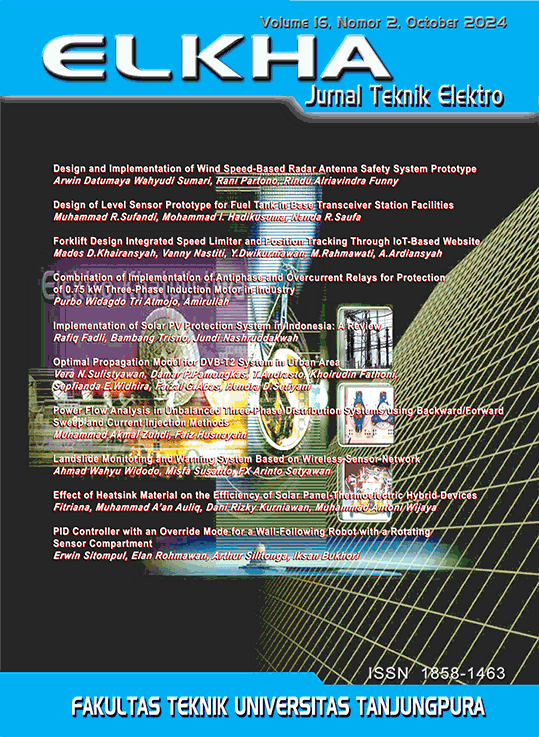
Design of Level Sensor Prototype for Fuel Tank in Base Transceiver Station Facilities
DOI:
https://doi.org/10.26418/elkha.v16i2.78357Keywords:
Generator set, Base Transceiver Station, sensor level, fuel, telecommunicationAbstract
A monitoring system for fuel availability at Base Transceiver Stations (BTS) is an absolute necessity. The fuel availability in the generator set must be guaranteed because it ensures the energy supply and continuous operation. This research purpose is to create a robust and effective sensor that can be monitored in real-time so that industry players can estimate the consumption of fuel at the BTS in a certain period. The novelty of this research is that instead of looking at the amount of fuel consumption/reduction like the previous research, this study focuses on how much diesel availability is in the generator tank. So, calculating fuel requirements and predicting actual consumption are done directly. The sensor is a reed-switch oil level sensor and is connected to ESP32 as the microcontroller. It's installed horizontally and uses an optimum distance between sensors of 2.5 mm to improve the sensor reading's accuracy. The test results of converting voltage values into ADC signals on sensor readings produced a determination coefficient of 0.9987, which showed the reliability of the sensor-level design. The sensor precision test results produced an RSD value of 0.17% and the accuracy test produced an error range of -3% to 2% with an average error value of 1.59%. These results indicate that the designed level sensor has good precision and accuracy. Through this research, the provider can predict and plan their fuel consumption needs for BTS power supply and increase the Domestic Component Level in the sensor industry.
References
A. Sucipto, et.al. “Sistem Pemeliharaan Menara BTS (Base Tranceiver Station) Berbasis Mobileâ€, Jurnal Saintekom, Vol. 12, No. 1, ISSN 2088-1770, pp. 12-22, March 2022.
F. Farizal, M.H.H., Ichsan, and G.E. Setyawan. “Purwarupa Sistyem Monitoring Tangki Bahan Bakar Genset pada STO dengan Metode Sensing Akumulasi Kecepatan Fluida (Studi Kasus PT. Telekomunikasi Indonesia)â€. Jurnal Pengembangan Teknologi Informasi dan Ilmu Komputer. e-ISSN: 2548-964X, Vol. 3, No. 4, pp. 4027-4032, April 2019
Hutapea, Zulkifli, and Lukas. “Implementasi Sensor Network untuk Monitoring Base Transceiver Station (BTS)â€. Komputika: Jurnal Sistem Komputer. 8. pp.13-20.
A. Saputra. “BTS X PLTS: Sambungkan Wilayah Terluar Indonesia dengan Energi Surya.†Available: https://kumparan.com/azissaputra2001/bts-x-plts-sambungkan-wilayah-terluar-indonesia-dengan-energi-surya- 1z2XvTq8Zuq, 2022, accessed by 19 May 2023
M.B. Ali, et.al. “Techno-economic assessment and optimization framework with energy storage for hybrid energy resources in base transceiver stations-based infrastructure across various climatic regions at a country scaleâ€. Journal of Energy Storage. Volume 72, Part A, 2023.
Tahir, M., Mustafa, S.M.N., Enam, R.N., Ismat, N. and Rizvi, H.H., “Real time monitoring and control of electrical diesel generator through internet of things,†Pakistan Journal of Engineering and Technology, Vol.5(2), pp.112-118. 2022
Patil, K., Patil, C. Y., & Barhate, S. (2019). “Design and development of fuel level measurement technique for automotive application.†2019 International Conference on Communication and Electronics Systems (ICCES).
Tian-he, W. and Zhong-hua, W, "Design of Low-cost Automobile Oil Level Sensor Detection Device," 2020 Chinese Control And Decision Conference (CCDC), Hefei, China, 2020, pp. 5427-5432, 2020.
Baysak, A. P., and Gunduzalp, M. “Fuel Tracking System for Trucksâ€. Innovations in Intelligent Systems and Applications Conference (ASYU). 2019.
P. Ripka, M.M. Arafat. Magnetic Sensors: Principles and Applications. Reference Module in Materials Science and Materials Engineering, Elsevier. 2019. ISBN 9780128035818.
M.Ya. Kletsel, B.E. Mashrapov, R.M. Mashrapova. “Reed switch protection of double-circuit lines without current and voltage transformers. International Journal of Electrical Power & Energy Systems. Volume 154, 2023.
Weir G, Chisholm G, Leveneur J., “The Magnetic Field About A Three-Dimensional Block Neodymium Magnet.†The ANZIAM Journal. 2020, Vol. 62(4), pp.386-405.
Elharati, H.A., Alharati, S.A., Wareg, Z.O, and Waregh, M.A. “Design Optomization for Generating High Static Magnetic Fieldâ€, World Journal of Engineering and Technology, Vol. 11, pp 793-806, November 2023.
Wannasuk, A., Projun, T., Teeka, C., “Measurements of The Magnetic Force and Field Strength of Neodymium High Magnetâ€. The 12th National Academic Conference SWU Research, Srinakharinwirot University, pp. 539-549, March 2019.
D.J Suroso, FYM Adiyatma, P Cherntanomwong, " Wi-Fi Sensing for Indoor Localization via Channel State Information: A Survey", ELKHA: Jurnal Teknik Elektro, Vol.15 No.2 October 2023, pp 152-159
K&J Magnetics, Inc. Magnetic Field Calculator. Available:https://www.kjmagnetics.com/fieldcalculator.asp, accessed by 19 May 2023
Downloads
Additional Files
Published
Issue
Section
License
Copyright (c) 2024 ELKHA : Jurnal Teknik Elektro

This work is licensed under a Creative Commons Attribution-NonCommercial-ShareAlike 4.0 International License.
1. Proposed Policy for Journals That Offer Open Access
Authors who publish with this journal agree to the following terms:
- Authors retain copyright and grant the journal right of first publication with the work simultaneously licensed under a Creative Commons Attribution License that allows others to share the work with an acknowledgement of the work's authorship and initial publication in this journal.
- Authors are able to enter into separate, additional contractual arrangements for the non-exclusive distribution of the journal's published version of the work (e.g., post it to an institutional repository or publish it in a book), with an acknowledgement of its initial publication in this journal.
- Authors are permitted and encouraged to post their work online (e.g., in institutional repositories or on their website) prior to and during the submission process, as it can lead to productive exchanges, as well as earlier and greater citation of published work (See The Effect of Open Access).
2. Proposed Policy for Journals That Offer Delayed Open Access
Authors who publish with this journal agree to the following terms:
- Authors retain copyright and grant the journal right of first publication, with the work [SPECIFY PERIOD OF TIME] after publication simultaneously licensed under a Creative Commons Attribution License that allows others to share the work with an acknowledgement of the work's authorship and initial publication in this journal.
- Authors are able to enter into separate, additional contractual arrangements for the non-exclusive distribution of the journal's published version of the work (e.g., post it to an institutional repository or publish it in a book), with an acknowledgement of its initial publication in this journal.
- Authors are permitted and encouraged to post their work online (e.g., in institutional repositories or on their website) prior to and during the submission process, as it can lead to productive exchanges, as well as earlier and greater citation of published work (See The Effect of Open Access).
