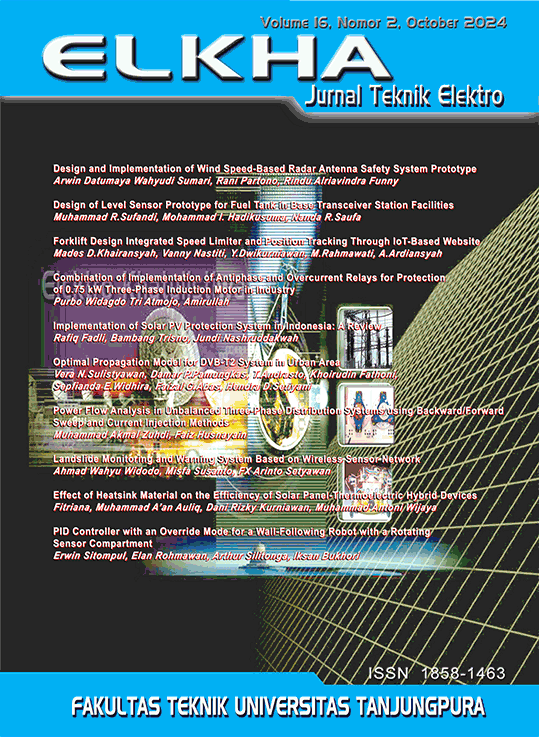
Design and Implementation of Wind Speed-Based Radar Antenna Safety System Prototype
DOI:
https://doi.org/10.26418/elkha.v16i2.78606Keywords:
Antenna, pivot antenna, air defense radar, safety system, Thomson TRS 2215DAbstract
Air defense radar is a system that detects the presence of one or more air objects at a certain distance, altitude, and direction. One type of air defense radar used by the Indonesian National Armed Forces (TNI) is the Thomson TRS 2215D. An essential part of the radar is the rotating part of the radar antenna support called the antenna pivot. The rotation of the radar antenna must constantly be monitored and controlled for rotational stability at a speed of 6 Rotations per Minute (RPM) with a maximum wind speed of 120 km/h to prevent damage to the driving gear. Stormy weather with high wind speeds can cause the rotation speed of the radar antenna to be uncontrollable, which can cause damage. The solution offered in this study is to build a safety system that will lock the radar antenna automatically when the wind speed is detected to exceed tolerances and maintain the security of the radar antenna and its support system. The safety system was designed using an ESP32 Wi-Fi device equipped with an anemometer wind speed sensor, a Liquid Crystal Display (LCD) monitor, a Direct Current (DC) motor, and a Blynk Internet of Things (IoT) application. The test was conducted in a simulation using a multi-meter and oscilloscope measuring instrument. Testing the radar antenna's safety system prototype on a laboratory scale shows that the safety system can work as designed. The system can lock the radar antenna when the airflow is set at a speed of 54 km/h or 15 m/s, communication with the Blynk server works well, and the ESP32 device can transmit data at a maximum distance of 14 meters.
References
National Air Defense Command, “Decree of the Commander of the National Air Defense Command Number Kep/79/XII/2017 regarding Fixed Procedures for Air Defense Operations,†2017, Komando Pertahanan Udara Nasional, Jakarta.
R. Des Mathurin, Long Range 3-D Mobile Fixed Radar Thomson TRS 2215. Thomson CSF, 1985.
Q. Meng, Y. Zhang, H. Xu, and K. Li, “The Influence of Rotating Axis Position on Wind Load Coefficient of Polyhedral Phased Array Antenna Model,†Procedia Comput Sci, vol. 208, pp. 675–680, 2022.
E. Systems, “ESP32 Series.†Accessed: Jan. 02, 2023. [Online]. Available: https://www.espressif.com/ sites/ default/ files/documentation/esp32_datasheet_en.pdf
M. Fernando, L. Jasa, and R. S. Hartati, “Monitoring System Kecepatan dan Arah Angin Berbasis Internet of Things (IoT) Menggunakan Raspberry Pi 3,†Majalah Ilmiah Teknologi Elektro, vol. 21, no. 1, p. 135, Jul. 2022.
R. Niranjana, S. Arvind, M. Vignesh, and S. Vishaal, “Effectual Home Automation using ESP32 NodeMCU,†in International Conference on Automation, Computing and Renewable Systems, ICACRS 2022 - Proceedings, IEEE, Dec. 2022, pp. 1–5.
T. Swati and K. Raghavendra Ra, “Industrial process monitoring system using esp32,†Int J Eng Adv Technol, vol. 8, no. 2C2, pp. 123–127, 2018.
M. Babiuch and J. Postulka, “Smart Home Monitoring System Using ESP32 Microcontrollers,†in Internet of Things, IntechOpen, 2021.
A. Naveena, “Analysis of Real Time Weather Monitoring System Using Thingspeak,†2022. [Online]. Available: https://www.e-afr.org/
U. Muhammad, Irvawansyah, and D. Muhammad, “Environmental Condition Measurement System with a Mini Weather Station Using ESP32,†Jurnal Media Elektrik, vol. 21, no. 1, pp. 34–43, 2024.
J. O. Wanogho, K. O. Ogbeide, and F. O. Agbontean, “Development of ESP 32 Based Weather Monitoring System for Photovoltaic Yield Chariterisation In Delta State, Nigeria,†International Journal of Engineering Science Invention (IJESI), vol. 11, no. 4, pp. 12–18, 2022.
A. Y. D. Pramesti, F. A. Soelistianto, and L. D. Mustafa, “Weather Condition Monitoring System as A Floods Prevention in Malang using Android Application,†Jurnal Jartel, vol. 12, no. 1, pp. 5–11, 2022.
S. Budijono and Felita, “Smart Temperature Monitoring System Using ESP32 and DS18B20,†IOP Conf Ser Earth Environ Sci, vol. 794, no. 1, 2021.
University of Pennsylvania, “MEAM. Design : ESP32 : Board Pinout & Functionality,†https:// medesign. seas.upenn.edu/ index.php/ Guides/ ESP32-pins.
M. Artiyasa, A. Nita Rostini, Edwinanto, and Anggy Pradifta Junfithrana, “Aplikasi Smart Home Node MCU IoT untuk Blynk,†Jurnal Rekayasa Teknologi Nusa Putra, vol. 7, no. 1, pp. 1–7, Mar. 2021.
Angga W. Aditya, Restu M. Utomo, Nur R. Alham, Hilmansyah, “The Industrial IoT Control Design of Three Phase Induction Motor using Conventional V/F Method,†ELKHA, vol.15 no.1, pp. 67-72, April 2023.
A. Othman and N. H. Zakaria, “Energy Meter based Wireless Monitoring System using Blynk Application via smartphone,†in 2020 IEEE 2nd International Conference on Artificial Intelligence in Engineering and Technology (IICAIET), IEEE, Sep. 2020, pp. 1–5.
U. Hidayati, I. Haryanto, R. Ismail, and J. Sudharto, “Rancang Bangun Pendeteksi Kecepatan Angin Berbasis Platform IoT Blynk,†Rotasi, vol. 23, no. 4, pp. 44–49, 2021.
M. Khairudin, Efendi, and N. Purwantiningsih, “Analisa Sistem Kendali Putaran Motor DC Menggunakan Silicon Controlled Rectifiers,†Jurnal Pendidikan Teknologi dan Kejuruan, vol. 13, no. 1, Apr. 2016.
D. T. Arif and A. Aswardi, “Kendali Kecepatan Motor DC Penguat Terpisah Berbeban Berbasis Arduino,†JTEV (Jurnal Teknik Elektro dan Vokasional), vol. 6, no. 2, p. 33, Apr. 2020.
A. P. Nebrida, C. D. Amador, C. M. Madiam, and G. J. S. Ranche, “Development of Smart Meter to Monitor Real Time Energy Consumption for Sustainability,†International Journal of Sustainable Construction Engineering and Technology, vol. 14, no. 4, pp. 28–39, Oct. 2023.
H. Maghfiroh et al., “Smart Home System with Battery Backup and Internet of Things,†Journal of Applied Engineering and Technological Science, vol. 5, no. 1, pp. 42–57, 2023.
A. Romputtal and C. Phongcharoenpanich, “T-Slot Antennas-Embedded ZigBee Wireless Sensor Network System for IoT-Enabled Monitoring and Control Systems,†IEEE Internet Things J, vol. 10, no. 23, pp. 20834–20845, Dec. 2023.
Downloads
Additional Files
Published
Issue
Section
License
Copyright (c) 2024 ELKHA

This work is licensed under a Creative Commons Attribution-NonCommercial-ShareAlike 4.0 International License.
1. Proposed Policy for Journals That Offer Open Access
Authors who publish with this journal agree to the following terms:
- Authors retain copyright and grant the journal right of first publication with the work simultaneously licensed under a Creative Commons Attribution License that allows others to share the work with an acknowledgement of the work's authorship and initial publication in this journal.
- Authors are able to enter into separate, additional contractual arrangements for the non-exclusive distribution of the journal's published version of the work (e.g., post it to an institutional repository or publish it in a book), with an acknowledgement of its initial publication in this journal.
- Authors are permitted and encouraged to post their work online (e.g., in institutional repositories or on their website) prior to and during the submission process, as it can lead to productive exchanges, as well as earlier and greater citation of published work (See The Effect of Open Access).
2. Proposed Policy for Journals That Offer Delayed Open Access
Authors who publish with this journal agree to the following terms:
- Authors retain copyright and grant the journal right of first publication, with the work [SPECIFY PERIOD OF TIME] after publication simultaneously licensed under a Creative Commons Attribution License that allows others to share the work with an acknowledgement of the work's authorship and initial publication in this journal.
- Authors are able to enter into separate, additional contractual arrangements for the non-exclusive distribution of the journal's published version of the work (e.g., post it to an institutional repository or publish it in a book), with an acknowledgement of its initial publication in this journal.
- Authors are permitted and encouraged to post their work online (e.g., in institutional repositories or on their website) prior to and during the submission process, as it can lead to productive exchanges, as well as earlier and greater citation of published work (See The Effect of Open Access).
