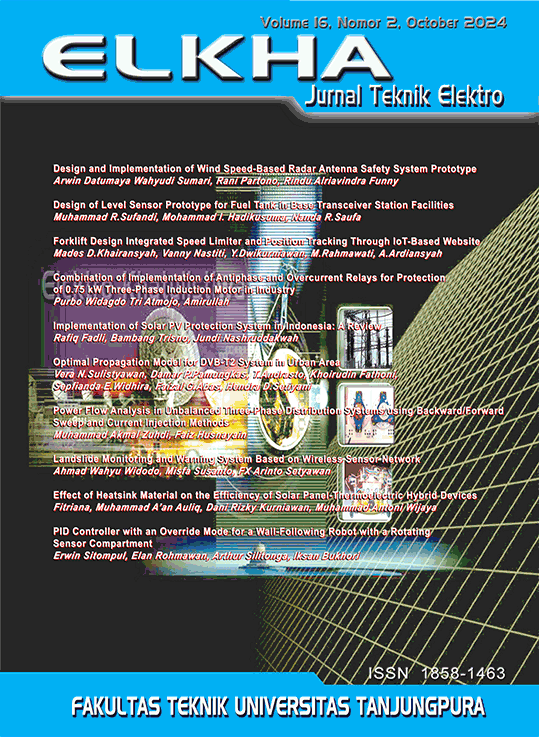
PID Controller with an Override Mode for a Wall-Following Robot with a Rotating Sensor Compartment
DOI:
https://doi.org/10.26418/elkha.v16i2.84708Keywords:
Wall-following robot, PID controller, overrideAbstract
This paper presents the design of a wall-following robot (WFR) with a rotating sensor compartment to reduce the number of distance sensors used. Two infrared (IR) sensors were fitted in the compartment that rotates back and forth at 45 °, producing four measurement values at each rotation cycle. The WFR was regulated using a novel control scheme of PID controller with an override mode. A discrete PID controller in position form was used to run the WFR to follow straight wall segments or walls turning left, while an override mode governed the WFR to follow walls turning right. The sampling time was set to 300 ms. The parameters of the PID controller were tuned using a trial-and-error method. The Mean Absolute Errors (MAE) was selected as the cost function. The WFR conducted twelve trial runs along a trial track with a length of 200 cm, consisting of one right turn and one left turn. The parameters that yielded the lowest MAE of 0.90 cm were used for further tests. Subsequently, a closed track for testing was constructed with a length of 845 cm, consisting of 7 right turns and 2 left turns. The WFR completed five test runs successfully, each elapsing the test track twice. The lowest MAE during the tests was 1.06 cm. The favorable performance of the proposed WFR strengthens future development efforts to equip the robot with more hardware to fulfill specific tasks and to put the completion time into optimization consideration.
References
V. Schettino and Y. Demiris, “Inference of user-intention in remote robot wheelchair assistance using multimodal interfaces,†in 2019 IEEE/RSJ International Conference on Intelligent Robots and Systems (IROS), Nov. 2019.
J. E. Daly, P. Bremner, and U. Leonards, “Robots in Need: Acquiring Assistance with Emotion,†in 2019 14th ACM/IEEE International Conference on Human-Robot Interaction (HRI), Mar. 2019.
C. W. D. Lumoindong and E. Sitompul, “A Prototype of an IoT-Based Pet Robot with Customizable Functions (CoFiBot V2),†International Journal of Mechanical Engineering and Robotics Research (IJMERR), pp. 510–518, 2021.
Z. J. Maknuny, S. F. Ramadhan, A. Turnip, and E. Sitompul, “RPLiDAR-based mapping in development of a health service assisting robot in COVID-19 pandemic,†in International Conference on Sustainable Engineering and Creative Computing, vol. 1, no. 1, p. 72, 2022.
A. Turnip, T. R. D. Montoya, H. M. Irfan, and L. H. Nguyen, "An Exploration of Autonomous Medical Robot Navigation Accuracy and Trajectory Precision with ROS Integrated Sensors," in 2024 IEEE International Conference on Artificial Intelligence and Mechatronics Systems (AIMS), February 2024.
M. T. M. Wijaya and M. D. Prayogo, “Implementasi Wall Following dengan Sistem Kendali PID pada Prototipe Robot Rescue,†Seminar Nasional Teknik Elektro, Sistem Informasi dan Teknik Informatika (SNESTIK), pp. 129-134, June 2021.
T. Wen, “Research on Architecture Design of Mobile Video Surveillance System in Information Room Based on Intelligent Robot Technology,†Wireless Communications and Mobile Computing, vol. 2022, pp. 1–7, Sep. 2022.
E. Sitompul and M. Y. Baihaqi, “Quasi-Dynamic Walking Optimization of Humanoid Robot Using Genetic Algorithm,†International Journal of Artificial Intelligence (IJAI), vol. 20, no. 1, pp. 24-45, March 2022.
A. Y. E. Dodu, A. Amriana, and F. Firmansyah, “Perancangan Robot Pemadam Api Wall Follower Beroda dengan Metode Fuzzy Logic (Studi Kasus : Simulasi Kebakaran pada Komplek Perumahan Citraland Kota Palu),†Jurnal Ilmiah Informatika Global, vol. 10, no. 2, Dec. 2019.
T. Huynh, J. Walter, and F. Aveta, “RoboRover – A Jetson Nano Powered Robot Car for Object Following, Obstacle Avoidance, and Wall Following,†in 2023 IEEE 14th Annual Ubiquitous Computing, Electronics & Mobile Communication Conference (UEMCON), Oct. 2023.
H. S. Purnama, T. Sutikno, N. S. Widodo, and S. Alavandar, “Efficient PID Controller based Hexapod Wall Following Robot,†in 2019 6th International Conference on Electrical Engineering, Computer Science and Informatics (EECSI), Sep. 2019.
I. Aniekan, O. Ikechukwu, and S. Paul, “Comparative Analysis of a PID Controller using Ziegler- Nichols and Auto Turning Method,†International Academic Journal of Science and Engineering, vol. 06, no. 01, pp. 51–66, Jun. 2019.
R. Risfendra, A. Asfinaldi, H. Habibullah, and J. Julisardi, “Sistem Pergerakan Robot Kiper Beroda Menggunakan Metode Wall Follower Berbasis Image Processing,†Jurnal Teknik Elektro ELKHA, vol. 12, no. 1, p. 1, Oct. 2020.
M. Goyal, A. Priya, C. Kumar, V. Verma, and M. Hota, “An Ingenious Traffic Control System Using Fuzzy Logic Control with Emergency Override Feature,†in 2018 IEEE International Conference on System, Computation, Automation and Networking (ICSCA), Jul. 2018.
W. Xue, Z. Wang, B. Yang, R. Zheng, and K. Nakano, “A Fail-safe System involving Shared Control Strategy for Driver Override,†IFAC-PapersOnLine, vol. 55, no. 27, pp. 478–483, 2022.
H. Richter, “Control design with output constraints: Multi-regulator sliding mode approach with override logic,†in 2012 American Control Conference (ACC), Jun. 2012.
E. Sitompul, R. M. Putra, H. Tarigan, A. Silitonga, and I. Bukhori, “Implementation of Digital Feedback Control with Change Rate Limiter in Regulating Water Flow Rate Using Arduino,†Buletin Ilmiah Sarjana Teknik Elektro (BISTE), vol. 6, no. 1, pp. 72-82, March 2024.
M. A. Haidekker, “The PID controller,†in Linear Feedback Controls, Elsevier, 2020, pp. 253–273.
G. F. Franklin, D. Powell, and A. F. Emami-Naeini, Feedback Control of Dynamic Systems, Global Edition. Pearson Higher Ed, 2019.
D. N. Minh, H. D. Quang, N. D. Phuong, T. N. Manh, and D. N. Bui, “An adaptive fuzzy dynamic surface control tracking algorithm for mecanum wheeled mobile robot,†International Journal of Mechanical Engineering and Robotics Research (IJMERR), pp. 354–361, 2023.
Downloads
Additional Files
Published
Issue
Section
License
Copyright (c) 2024 ELKHA : Jurnal Teknik Elektro

This work is licensed under a Creative Commons Attribution-NonCommercial-ShareAlike 4.0 International License.
1. Proposed Policy for Journals That Offer Open Access
Authors who publish with this journal agree to the following terms:
- Authors retain copyright and grant the journal right of first publication with the work simultaneously licensed under a Creative Commons Attribution License that allows others to share the work with an acknowledgement of the work's authorship and initial publication in this journal.
- Authors are able to enter into separate, additional contractual arrangements for the non-exclusive distribution of the journal's published version of the work (e.g., post it to an institutional repository or publish it in a book), with an acknowledgement of its initial publication in this journal.
- Authors are permitted and encouraged to post their work online (e.g., in institutional repositories or on their website) prior to and during the submission process, as it can lead to productive exchanges, as well as earlier and greater citation of published work (See The Effect of Open Access).
2. Proposed Policy for Journals That Offer Delayed Open Access
Authors who publish with this journal agree to the following terms:
- Authors retain copyright and grant the journal right of first publication, with the work [SPECIFY PERIOD OF TIME] after publication simultaneously licensed under a Creative Commons Attribution License that allows others to share the work with an acknowledgement of the work's authorship and initial publication in this journal.
- Authors are able to enter into separate, additional contractual arrangements for the non-exclusive distribution of the journal's published version of the work (e.g., post it to an institutional repository or publish it in a book), with an acknowledgement of its initial publication in this journal.
- Authors are permitted and encouraged to post their work online (e.g., in institutional repositories or on their website) prior to and during the submission process, as it can lead to productive exchanges, as well as earlier and greater citation of published work (See The Effect of Open Access).
