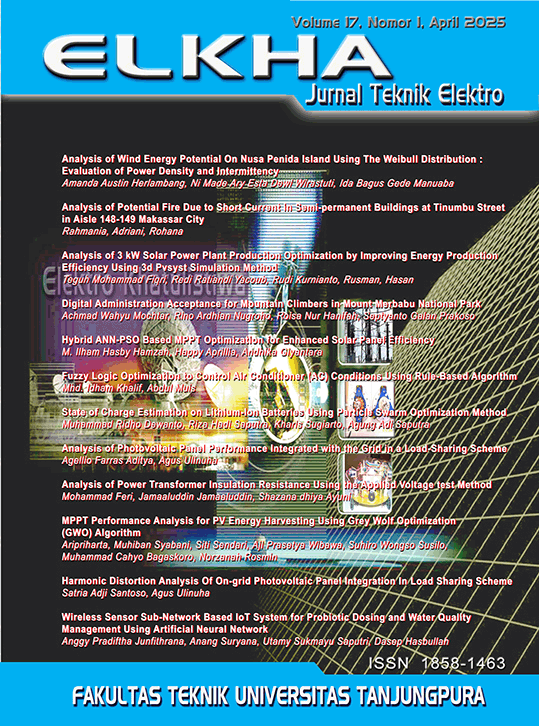
Analysis of Wind Energy Potential On Nusa Penida Island Using The Weibull Distribution: Evaluation of Power Density and Intermittency
DOI:
https://doi.org/10.26418/elkha.v17i1.87857Keywords:
Wind Energy Potential, Weibull Distribution, Power Density, Intermittency, Nusa Penida.Abstract
Nusa Penida Island faces increasing energy demands driven by tourism and development, highlighting the need for sustainable energy solutions. While previous wind studies in Indonesia have primarily focused on larger islands, this research evaluates Nusa Penida"™s wind energy potential using the Weibull distribution method for power density and intermittency analysis. Unlike prior studies, this research incorporates seasonal variations and probabilistic modeling to provide a more accurate assessment of wind intermittency. Statistical analysis of 2019"“2020 wind speed data from NASA Power reveals stable wind conditions, with an average power density of 104 W/m ², making it suitable for medium scale wind energy projects. Peak wind speeds occur mid year, optimizing conditions for energy harvesting, while intermittency analysis indicates that wind speeds fall below 3 m/s approximately 30% of the time, emphasizing the need for energy storage or hybrid systems. This research quantifies the impact of intermittency on energy planning, offering a data driven approach to support Indonesia"™s renewable energy diversification and reduce reliance on fossil fuels. The findings establish Nusa Penida"™s feasibility for wind energy deployment, contributing to enhanced energy resilience in remote island communities.References
E. Ilbahar, S. Cebi, and C. Kahraman, “A state-of-the-art review on multi-attribute renewable energy decision making,†Aug. 01, 2019, Elsevier Ltd.
T. S. Genc and S. S. Reynolds, “Who should own a renewable technology? Ownership theory and an application,†Int J Ind Organ, vol. 63, pp. 213–238, Mar. 2019.
B. Yang et al., “State-of-the-art one-stop handbook on wind forecasting technologies: An overview of classifications, methodologies, and analysis,†Feb. 10, 2021, Elsevier Ltd.
A. U. Krismanto, “Analisa Pengaruh Pembangkit Tenaga Angin Skala Besar Terhadap Stabilitas Tegangan Statik Dan Dinamik Sistem Tenaga Listrik,†2019.
M. F. Fikri, R. A. R. Ardiansyah, and C. Hudaya, “Studi Optimasi Pembangkit Listrik Berbasis,†SENTER 2018: Seminar Nasional Teknik Elektro 2018, pp. 265–75, 2018.
R. A. Syihab, S. Sasmono, and W. Priharti, “Desain Turbin Angin Untuk Pemanfaatan Energi Angin (Studi Kasus pada Grid 3 Nusa Di Pulau Nusa Penida),†e-Proceeding of Engineering, vol. Vol. 9 No. 5, p. 2057, Oct. 2022.
A. A. S. Siahaya, R. Setiati, and M. T. Malinda, “The Opportunities and Constraints of Wind Energy,†in IOP Conference Series: Earth and Environmental Science, IOP Publishing Ltd, Jul. 2021.
st Adisti Wulanditya and D. Kristina Silalahi, “Proyeksi Kecepatan Angin Dan Probabilitas Terjadinya Intermitensi Di Grid 3 Nusa, Pulau Nusa Penida Menggunakan Metode Principal Component Analysis,†e-Proceeding of Engineering, vol. Vol. 9 No. 5, p. 2298, Oct. 2022.
H. Wang, N. Zhang, E. Du, J. Yan, S. Han, and Y. Liu, “A comprehensive review for wind, solar, and electrical load forecasting methods,†Global Energy Interconnection, vol. 5, pp. 9–30, 2022.
M. A. Saeed, Z. Ahmed, and W. Zhang, “Wind energy potential and economic analysis with a comparison of different methods for determining the optimal distribution parameters,†Renew Energy, vol. 161, pp. 1092–1109, Dec. 2020.
H. H. Pourasl and V. M. Khojastehnezhad, “Techno-economic analysis of wind energy potential in Kazakhstan,†Proceedings of the Institution of Mechanical Engineers, Part A: Journal of Power and Energy, vol. 235, no. 6, pp. 1563–1576, Sep. 2021.
S. Rüstemli, O. Güntas, G. Şahin, A. Koç, W. van Sark, and S. Ş. Doğan, “Wind power plant site selection problem solution using GIS and resource assessment and analysis of wind energy potential by estimating Weibull distribution function for sustainable energy production: The case of Bitlis/Turkey,†Energy Strategy Reviews, vol. 56, Nov. 2024.
M. Mudelsee, “Trend analysis of climate time series: A review of methods,†Mar. 01, 2019, Elsevier B.V.
E. J. Topol, “High-performance medicine: the convergence of human and artificial intelligence,†Jan. 01, 2019, Nature Publishing Group.
L. G. B. Ruiz, M. C. Pegalajar, R. Arcucci, and M. Molina-Solana, “A time-series clustering methodology for knowledge extraction in energy consumption data,†Expert Syst Appl, vol. 160, Dec. 2020.
M. Hoffmann, L. Kotzur, D. Stolten, and M. Robinius, “A review on time series aggregation methods for energy system models,†2020, MDPI AG.
M. Farrokhifar, Y. Nie, and D. Pozo, “Energy systems planning: A survey on models for integrated power and natural gas networks coordination,†Mar. 15, 2020, Elsevier Ltd.
M. Rizki, M. Isnaini, H. Umam, A. Wenda, M. L. Hamzah, and F. Dio, “Comparison of Four Time Series Forecasting Methods for Coal Material Supplies: Case Study of a Power Plant in Indonesia,†Oct. 2021.
H. Sharadga, S. Hajimirza, and R. S. Balog, “Time series forecasting of solar power generation for large-scale photovoltaic plants,†Renew Energy, vol. 150, pp. 797–807, May 2020.
Y. Choi, H. Lim, H. Choi, and I. J. Kim, “GAN-based anomaly detection and localization of multivariate time series data for power plant,†in Proceedings - 2020 IEEE International Conference on Big Data and Smart Computing, BigComp 2020, Institute of Electrical and Electronics Engineers Inc., Feb. 2020, pp. 71–74.
Z. Liu, P. Jiang, L. Zhang, and X. Niu, “A combined forecasting model for time series: Application to short-term wind speed forecasting,†Appl Energy, vol. 259, Feb. 2020.
M. A. Hossain, R. K. Chakrabortty, S. Elsawah, and M. J. Ryan, “Very short-term forecasting of wind power generation using hybrid deep learning model,†J Clean Prod, vol. 296, May 2021.
A. Torina et al., “Modelling time-series Aedes albopictus abundance as a forecasting tool in urban environments,†Ecol Indic, vol. 150, Jun. 2023.
A. D. Woods et al., “Missing Data and Multiple Imputation Decision Tree,†Aug. 02, 2021.
P. O. Schenk and C. Kern, “Connecting algorithmic fairness to quality dimensions in machine learning in official statistics and survey production,†AStA Wirtschafts- und Sozialstatistisches Archiv, vol. 18, no. 2, pp. 131–184, Jun. 2024.
V. Grey, B. E. Hatt, T. D. Fletcher, K. Smith-Miles, and R. A. Coleman, “Analysis of irregularly sampled stream temperature time series: challenges and solutions,†J Hydrol (Amst), vol. 636, Jun. 2024.
H. Teimourian, M. Abubakar, M. Yildiz, and A. Teimourian, “A Comparative Study on Wind Energy Assessment Distribution Models: A Case Study on Weibull Distribution,†Energies (Basel), vol. 15, no. 15, Aug. 2022.
J. R. Farkat Diógenes, J. Coelho Rodrigues, M. C. Farkat Diógenes, and J. Claro, “Overcoming barriers to onshore wind farm implementation in Brazil,†Energy Policy, vol. 138, Mar. 2020.
P. Zhang, Y. Wang, L. Liang, X. Li, and Q. Duan, “Short-Term wind power prediction using GA-BP neural network based on DBSCAN algorithm outlier identification,†Processes, vol. 8, no. 2, Feb. 2020.
GWEC, “GWEC | Global Wind Report 2019,†Mar. 2020.
H. Ren, J. Dudhia, S. Ke, and H. Li, “The basic wind characteristics of idealized hurricanes of different intensity levels,†Journal of Wind Engineering and Industrial Aerodynamics, vol. 225, p. 104980, 2022.
O. M. Kam, S. Noël, H. Ramenah, P. Kasser, and C. Tanougast, “Comparative Weibull distribution methods for reliable global solar irradiance assessment in France areas,†Renew Energy, vol. 165, pp. 194–210, Mar. 2021.
M. A. Alanazi, M. Aloraini, M. Islam, S. Alyahya, and S. Khan, “Wind Energy Assessment Using Weibull Distribution with Different Numerical Estimation Methods: A Case Study,†Emerging Science Journal, vol. 7, no. 6, pp. 2260–2278, Dec. 2023.
M. Al-Ghriybah, “Assessment of Wind Energy Potentiality at Ajloun, Jordan Using Weibull Distribution Function,†Evergreen, vol. 9, no. 1, pp. 10–16, 2022.
A. R. Shoib, D. H. Didane, A. N. Mohammed, K. Abdullah, and M. F. M. Ali, “Technical Assessment of Wind Energy Potentiality in Malaysia Using Weibull Distribution Function,†Journal of Advanced Research in Fluid Mechanics and Thermal Sciences, vol. 86, no. 1, pp. 1–13, Oct. 2021.
Y. Li, X. Huang, K. F. Tee, Q. Li, and X. P. Wu, “Comparative study of onshore and offshore wind characteristics and wind energy potentials: A case study for southeast coastal region of China,†Sustainable Energy Technologies and Assessments, vol. 39, Jun. 2020.
M. S. Shama et al., “Modified generalized Weibull distribution: theory and applications,†Sci Rep, vol. 13, no. 1, Dec. 2023.
Y. M. Gómez, D. I. Gallardo, C. Marchant, L. Sánchez, and M. Bourguignon, “An In-Depth Review of the Weibull Model with a Focus on Various Parameterizations,†Jan. 01, 2024, Multidisciplinary Digital Publishing Institute (MDPI).
A. Abdul Majid, “Accuracy of wind speed forecasting based on joint probability prediction of the parameters of the Weibull probability density function,†Front Energy Res, vol. 11, 2023.
I. Wonodi and C. O. Ahiakwo, “Techno-Economic Assessment of Wind Power Potential of Abuloma Community Using Two-Parameter Weibull Distribution,†2024.
Downloads
Additional Files
Published
Issue
Section
License
Copyright (c) 2025 ELKHA : Jurnal Teknik Elektro

This work is licensed under a Creative Commons Attribution-NonCommercial-ShareAlike 4.0 International License.
1. Proposed Policy for Journals That Offer Open Access
Authors who publish with this journal agree to the following terms:
- Authors retain copyright and grant the journal right of first publication with the work simultaneously licensed under a Creative Commons Attribution License that allows others to share the work with an acknowledgement of the work's authorship and initial publication in this journal.
- Authors are able to enter into separate, additional contractual arrangements for the non-exclusive distribution of the journal's published version of the work (e.g., post it to an institutional repository or publish it in a book), with an acknowledgement of its initial publication in this journal.
- Authors are permitted and encouraged to post their work online (e.g., in institutional repositories or on their website) prior to and during the submission process, as it can lead to productive exchanges, as well as earlier and greater citation of published work (See The Effect of Open Access).
2. Proposed Policy for Journals That Offer Delayed Open Access
Authors who publish with this journal agree to the following terms:
- Authors retain copyright and grant the journal right of first publication, with the work [SPECIFY PERIOD OF TIME] after publication simultaneously licensed under a Creative Commons Attribution License that allows others to share the work with an acknowledgement of the work's authorship and initial publication in this journal.
- Authors are able to enter into separate, additional contractual arrangements for the non-exclusive distribution of the journal's published version of the work (e.g., post it to an institutional repository or publish it in a book), with an acknowledgement of its initial publication in this journal.
- Authors are permitted and encouraged to post their work online (e.g., in institutional repositories or on their website) prior to and during the submission process, as it can lead to productive exchanges, as well as earlier and greater citation of published work (See The Effect of Open Access).
