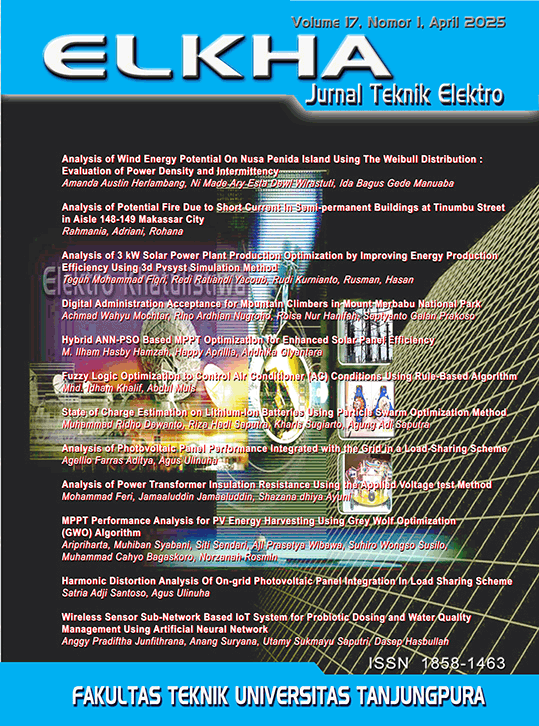
Hybrid ANN-PSO Based MPPT Optimization for Enhanced Solar Panel Efficiency
DOI:
https://doi.org/10.26418/elkha.v17i1.88711Keywords:
photovoltaic, PSO, neural network, MPPTAbstract
In some cases of Solar Power Generation System (PLTS) optimization, AI algorithms can be used to solve complex problems such as efficiency problems. In this research, a hybrid approach that combines Artificial Neural Network (ANN) and Particle Swarm Optimization (PSO) algorithms is used to optimize the Maximum Power Point Tracking (MPPT) system for solar panels. The hybrid technique seeks to maximize power output by precisely determining the ideal voltage and current points, which will increase the efficiency of solar panels. This study includes the measurement of parameters such as current (I), voltage (V), and power (W) in the MPPT system. The research shows that the hybrid ANN-PSO approach performs better than the traditional ANN method, producing mean squared error (MSE) and root mean squared error (RMSE) values that are lower. Moreover, research results show that the hybrid system maintains a load efficiency of approximately 51% in real-world measurements and about 67% in simulation data, indicating better performance and implementation ease.References
Directorate General EBTKE, 2024. Energy Journal, ESDM Ministry: Jakarta.
Zuliari, E. A., Priananda, C. W. & Haryudo, S. I., 2017. Penggunaan Algoritma Peturb And Observe (Pno) dalam Studi Penggunaan Sepic dan Zeta Konverter untuk Maximum Power Point Tracker (Mppt) pada Photovoltaic Statis. JIEET, Volume 1, pp. 27-31.
Palevi, B. R. P. D. & Sulistiawati, I. B., 2021. Penerapan Algoritma Fuzzy Logic Pada Solar MPPT Controller. ALINIER JURNAL, 2(2), pp. 45-49.
Khosravanian, R., Mansouri, V., Wood, D.A. et al. A comparative study of several metaheuristic algorithms for optimizing complex 3-D well-path designs. J Petrol Explor Prod Technol 8, 1487–1503 (2018).
IRENA, 2017. Renewable Energy Prospects: Indonesia. Abu Dhabi: www.irena.org/remap.
Yahyaoui, I., 2018. Advances in Renewable Energies and Power Technologies. s.l.:Elsevier.
Fathi, M. & Parian, J. A., 2021. Intelligent MPPT for photovoltaic panels using novel fuzzy logic and artificial neural networks based on evolutionary algorithms. Energy Reports, Volume 7, pp. 1338- 1348.
Seyedmahmoudian, M. et al., 2016. State-of-the-art artificial intelligence-based MPPT techniques for mitigating partial shading effects on PV systems – A review. Renewable and Sustainable Energy Reviews, pp. 435-455.
Haseeb, I. et al., 2021. Solar Power System Assessments Using ANN and Hybrid Boost Converter Based MPPT Algorithm. Applied Sciences, 11(23), pp. 11132-11151.
Rahman, M. M. & Islam, M. S., 2020. PSO and ANN-Based Hybrid MPPT Algorithm for Photovoltaic Array under Partial Shading Condition. Engineering International, 8(1), pp. 9-24.
R, D., R, N.B., & D, D. (2024). Optimized ANN-based MPPT for Solar Photovoltaic System. 2024 Third International Conference on Intelligent Techniques in Control, Optimization and Signal Processing (INCOS), 1-6.
Abo-Sennah, M. A., El-Dabah, M. A. & Mansour, A. E.-B., 2021. Maximum power point tracking techniques for photovoltaic systems: A comparative study. International Journal of Electrical and Computer Engineering, 11(1), pp. 57-73.
Veldhuis & Reinders, 2013. Reviewing the potential and cost-effectiveness of grid-connected solar PV in Indonesia on a provincial level. Renewable and Sustainable Energy Reviews, Volume 27, pp. 315- 324.
Al-Majidi, S. D., Abbod, M. F. & Al-Raweshidy, H. S., 2020. A particle swarm optimisation-trained feedforward neural network for predicting the maximum power point of a photovoltaic array. Engineering Applications of Artificial Intelligence, Volume 92.
Andrew-Cotter, J., 2019. Particle Swarm Optimization based Adaptive Neuro-Fuzzy Inference System for MPPT Control of a Three Phase Grid Connected Photovoltaic System, Thunder Bay, Ontario: Lakehead University.
EBTKE dan Ketenagalistrikan, 2018. Jurnal Energi, Jakarta: 2018.
Farayola, A. M., Hasan, A. N. & Ali, A., 2017. Implementation of modified incremental conductance and fuzzy logic MPPT techniques using MCUK converter under various environmental conditions. Applied Solar Energy, 53(2), pp. 173-184.
Ferryawan, I. G., Natsir, A. & Nratha, I. M. A., 2017. Maximum Power Point Tracking (MPPT) in Photovoltaic System with Boost Converter Fuzzy Logic-Based. Dielektrika, 4(2), pp. 147-154.
Hidayat, K., Hasanah, R. N. & Suyono, H., 2019. Hybrid Improved Differential Evolution and Splinebased Jaya for Photovoltaic MPPT Technique. Proc. EECSI, pp. 344-351.
Villegas-Mier, C. G. et al., 2021. Artificial neural networks in MPPT algorithms for optimization of photovoltaic power systems: A review. Micromachines, 12(10).
Downloads
Additional Files
Published
Issue
Section
License
Copyright (c) 2025 ELKHA : Jurnal Teknik Elektro

This work is licensed under a Creative Commons Attribution-NonCommercial-ShareAlike 4.0 International License.
1. Proposed Policy for Journals That Offer Open Access
Authors who publish with this journal agree to the following terms:
- Authors retain copyright and grant the journal right of first publication with the work simultaneously licensed under a Creative Commons Attribution License that allows others to share the work with an acknowledgement of the work's authorship and initial publication in this journal.
- Authors are able to enter into separate, additional contractual arrangements for the non-exclusive distribution of the journal's published version of the work (e.g., post it to an institutional repository or publish it in a book), with an acknowledgement of its initial publication in this journal.
- Authors are permitted and encouraged to post their work online (e.g., in institutional repositories or on their website) prior to and during the submission process, as it can lead to productive exchanges, as well as earlier and greater citation of published work (See The Effect of Open Access).
2. Proposed Policy for Journals That Offer Delayed Open Access
Authors who publish with this journal agree to the following terms:
- Authors retain copyright and grant the journal right of first publication, with the work [SPECIFY PERIOD OF TIME] after publication simultaneously licensed under a Creative Commons Attribution License that allows others to share the work with an acknowledgement of the work's authorship and initial publication in this journal.
- Authors are able to enter into separate, additional contractual arrangements for the non-exclusive distribution of the journal's published version of the work (e.g., post it to an institutional repository or publish it in a book), with an acknowledgement of its initial publication in this journal.
- Authors are permitted and encouraged to post their work online (e.g., in institutional repositories or on their website) prior to and during the submission process, as it can lead to productive exchanges, as well as earlier and greater citation of published work (See The Effect of Open Access).
