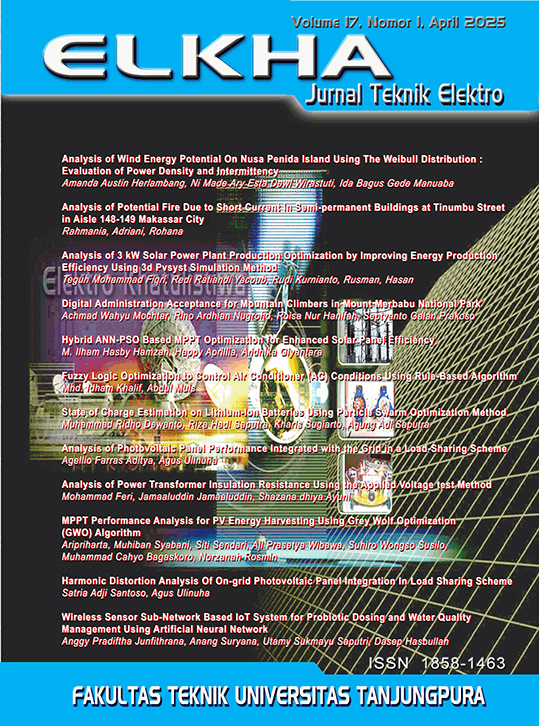
State of Charge Estimation on Lithium-Ion Batteries Using Particle Swarm Optimization Method
DOI:
https://doi.org/10.26418/elkha.v17i1.90020Keywords:
Lithium-Ion, Sensor, State of Charge, Particle Swarm Optimization, Battery Management,Abstract
Lithium-ion battery management is crucial as their use grows in devices and electric vehicles. A key aspect is State of Charge (SoC) estimation, which indicates the battery's charge level at any given time. This research aims to develop a method that can provide accurate SoC estimates for Li-ion batteries using the Particle Swarm Optimization (PSO) method. In this research, a 12V 8.4 Ah Lithium-Ion battery was used as a test subject, utilizing a voltage sensor, ACS712 sensor, and LM35 temperature sensor to measure key parameters such as voltage, current, and temperature. The PSO approach was chosen because of its ability to find optimal solutions in complex search spaces, such as SoC estimation in batteries. Through a combination of the PSO algorithm and data generated from sensors, it is hoped that the SoC estimates produced can improve battery usage efficiency, extend service life, and increase the performance of systems that depend on batteries. PSO can provide more accurate predictions with smaller errors, both in terms of the RMSE value of 0.0391 and the MAPE value of 12.028%. The high accuracy of 87.972% of PSO also shows that this method is reliable for applications that require precise SoC predictions. It is hoped that the results of this research can become a basis for further research in the field of battery management and metaheuristic algorithm optimization. After all, this research aims to enhance battery management systems and deepen understanding of PSO-based SoC estimation.References
Sugeng, B. and Saputra, RH (2019) 'State-Of-Charge Estimation Using Simulink on Solar Power Plant Batteries', ELTIKOM Journal, 3(1), pp. 1–8.
Perdana, FA (2021) 'Lithium Batteries', INQUIRI: Journal of Science Education, 9(2), p. 113.
Farizy, AF and Asfani, DA, 2016. Design of a Battery State of Charge Monitoring System at an Electric Car Charging Station Based on Fuzzy Logic Taking Temperature into Account. ITS Engineering Journal, 5(2), pp. B278-B282.
Kong, X. et al., 2018. State of Health Estimates for Lithium-ion Batteries. ELSEVIER.
Nashirul Haq, et al., 2019. State of Charge (SoC) Estimation of LiFePO4 Battery Module Using Support Vector Regression, ICEVT & IMECE, IEEE.
Jongerden, et al, (2020). Battery Modeling, White Paper/Technical Paper.
Rahmawan, Z. (2018) 'Estimation of State of Charge (Soc) in Lead-Acid Batteries Using the Coulomb Counting Method in Hybrid PV', Its, (0 Surabaya), p. 123.
Muzakkir, I., Syukur, A. & Dewi, IN, 2014. Increasing the Accuracy of the Backpropagation Algorithm with Particle Swarm Optimization Feature Selection in Telecommunication Customer Prediction. Pseudocode Journal, February, 1(1), pp. 1- 10.
Nababan, MG, Regasari, R. and Putri, M. (2017) 'Generation of Belief Values in Dempster-Shafer Using Particle Swarm Optimization (PSO) for Determining Articles of Persecution Cases', Journal of Information Technology and Computer Science Development (J-PTIIK) Brawijaya University, 1(10), pp. 1036–1044.
Ananta, F., Syauqy, D., & Prasetio, BH (2023). Design of an anomaly detection system for solar panels using a microcontroller with the K-Nearest Neighbors algorithm. 7(5), 2305–2312.
Saputra, RH et al. (2023) 'Performance Degradation Evaluation of a Lithium-Ion Battery from Multiple SoC Measurements', Journal of Electrical Engineering (JTE), 14(2).
Widya Suseno, E. and Ma'arif, A. (2022) 'Tuning of PID Controller Parameters with Genetic Algorithm Method on DC Motor', International Journal of Robotics and Control Systems, 1(1), pp. 41–53.
Prabowo, BD, Siregar, IRS, Faidil, A., Alham, NR, & Afandi, MJN (2020). Current and Voltage Measurement in Arduino and Multimeter Based Pltmh Prototypes. Journal of Electronic Media, IX(2), 45–52.
Makruf, A., Ningsih, PS, Jayaditama, W., & Alham, NR (2020). Measurement of Voltage, Current, Power on a PLTS Prototype Based on an Arduin Uno Microcontroller. ScienceETIn, 5(1), 8–16.
Haikal, MA (2021) 'PID Controller Optimization Design for Heating Furnace Temperature Using the Particle Swarm Optimization (PSO) Method'.
Rasyid, A. et al. (2023) 'Human Resource Development Through Basic Robotics Training Using Microcontrollers', Dirkantara Indonesia, 1(2), pp. 55–64.
Dan, BL-, Acquisition, S. and Kalsum, U. (2016) 'Temperature Rate Measurement of Electric Heaters', 2(2), pp. 115–121.
Zunic. E., K.K. (2020). "Application Of Facebook's Prophet Algorithm For Successful Sales Forecasting BASED On Real-World Data". International Journal of Computer Science & Information Technology (IJCSIT)
Muzakki, MA (2021). Analysis of the Prophet Algorithm to Predict Food Prices in Bandung City.
Adhim, A. (2016) 'PID Auto Tuning Using Pso in Two-Axis Solar Tracking Photovoltaic Systems Auto Tuning of PID Controller Using PSO For Two-Axis Solar'.
Syarif, M. et al. (2023) 'CHARGER DESIGN ON LITHIUM-ION BATTERIES AND REGULATED LEAD ACID VALVE USING'.
Suherman, S., Andriyanto, I. and Dwiyatno, Saleh (2015) 'Design and Construction of Server Device Temperature Measuring Tools Using Lm35nin Sensors Free of SMS Gateway', Prosisko, 2(1), pp. 42–63.
Texas Instruments. 2015. Zero-Drift, Bi-Directional Current Power Monitor with I2C Interface Datasheet (Rev. G). Texas: Texas Instruments Inc.
Wahid, IN, Nainggolan, B., & Silanegara, I. (2021). Design and Construction of Current and Voltage Monitoring in Floating Photovoltaics at the Jakarta State Polytechnic Pool. Proceedings of the National Seminar on Mechanical Engineering, Jakarta State Polytechnic, 193–200.
Y. Zhang, C. Wang, H. Ge, and X. Li, "State of charge estimation of lithium-ion battery based on adaptive unscented Kalman filter and improved PSO–BP neural network," Energy Reports, vol. 4, pp. 1–7, Nov. 2018.
J. Li, S. Wang, X. Zhang, Y. Yang, and M. Wu, "A novel state of charge estimation method for lithium-ion batteries using a PSO-based parameter identification approach," Energy, vol. 213, p. 118922, Dec. 2020.
Downloads
Additional Files
Published
Issue
Section
License
Copyright (c) 2025 ELKHA : Jurnal Teknik Elektro

This work is licensed under a Creative Commons Attribution-NonCommercial-ShareAlike 4.0 International License.
1. Proposed Policy for Journals That Offer Open Access
Authors who publish with this journal agree to the following terms:
- Authors retain copyright and grant the journal right of first publication with the work simultaneously licensed under a Creative Commons Attribution License that allows others to share the work with an acknowledgement of the work's authorship and initial publication in this journal.
- Authors are able to enter into separate, additional contractual arrangements for the non-exclusive distribution of the journal's published version of the work (e.g., post it to an institutional repository or publish it in a book), with an acknowledgement of its initial publication in this journal.
- Authors are permitted and encouraged to post their work online (e.g., in institutional repositories or on their website) prior to and during the submission process, as it can lead to productive exchanges, as well as earlier and greater citation of published work (See The Effect of Open Access).
2. Proposed Policy for Journals That Offer Delayed Open Access
Authors who publish with this journal agree to the following terms:
- Authors retain copyright and grant the journal right of first publication, with the work [SPECIFY PERIOD OF TIME] after publication simultaneously licensed under a Creative Commons Attribution License that allows others to share the work with an acknowledgement of the work's authorship and initial publication in this journal.
- Authors are able to enter into separate, additional contractual arrangements for the non-exclusive distribution of the journal's published version of the work (e.g., post it to an institutional repository or publish it in a book), with an acknowledgement of its initial publication in this journal.
- Authors are permitted and encouraged to post their work online (e.g., in institutional repositories or on their website) prior to and during the submission process, as it can lead to productive exchanges, as well as earlier and greater citation of published work (See The Effect of Open Access).
