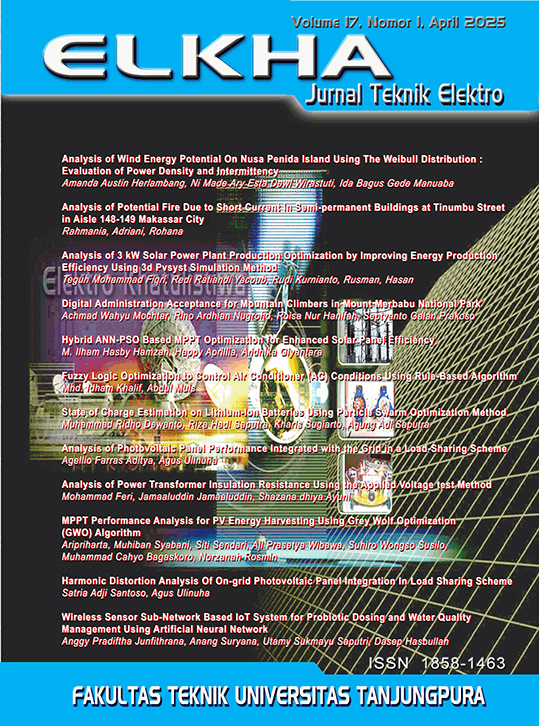
Digital Administration Acceptance for Mountain Climbers in Mount Merbabu National Park
DOI:
https://doi.org/10.26418/elkha.v17i1.90063Keywords:
E-Government, Online Registration, UMEGA, BTNGMb, and Mountain ClimbingAbstract
Adoption of e-government is one of the government's ongoing efforts to improve the standard of public services. Mount Merbabu National Park (BTNGMb) established an online climbing registration system and assessed the carrying capacity of the area. This is also an effort to protect natural areas for conservation. Users continue to voice complaints about the system. Therefore, the goal of this study is to determine the factors influencing the frequency of usage of the online climbing registration system available from the Mount Merbabu National Park Office. The analytical tool was the Unified Model of Electronic Government Adoption (UMEGA). In this study, associative quantitative methods and convenience sampling are employed. The questionnaire was given to one hundred participants, each of whom was registered and led a climbing group. The acquired data was evaluated using the partial least squares structural equation modeling (PLS-SEM) technique using the SmartPLS 4.1.0.3 application. The results show that the UMEGA model can predict the interest of 73.5% of respondents in using BTNGMb's online climbing registration system, while factors outside the scope of this study affect the remaining respondents. The five UMEGA variables"”user attitudes, societal influence, business expectations, performance expectations, and facility circumstances"”have a favorable effect on interest in using BTNGMb's online registration system. Perceived risk has little effect on enthusiasm in using BTNGMb's online climbing registration system in the interim. These findings can be used, particularly for the Mount Merbabu National Park Office, as evaluation material and input while developing an online climbing registration system.
References
Y. E. Rachmad et al., Layanan Dan Tata Kelola E-Government : Teori, Konsep Dan Penerapan. PT. Green Pustaka Indonesia, 2024.
E. Elistia, “Perkembangan dan Dampak Pariwisata di Indonesia Masa Pandemi Covid-19,†Prosiding Konferensi Nasional Ekonomi Manajemen dan Akuntansi (KNEMA), vol. 1, no. 1, Mar. 2021.
R. Komalasari, P. Pramesti, and B. Harto, “Teknologi Informasi E-Tourism Sebagai Strategi Digital Marketing Pariwisata,†altasia, vol. 2, no. 2, 2020.
F. W. Sabila and E. Y. Purwanti, “Pendakian di Jawa Tengah : Motivasi Ekowisata dan Perilaku Wisatawan,†Jurnal Dinamika Ekonomi Pembangunan, vol. 2, no. 3, pp. 67–86, Feb. 2020.
A. Suwarno, E. Edora, and R. Hamimi, “Pemodelan Aplikasi Pemesanan E-Tiket pendakian Gunung Berbasis Android,†TeknoIS : Jurnal Ilmiah Teknologi Informasi dan Sains, vol. 13, no. 1, pp. 133–145, Feb. 2023.
L. N. Malasari, W. H. N. Putra, and W. Purnomo, “Pengembangan Sistem e-Ticketing pada Dander Water Park menggunakan Digital Payment,†Jurnal Pengembangan Teknologi Informasi dan Ilmu Komputer, vol. 5, no. 8, 2021.
N. Anggit P, “Aplikasi Informasi Pendakian Gunung di Pulau Jawa Berbasis Windows Phone,†other, UPN “Veteran†Yogyakarta, 2015.
M. Ali, S. A. Raza, C. H. Puah, and T. Arsalan, “Does e-government control corruption? Evidence from South Asian countries,†Journal of Financial Crime, vol. 29, no. 1, pp. 258–271, May 2021.
Hadad, M.D. Financial Technologi (FinTech) di Indonesia. IBS. 2017.
D. Y. Prasetyo, “Analisis Penerimaan Informasi Pengguna Website Dengan Menggunakan Technology Acceptance Model (Studi Kasus : dpmd.inhilkab.go.id),†Selodang Mayang: Jurnal Ilmiah Badan Perencanaan Pembangunan Daerah Kabupaten Indragiri Hilir, vol. 6, no. 3, pp. 178–187, Dec. 2020.
A. A. Alalwan, Y. K. Dwivedi, and N. P. Rana, “Factors influencing adoption of mobile banking by Jordanian bank customers: Extending UTAUT2 with trust,†Int. J. Inf. Manage., vol. 37, no. 3, pp. 99–110, Jun. 2017.
R. A. Nugroho, “Electronic government adoption in developing countries: The case of the Indonesian electronic procurement system,†PhD, The University of Queensland, 2015.
R. Romadhon and G. Kusuma, “Sistem Informasi Booking Wisata Pendakian Melalui Online Di Kawasan Gunung PRAU Dataran Tinggi Dieng Jawa Tengah,†Journal of Informatics and Advanced Computing , vol. 2, no. 1, May 2021.
R. Fahrezi and Y. Asriningtias, “Model Aplikasi Sistem Booking Pendakian Gunung Sindoro Berbasis Android (Studi Kasus: Basecamp Pajero),†Jutisi: Jurnal Ilmiah Teknik Informatika dan Sistem Informasi, vol. 13, no. 3, Dec. 2024.
M. R. Firnando and E. Effiyaldi, “Sistem Informasi Pendaftaran Surat Izin Masuk Kawasan Konservasi (SIMAKSI) Pada Jalur Pendakian Gunung Kerinci Dan Danau Gunung Tujuh Berbasis Web,†MANAJEMEN SISTEM INFORMASI, vol. 7, no. 1, Mar. 2022.
I. S. M. Negara and F. M. Savitri, “Analisis Penerimaan Pengguna Sistem Informasi Akademik, Studi Kasus STIKES Harapan Bangsa,†Solusi, vol. 17, no. 3, Oct. 2019.
Y. K. Dwivedi, N. P. Rana, M. Janssen, B. Lal, M. D. Williams, and M. Clement, “An empirical validation of a unified model of electronic government adoption (UMEGA),†Gov. Inf. Q., vol. 34, no. 2, pp. 211–230, Apr. 2017.
A. Juliandi, “Structural Equation Model Partial Least Square (SEM-PLS) dengan SmartPLS,†May 2018, doi: https://doi.org/10.5281/zenodo.1243777.
I. Ghozali, Structural Equation Modeling Metode Alternatif dengan Partial Least Squares (PLS). Badan Penerbit Universitas Diponegoro, 2014.
I. Ghozali and H. Latan, Partial Least Squares : Konsep, Teknik dan Aplikasi Menggunakan Program SmartPLS 3.0. Badan Penerbit Undip, 2015.
J. F. Hair Jr, G. T. M. Hult, C. M. Ringle, M. Sarstedt, N. P. Danks, and S. Ray, Partial Least Squares Structural Equation Modeling (PLS-SEM) Using R: A Workbook. Springer International Publishing, 2021.
M. Sarstedt, C. M. Ringle, and J. F. Hair, “Partial Least Squares Structural Equation Modeling,†in Handbook of Market Research, C. Homburg, M. Klarmann, and A. Vomberg, Eds. Cham: Springer International Publishing, 2022, pp. 587–632.
W. W. Chin and G. Morcoulides, “The Partial Least Squares Approach to Structural Equation Modeling,†Advances in Hospitality and Leisure, Jan. 1998.
J. F. Hair, J. J. Risher, M. Sarstedt, and C. M. Ringle, “When to use and how to report the results of PLS-SEM,†European Business Review, vol. 31, no. 1, pp. 2–24, Jan. 2019.
J. F. Hair, G. T. M. Hult, C. M. Ringle, and M. Sarstedt, A Primer on Partial Least Squares Structural Equation Modeling (PLS-SEM). Sage Publishing, 2022.
H. Latan and I. Ghozali, Kuadrat Terkecil Parsial: Konsep, Teknik dan Aplikasi menggunakan SmartPLS 3. Diponegoro University Press, 2015.
J. Henseler, C. M. Ringle, and M. Sarstedt, “A new criterion for assessing discriminant validity in variance-based structural equation modeling,†Journal of the Academy of Marketing Science, vol. 43, no. 1, pp. 115–135, Jan. 2015.
J. F. Hair Jr, M. Sarstedt, L. Hopkins, and V. G. Kuppelwieser, “Partial least squares structural equation modeling (PLS-SEM),†Eur. Bus. Rev., vol. 26, no. 2, pp. 106–121, Mar. 2014.
V. Venkatesh, M. G. Morris, G. B. Davis, and F. D. Davis, “User Acceptance of Information Technology: Toward a Unified View,†Miss. Q., vol. 27, no. 3, pp. 425–478, 2003.
A. Faroqi, T. L. M. Suryanto, and E. M. Safitri, “The Determinant of E-Government Services Adoption among Citizen in Indonesia,†in 2020 6th Information Technology International Seminar (ITIS), 2020, pp. 130–134.
Y. Zhao, H. Wang, Z. Guo, M. Huang, Y. Pan, and Y. Guo, “Online Reservation Intention of Tourist Attractions in the COVID-19 Context: An Extended Technology Acceptance Model,†Sustain. Sci. Pract. Policy, vol. 14, no. 16, p. 10395, Aug. 2022.
R. A. Nugroho, A. D. Susilowati, O. C. Ambarwati, and A. Pratiwi, “Factors Affecting Users’ Acceptance of E-Billing System in Surakarta Tax Office,†ComTech, vol. 9, no. 1, pp. 37–42, Jun. 2018.
B. Antaris, A. Faroqi, and A. Wulansari, “Faktor-Faktor Penerimaan Aplikasi Mobile Rumah Sakit Bhayangkara Surabaya Dengan Metode TAM,†Klik : Kajian Ilmiah Informatika dan Komputer, Jun. 2023.
M. N. Islam, “Factors affecting adoption of self-service E-ticketing technology: A study on heritage sites in Bangladesh,†Heliyon, vol. 9, no. 3, p. e14691, Mar. 2023.
H. Dwijayani, J. R. Septian, and L. T. Harinie, “Pengaruh Persepsi Penggunaan, Efisiensi, Efektif terhadap Kemudahan Pemesanan E-Ticketing Kereta Api,†JPP, vol. 6, no. 1, pp. 59–65, Jun. 2022.
N. G. A. Rismandini, “Analisis Faktor-Faktor Yang Mempengaruhi Perilaku Pengguna Website Tiket Wisata Surabaya Menggunakan UTAUT,†UPN Veteran Jawa Timur, 2022.
D. Y. Pandey and R. A. Nugroho, “Faktor - Faktor Yang Mempengaruhi Penerimaan Pengguna Terhadap Layanan E-SPTPD Di Kota Surakarta,†Publica: Jurnal Pemikiran Administrasi Negara, vol. 12, no. 2, pp. 70–82, Dec. 2020.
M. D. P. Kusuma and U. Pribadi, “Faktor-Faktor Yang Mempengaruhi Niat Perilaku Pengguna Aplikasi ‘Jogja Istimewa’ Melalui Model Umega,†Moderat: Jurnal Ilmiah Ilmu Pemerintahan, vol. 6, no. 4, 2020.
Kominfo, “Status Literasi Digital di Indonesia 2022,†Kominfo : Jakarta, 2023.
Downloads
Additional Files
Published
Issue
Section
License
Copyright (c) 2025 ELKHA : Jurnal Teknik Elektro

This work is licensed under a Creative Commons Attribution-NonCommercial-ShareAlike 4.0 International License.
1. Proposed Policy for Journals That Offer Open Access
Authors who publish with this journal agree to the following terms:
- Authors retain copyright and grant the journal right of first publication with the work simultaneously licensed under a Creative Commons Attribution License that allows others to share the work with an acknowledgement of the work's authorship and initial publication in this journal.
- Authors are able to enter into separate, additional contractual arrangements for the non-exclusive distribution of the journal's published version of the work (e.g., post it to an institutional repository or publish it in a book), with an acknowledgement of its initial publication in this journal.
- Authors are permitted and encouraged to post their work online (e.g., in institutional repositories or on their website) prior to and during the submission process, as it can lead to productive exchanges, as well as earlier and greater citation of published work (See The Effect of Open Access).
2. Proposed Policy for Journals That Offer Delayed Open Access
Authors who publish with this journal agree to the following terms:
- Authors retain copyright and grant the journal right of first publication, with the work [SPECIFY PERIOD OF TIME] after publication simultaneously licensed under a Creative Commons Attribution License that allows others to share the work with an acknowledgement of the work's authorship and initial publication in this journal.
- Authors are able to enter into separate, additional contractual arrangements for the non-exclusive distribution of the journal's published version of the work (e.g., post it to an institutional repository or publish it in a book), with an acknowledgement of its initial publication in this journal.
- Authors are permitted and encouraged to post their work online (e.g., in institutional repositories or on their website) prior to and during the submission process, as it can lead to productive exchanges, as well as earlier and greater citation of published work (See The Effect of Open Access).
