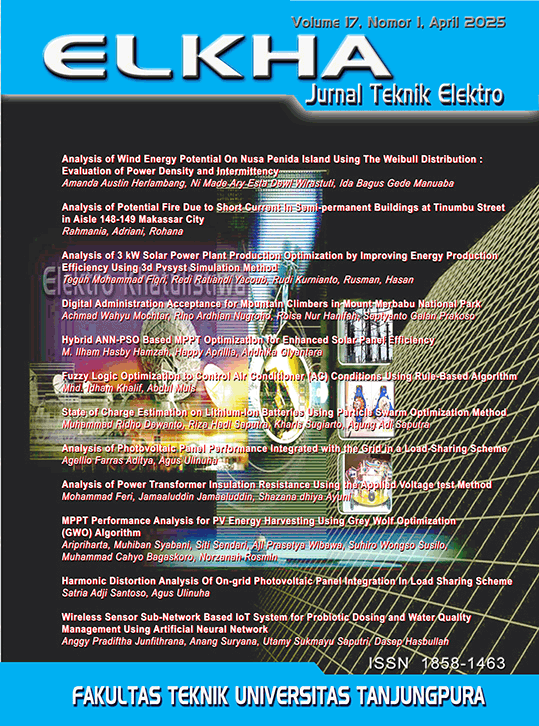
Analysis of Photovoltaic Panel Performance Integrated with the Grid in a Load-Sharing Scheme
DOI:
https://doi.org/10.26418/elkha.v17i1.91191Keywords:
Photovoltaic panels, load sharing scheme, grid connected system, renewable energy.Abstract
This paper examines the performance of photovoltaic panels integrated into the electrical grid in a load-sharing scheme at Darool Ehsan Muhammadiyah Senior High School, Sragen. The study is part of Universitas Muhammadiyah Surakarta's community service program focused on renewable energy development in educational environments. Unlike previous studies relying on simulated data, this research uses real-time primary data from direct measurements of photovoltaic power production and grid electricity consumption over a specific period. The study"™s innovation lies in analyzing the photovoltaic system within a tropical climate-based load-sharing scheme and comparing energy usage when connected to photovoltaic panels versus when disconnected. It also evaluates the impact of reducing solar energy consumption from the grid. The collected data reveal an estimated daily load of 49.89 kWh, with PLN-supplied energy consistently exceeding inverter-supplied energy. Integration of photovoltaic panels into the grid reduces PLN electricity consumption by up to 30% during optimal sunlight periods, achieving an average system efficiency of 15%. This research offers valuable insights into the potential and challenges of implementing photovoltaic panels in educational settings, emphasizing the importance of climate considerations in system design and optimization. Future studies will focus on techno-economic evaluations of solar power installations and harmonic distortion (THD) analysis for larger-scale implementations.
References
Y. G. Sitorus, B. Widodo, and R. Purba, “Perancangan Pembangkit Listrik Tenaga Surya Sistem On-Grid di Atap Gedung untuk Memenuhi Kebutuhan Energi Listrik Fakultas Teknik Universitas Kristen Indonesia – Jakarta,†Lektrokom J. Ilm. Tek. Elektro, vol. 5, no. 1, pp. 47–57, 2022.
Esdm.go.id, “Konsumsi Listrik Masyarakat Meningkat, Tahun 2023 Capai 1.285 kWh/Kapita,†esdm.go.id. [Online]. Available: https://www.esdm.go.id/id/media-center/arsip-berita/konsumsi-listrik-masyarakat-meningkat-tahun-2023-capai-1285-kwh-kapita
A. E. Setyono and B. F. T. Kiono, “Dari Energi Fosil Menuju Energi Terbarukan: Potret Kondisi Minyak dan Gas Bumi Indonesia Tahun 2020 – 2050,†J. Energi Baru dan Terbarukan, vol. 2, no. 3, pp. 154–162, 2021.
M. Qaraad, S. Amjad, N. K. Hussein, M. Badawy, S. Mirjalili, and M. A. Elhosseini, “Photovoltaic parameter estimation using improved moth flame algorithms with local escape operators,†Comput. Electr. Eng., vol. 106, no. September 2022, p. 108603, 2023.
A. Kharisma, S. Pinandita, and A. E. Jayanti, “Literature Review: Kajian Potensi Energi Surya Alternatif Energi Listrik,†J. Energi Baru dan Terbarukan, vol. 5, no. 2, pp. 145–154, 2024.
M. R. D. Abdilla, N. A. Windarko, and B. Sumantri, “Photovoltaic energy harvesting booster under partially shaded conditions using MPPT based sand cat swarm optimizer,†J. Mechatronics, Electr. Power, Veh. Technol., vol. 15, no. 1, pp. 42–56, 2024.
L. Ramdhan, D. Pravitasari, and A. A. Setiawan, “Kinerja Pembangkit Listrik Tenaga Surya (PLTS) Atap On-Grid Residensial Berkapasitas 46,6 Kwp Serpong, Tangerang,†J. Electr. Eng. Comput. Inf. Technol., vol. 4, no. 1, pp. 35–42, 2023.
Y. Moa, A. Uji Krismanto, I. Budi Sulistiawati Teknik Elektro, and I. Magnetika, Teknologi Nasional, “Analisis Pengaruh Integrasi PLTS ON-GRID Terhadap Stabilitas Tegangan Sistem Distribusi Listrik Maumere Pada Penyulang Geliting,†vol. 8, pp. 384–394, Vol 8 No.1, 2024.
M. A. A. Allah, “Feasibility Analysis of Grid-Connected Solar Photovoltaic Systems in Dhahran and Bisha, Saudi Arabia,†J. Ecol. Eng., vol. 25, no. 9, pp. 260–271, 2024.
M. I. Maulana, V. Naubnome, and J. Sumarjo, “Pengaruh iradiasi dan temperatur terhadap efisiensi daya keluaran pada pemodelan photovoltaic canadian solar 270 wp The effect of irradiation and temperature on output power efficiency in 270 Wp Canadian solar photovoltaic modeling,†vol. 19, pp. 176–181, 2021.
R. R. Ramadhana, M. M. Iqbal, A. Hafid, and Adriani, “Analisis Plts on Grid,†J. Tek. Elektro UNISMUH, vol. 14, no. 1, pp. 12–25, 2022.
A. R. Amelia, Y. M. Irwan, W. Z. Leow, M. Irwanto, I. Safwati, and M. Zhafarina, “Investigation of the effect temperature on photovoltaic (PV) panel output performance,†Int. J. Adv. Sci. Eng. Inf. Technol., vol. 6, no. 5, pp. 682–688, 2016.
S. Shelar, D. Bankar, and S. Bakre, “Review of revisions of IEEE 519 Standard on Power System Harmonics (1981 to 2022),†Proc. Int. Conf. Harmon. Qual. Power, ICHQP, pp. 415–420, 2024.
R. T. L. per Kw. B. J. 2025, “Rincian Tarif Listrik per KWh Berlaku Januari 2025â€, [Online]. Available: https://money.kompas.com/read/2025/01/02/212654526/rincian-tarif-listrik-per-kwh-berlaku-januari-2025?lgn_method=google&google_btn=onetap
Downloads
Additional Files
Published
Issue
Section
License
Copyright (c) 2025 ELKHA : Jurnal Teknik Elektro

This work is licensed under a Creative Commons Attribution-NonCommercial-ShareAlike 4.0 International License.
1. Proposed Policy for Journals That Offer Open Access
Authors who publish with this journal agree to the following terms:
- Authors retain copyright and grant the journal right of first publication with the work simultaneously licensed under a Creative Commons Attribution License that allows others to share the work with an acknowledgement of the work's authorship and initial publication in this journal.
- Authors are able to enter into separate, additional contractual arrangements for the non-exclusive distribution of the journal's published version of the work (e.g., post it to an institutional repository or publish it in a book), with an acknowledgement of its initial publication in this journal.
- Authors are permitted and encouraged to post their work online (e.g., in institutional repositories or on their website) prior to and during the submission process, as it can lead to productive exchanges, as well as earlier and greater citation of published work (See The Effect of Open Access).
2. Proposed Policy for Journals That Offer Delayed Open Access
Authors who publish with this journal agree to the following terms:
- Authors retain copyright and grant the journal right of first publication, with the work [SPECIFY PERIOD OF TIME] after publication simultaneously licensed under a Creative Commons Attribution License that allows others to share the work with an acknowledgement of the work's authorship and initial publication in this journal.
- Authors are able to enter into separate, additional contractual arrangements for the non-exclusive distribution of the journal's published version of the work (e.g., post it to an institutional repository or publish it in a book), with an acknowledgement of its initial publication in this journal.
- Authors are permitted and encouraged to post their work online (e.g., in institutional repositories or on their website) prior to and during the submission process, as it can lead to productive exchanges, as well as earlier and greater citation of published work (See The Effect of Open Access).
