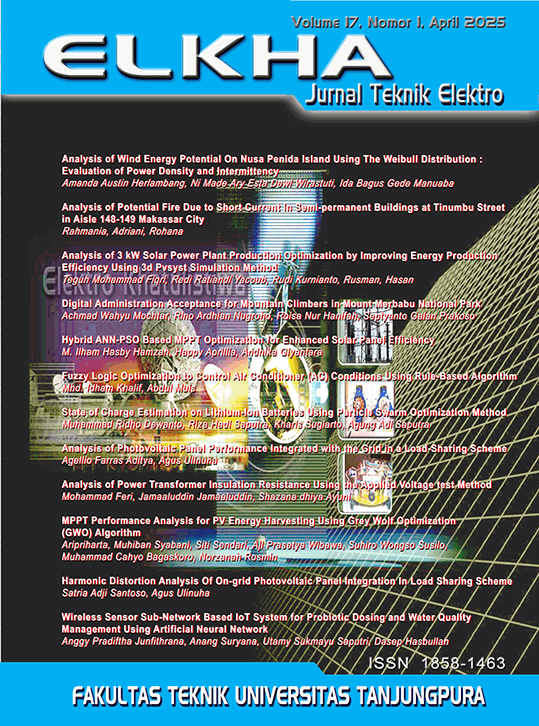
MPPT Performance Analysis for PV Energy Harvesting Using Grey Wolf Optimization (GWO) Algorithm
DOI:
https://doi.org/10.26418/elkha.v17i1.91643Keywords:
Gray Wolf Optimization, MPPT, Photovoltaic, Solar Power PlantAbstract
Renewable energy is a key solution to meeting the growing demand for electricity while reducing reliance on non-renewable sources. Among various renewable technologies, photovoltaic (PV) systems are widely used in solar power plants (PLTS) to harness solar energy. However, PV efficiency is affected by environmental factors such as fluctuating solar irradiance and temperature, which cause instability in output voltage and power. To address these issues, Maximum Power Point Tracking (MPPT) techniques are applied to optimize power extraction. This study proposes the Grey Wolf Optimization (GWO) algorithm for MPPT and evaluates its performance through MATLAB/SIMULINK simulations under varying irradiance and temperature conditions. Inspired by the hunting behavior and social hierarchy of grey wolves, GWO dynamically adjusts the converter's duty cycle based on real-time voltage and current measurements to maximize output power. The study focuses on PV systems in Malang, Indonesia, and compares GWO with the Particle Swarm Optimization (PSO) method in terms of accuracy and stability. The results indicate that increased solar irradiance substantially enhances PV power output, while rising temperatures tend to reduce efficiency. The GWO algorithm achieves an average tracking accuracy of 94.5632%, slightly lower than the 96.9851% achieved by PSO. However, GWO demonstrates superior performance in terms of stability, with faster convergence and reduced oscillations during the tracking process. A comparison of system performance before and after applying the GWO method shows notable improvements in tracking consistency and power extraction efficiency, especially under dynamic environmental changes. The novelty of this study lies in its use of real-world environmental data collected over a 30-day period in a tropical setting, which is rarely addressed in previous GWO-based MPPT research. These findings highlight the potential of the GWO-based MPPT strategy to enhance PV system reliability and efficiency in real-time renewable energy applications.
References
Kementerian Energi dan Sumber Daya Mineral, "Matahari untuk PLTS di Indonesia - Google Search". [Online]. Tersedia: https://www.esdm.go.id. [Diakses: 25 Februari 2023].
R. Faulianur, I. D. Sara, and F. Arnia, "Simulasi Pelacakan Titik Daya Maksimum Modul Surya dengan Metode Grey Wolf Optimization," Jurnal Rekayasa Elektrika, vol. 14, no. 1, pp. 26-34, Apr. 2018.
N. Femia, G. Petrone, G. Spagnuolo, and M. Vitelli, "Optimization of Perturb and Observe Maximum Power Point Tracking Method," IEEE Trans. Power Electron., vol. 20, no. 4, pp. 963-973, Jul. 2005.
D. Debnath, N. Soren, A. D. Pandey, and N. H. Barbhuiya, "Improved Grey Wolf assists MPPT Approach for Solar Photovoltaic System under Partially Shaded and Gradually Atmospheric Changing Condition," Int. Energy J., vol. 20, pp. 87-100, 2020.
Kementerian Energi dan Sumber Daya Mineral, "Potensi Energi Baru Terbarukan (EBT) Indonesia - Google Search". [Online]. Tersedia: https://www.esdm.go.id. [Diakses: 3 Maret 2023].
R. A. Aurelia, Optimalisasi Daya Output Permanent Magnet Synchronous Generator (PMSG) pada Pembangkit Listrik Tenaga Bayu dengan Metode Grey Wolf Optimization (GWO). [Skripsi, Fakultas Teknik Universitas Negeri Malang] 2021.
Aripriharta et al., "The Performance of a New Heuristic Approach for Tracking Maximum Power of PV Systems," Hindawi Appl. Comput. Intell. Soft Comput., vol. 2022, 2022.
D. Darmansyah, Robandi, and I. "Photovoltaic Parameter Estimation Using Grey Wolf Optimization," in 2017 3rd International Conference on Control, Automation and Robotics, pp. 593-597, 2017.
NASA Prediction Of Worldwide Energy Resources, "Data Access Viewer - Google Search." [Online]. Tersedia: https://power.larc.nasa.gov. [Diakses: 5 Februari 2023].
Asosiasi Energi Surya Indonesia, "Indonesia Solar Map - Google Search". [Online] Tersedia: https://indonesiasolarmap.com. [Diakses: 5 Februari 2023].
A. Pandey and S. Pattnaik, "Design and Analysis of Extendable Switched-Inductor and Capacitor-Divider Network Based High-Boost DC-DC Converter for Solar PV Application," IEEE Access, vol. 10, pp. 66992-67007, 2022.
N. Hidayatullah, "Analisis Performa MPPT Berbasis Algoritma QHBM Untuk Mengatasi Kondisi Bayangan pada PV Array," Bachelor's thesis, Faculty of Engineering, Universitas Negeri Malang, 2021.
R. Devarapalli, B. V. Rao, and A. Al-Durra, "Optimal parameter assessment of Solar Photovoltaic module equivalent circuit using a novel enhanced hybrid GWO-SCA algorithm," Energy Rep., vol. 8, pp. 12282-12301, 2022.
A. Niknejad, "Lecture 9: PN Junctions," University of California, Berkeley, 2003
H. Harmini and T. Nurhayati, "Desain Solar Power Inverter pada Sistem Photovoltaic," Elektrika, vol. 12, no. 1, pp. 1-6, 2020.
L. Xu, Z. Xia, R. Cheng, and Z. Shen, "Improved Particle Swarm Optimization (PSO)-based MPPT Method for PV String under Partially Shading and Uniform Irradiance Condition," in Asia Energy and Electrical Engineering Symposium, 2020.
Z. Yang et al., "Analysis of Improved PSO and Perturb & Observe Global MPPT Algorithm for PV Array under Partial Shading Condition," in 29th Chinese Control And Decision Conference (CCDC), 2021.
S. D. Al-Majidi, M. F. Abbod, and H. S. Al-Raweshidy, "Design of an intelligent MPPT based on ANN using a real photovoltaic system data," Int. J. Hydrogen Energy, 2019.
S. K. Zahariev, K. S. Kirilov, and M. Ivanova, "Energy Performance Modeling of а Stand-Alone PV System Using Real Meteorological Data," in Proc. XXVI International Scientific Conference Electronics - ET2017, 2017.
N. Singh, "A modified variant of grey wolf optimizer," Trans. D: Comput. Sci. Eng. Electr. Eng., vol. 27, pp. 1450-1466, 2018.
M. V. Rocha, L. P. Sampaio, and S. Silva, "Comparative Analysis of ABC, Bat, GWO and PSO Algorithms for MPPT in PV Systems," in 8th International Conference on Renewable Energy Research and Application, 2019.
X. Tian, Q. Hu, and C. A. Liu, "An improved Multi-objective Grey Wolf Optimization Algorithm Based on Multiple Strategies," in 2022 International Conference on Computer Engineering and Artificial Intelligence (ICCEAI), 2022.
K. Atici, I. Sefa, and N. Altin, "Grey wolf optimization based MPPT algorithm for solar PV system with SEPIC converter," in 2019 4th International Conference on Power Electronics and their Applications (ICPEA), 2019.
R. S and D. V. S, "GWO based controlling of SEPIC converter in PV fed grid connected single phase system," Microprocessors and Microsystems, p. 103312, 2020.
A. M. Eltamaly and H. M. H. Farh, "Dynamic global maximum power point tracking of the PV systems under variant partial shading using hybrid GWO-FLC," Solar Energy, vol. 177, pp. 306–316, 2019.
X. Ma et al., "Research of photovoltaic systems MPPT based on improved grey wolf algorithm under partial shading conditions," in 2018 2nd IEEE Conference on Energy Internet and Energy System Integration (EI2), 2018.
L. Jing, B. Song, Y. Zhu, B. Yang, and H. Shu, "Grey Wolf optimizer based MPPT control of centralized thermoelectric generator applied in thermal power stations," in 2020 Asia Energy and Electrical Engineering Symposium (AEEES), 2020.
S. Mohanty, B. Subudhi, and P. K. Ray, "A Grey Wolf-assisted perturb & observe MPPT algorithm for a PV system," IEEE Trans. Energy Conversion, vol. 32, no. 1, pp. 340–347, 2017.
M. V. da Rocha, L. P. Sampaio, and S. A. Oliveira da Silva, “Comparative analysis of ABC, Bat, gwo and PSO algorithms for MPPT in PV systems,†2019 8th International Conference on Renewable Energy Research and Applications (ICRERA), 2019.
Q. A. Sias, I. Fadlika, I. D. Wahyono, and A. Nur Afandi, “Quasi Z-source inverter as MPPT on renewable energy using Grey Wolf Technique,†2018 5th International Conference on Electrical Engineering, Computer Science and Informatics (EECSI), 2018.
F. D. Murdianto, Moh. Z. Efendi, R. E. Setiawan, and A. S. Hermawan, “Comparison method of MPSO, FPA, and GWO algorithm in MPPT SEPIC converter under dynamic partial shading condition,†2017 International Conference on Advanced Mechatronics, Intelligent Manufacture, and Industrial Automation (ICAMIMIA), 2017.
Downloads
Additional Files
Published
Issue
Section
License
Copyright (c) 2025 ELKHA : Jurnal Teknik Elektro

This work is licensed under a Creative Commons Attribution-NonCommercial-ShareAlike 4.0 International License.
1. Proposed Policy for Journals That Offer Open Access
Authors who publish with this journal agree to the following terms:
- Authors retain copyright and grant the journal right of first publication with the work simultaneously licensed under a Creative Commons Attribution License that allows others to share the work with an acknowledgement of the work's authorship and initial publication in this journal.
- Authors are able to enter into separate, additional contractual arrangements for the non-exclusive distribution of the journal's published version of the work (e.g., post it to an institutional repository or publish it in a book), with an acknowledgement of its initial publication in this journal.
- Authors are permitted and encouraged to post their work online (e.g., in institutional repositories or on their website) prior to and during the submission process, as it can lead to productive exchanges, as well as earlier and greater citation of published work (See The Effect of Open Access).
2. Proposed Policy for Journals That Offer Delayed Open Access
Authors who publish with this journal agree to the following terms:
- Authors retain copyright and grant the journal right of first publication, with the work [SPECIFY PERIOD OF TIME] after publication simultaneously licensed under a Creative Commons Attribution License that allows others to share the work with an acknowledgement of the work's authorship and initial publication in this journal.
- Authors are able to enter into separate, additional contractual arrangements for the non-exclusive distribution of the journal's published version of the work (e.g., post it to an institutional repository or publish it in a book), with an acknowledgement of its initial publication in this journal.
- Authors are permitted and encouraged to post their work online (e.g., in institutional repositories or on their website) prior to and during the submission process, as it can lead to productive exchanges, as well as earlier and greater citation of published work (See The Effect of Open Access).
