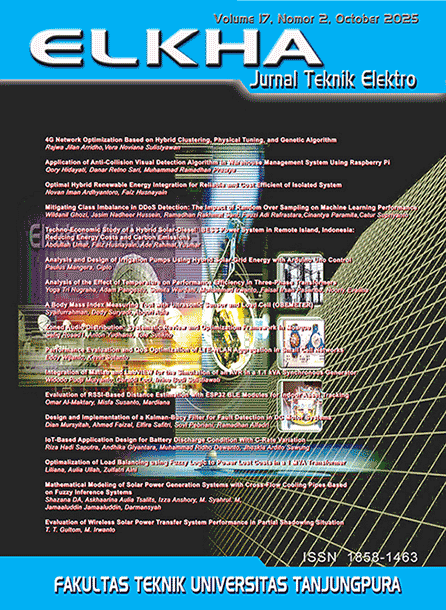
Optimal Hybrid Renewable Energy Integration for Reliable and Cost Efficient of Isolated System
DOI:
https://doi.org/10.26418/elkha.v17i2.93891Keywords:
Optimization of Techno-Economic, Cost Efficiency, Isolated islands, Hybrid System, COE, Net Zero EmissionAbstract
Nusmapi Island is one of Indonesia's isolated islands that rely on Diesel Power Plant (PLTD) with a capacity of 20 kW to meet the electricity needs of its 50 customers. However, this PLTD only operates 12 hours a day due to high operational costs, reaching IDR 215,240,980/year with fuel consumption of 20,889 liters of diesel, equivalent to 17.56 tons with a COE of IDR 7,132/kWh in 2023. The reliance on diesel generators exacerbates ecological harm by releasing COâ‚‚ emissions"”a critical contradiction to Indonesia"™s nationally determined contribution (NDC) under the Paris Agreement, which mandates carbon neutrality by 2060. This research seeks to determine the most effective hybrid energy system design and configuration for Nusmapi Island, evaluating both technical feasibility and economic viability. The technical feasibility was assessed based on the unmet electric load, while the economic feasibility was evaluated using operational costs and the Cost of Energy (COE). The analysis indicates that the optimal system configuration comprises a 8,1-kW solar photovoltaic array, a 20-kW diesel generator, a 12-kW inverter, and five battery units housed within a single compartment. This configuration in real implementation will be able to produce 61,193 kWh/year, thereby increasing the power hours to 24 hours and reducing the unmet electric load to 0%. It will have a COE of IDR 3,280/kWh and will result in a fuel consumption reduction of 3,661 liters/year and operational costs of IDR 30,692,119/year. In addition, this configuration has environmental advantages with a renewable fraction reaching 18.3%References
Badan Pusat Statistik Kabupaten Manokwari, Luas Daerah dan Jumlah Pulau Menurut Kecamatan di Kabupaten Manokwari, 2019.
PT PLN (Persero) UP3 Manokwari, Data Sekunder Pengusahaan PLTD Pulau Nusmapi, 2023.
Kementerian Energi dan Sumber Daya Mineral, Rencana Usaha Penyediaan Tenaga Listrik (RUPTL) 2021–2030 PT PLN (Persero), Jakarta, 2021.
Kementerian Energi dan Sumber Daya Mineral, "Website resmi," [Online]. Available: https://www.esdm.go.id/. [Accessed: Jan. 18, 2024].
G. L. Morrison and Sudjito, “Solar radiation data for indonesia,†Sol. Energy, vol. 49, no. 1, pp. 65–76, 1992, doi: 10.1016/0038-092X(92)90128-W.
D. H. Sinaga, Desain dan Analisis Ekonomi Microgrid Berbasis Energi Terbarukan untuk Elektrifikasi Pedesaan di Sumatera Utara, Master's thesis, Universitas Gadjah Mada, Yogyakarta, 2018.
Z. D. Kurnaini et al., Optimalisasi BPDLH dalam Pengembangan Energi Terbarukan di Sektor Ketenagalistrikan, Badan Kebijakan Fiskal Kementerian Keuangan, Jakarta, 2021. [Online]. Available:https://fiskal.kemenkeu.go.id/files/berita%20kajian/file/kajian%20BPDLH.pdf. [Accessed: Sep. 24, 2021]
M. Thirunavukkarasu, H. Lala, and Y. Sawle, “Techno-economic-environmental analysis of off-grid hybrid energy systems using honey badger optimizer,†Renew. Energy, vol. 218, Dec. 2023, doi: 10.1016/j.renene.2023.119247.
M. A. Omar, “Techno-economic analysis of PV/diesel/battery hybrid system for rural community electrification: A case study in the Northern West Bank,†Energy, vol. 317, Feb. 2025, doi: 10.1016/j.energy.2025.134770.
R. Rajbongshi and A. Rajkumari, “Optimization and economic analysis of hybrid renewable energy system,†Energy, vol. 317, Feb. 2025, doi: 10.1016/j.energy.2025.134689.
H. P. Kumar et al., "Techno-economic optimization andsensitivity analysis of off-grid hybrid renewable energysystems: A case study for sustainable energy solutions in rural India," Results in Engineering, vol. 25, 2025, Art. no. 103674.
A. S. Aziz, M. F. N. Tajuddin, T. E. K. Zidane, C. L. Su, A. J. K. Alrubaie, and M. J. Alwazzan, “Techno-economic and environmental evaluation of PV/diesel/battery hybrid energy system using improved dispatch strategy,†Energy Reports, vol. 8, pp. 6794–6814, Nov. 2022, doi: 10.1016/j.egyr.2022.05.021.
A. A. Patil, R. Arora, R. Arora, and S. N. Sridhara, “Techno-economic analysis of solar, wind and biomass hybrid renewable energy systems in Bhorha village, India,†J. Atmos. Solar-Terrestrial Phys., vol. 265, p. 106362, Dec. 2024, doi: 10.1016/j.jastp.2024.106362.
S. Al Dawsari, F. Anayi, and M. Packianather, "Technoeconomic analysis of hybrid renewable energy systems for cost reduction and reliability improvement using dwarf mongoose optimization algorithm," Energy, vol. 313, 2024, Art. no. 133653
Z. Chen, A. Ghosh, and N. S. A. Lopez, "Optimisation of a standalone photovoltaic electric vehicle charging station using the loss of power supply probability," Energy Advances, vol. 9, 2023, Art. no. e20836.
J. Jung and M. Villaran, "Optimal planning and design of hybrid renewable energy systems for microgrids," Renewable and Sustainable Energy Reviews, vol. 75, pp.93–108, 2017, doi: 10.1016/j.rser.2016.10.061.
F. Nejabatkhah, "Optimal Design and Operation of a Remote Hybrid Microgrid," CPSS Transactions on Power Electronics and Applications, vol. 3, no. 1, pp. 3–13, 2018, doi: 10.24295/cpsstpea.2018.00001
Kementerian Kelautan dan Perikanan, Direktori PulauPulau Kecil Indonesia, [Online]. Available:http://www.ppk3k.kkp.go.id/direktori_pulau/index.php.
F. H. Jufri, B. Sudiarto, and I. Garniwa, "Optimal hybrid renewable energy system design for generation cost reduction and increased electrification in isolated grid in Indonesia," in Proc. 2021 IEEE 4th Int. Conf. Power Energy Appl. (ICPEA), 2021, pp. 147–152.
HOMER Energy, HOMER® Pro Version 3.7 User Manual, Boulder, CO, USA: HOMER Energy, Aug. 2016. [Online]. Available: https://www.homerenergy.com.
Downloads
Additional Files
Published
Issue
Section
License
Copyright (c) 2025 ELKHA : Jurnal Teknik Elektro

This work is licensed under a Creative Commons Attribution-NonCommercial-ShareAlike 4.0 International License.
1. Proposed Policy for Journals That Offer Open Access
Authors who publish with this journal agree to the following terms:
- Authors retain copyright and grant the journal right of first publication with the work simultaneously licensed under a Creative Commons Attribution License that allows others to share the work with an acknowledgement of the work's authorship and initial publication in this journal.
- Authors are able to enter into separate, additional contractual arrangements for the non-exclusive distribution of the journal's published version of the work (e.g., post it to an institutional repository or publish it in a book), with an acknowledgement of its initial publication in this journal.
- Authors are permitted and encouraged to post their work online (e.g., in institutional repositories or on their website) prior to and during the submission process, as it can lead to productive exchanges, as well as earlier and greater citation of published work (See The Effect of Open Access).
2. Proposed Policy for Journals That Offer Delayed Open Access
Authors who publish with this journal agree to the following terms:
- Authors retain copyright and grant the journal right of first publication, with the work [SPECIFY PERIOD OF TIME] after publication simultaneously licensed under a Creative Commons Attribution License that allows others to share the work with an acknowledgement of the work's authorship and initial publication in this journal.
- Authors are able to enter into separate, additional contractual arrangements for the non-exclusive distribution of the journal's published version of the work (e.g., post it to an institutional repository or publish it in a book), with an acknowledgement of its initial publication in this journal.
- Authors are permitted and encouraged to post their work online (e.g., in institutional repositories or on their website) prior to and during the submission process, as it can lead to productive exchanges, as well as earlier and greater citation of published work (See The Effect of Open Access).
