Zoned Audio Distribution: Systematic Review and Optimization Framework in Mosque
DOI:
https://doi.org/10.26418/elkha.v17i2.96757Keywords:
mosque acoustics, sound intelligibility, zoned distribution, speaker placement, DSP, psychoacoustics, STI, RT60Abstract
The acoustics of mosques present significant challenges due to their substantial spatial dimensions, highly reflective surfaces, and intricate architectural designs. These characteristics frequently compromise the clarity of sound, which is imperative for religious activities such as sermons and prayers. Despite global advancements in audio technology, centralized sound systems remain the most common choice in many mosques worldwide. However, this approach frequently results in issues such as uneven sound distribution, acoustic dead zones, and excessive reverberation. These factors significantly impact speech intelligibility and overall listener comfort. To address this critical issue, this study presents a systematic literature review spanning from 2003 to 2025. This research also incorporates an initial empirical survey conducted on 77 mosques in Indonesia to provide real-world validation. The survey results empirically corroborated the theoretical problems, revealing that 65% of respondents considered the sound unclear, and less than 50% expressed satisfaction with the current audio system. In light of these findings, the present paper puts forth an integrated optimization framework centered on speaker zoning. The framework synthesizes insights from acoustic engineering, psychoacoustics, and predictive modeling to create a holistic, data-driven solution. The model outlined herein provides a procedural framework for future research endeavors, emphasizing the utilization of professional acoustic simulation tools to achieve uniform sound distribution and high speech intelligibility. This methodological approach guarantees that the acoustic solutions are not only scientifically valid but also user-centric and relevant to the congregation's needs.References
L. A. Ali and F. A. Mustafa, “Mosque Typo-Morphological Classification for Pattern Recognition Using Shape Grammar Theory and Graph-Based Techniques,†Buildings, vol. 13, no. 3, Mar. 2023.
A. Elkhateeb, M. Attia, Y. Balila, and A. Adas, “The classification of prayer halls in modern saudi masjids: With special reference to the city of jeddah,†Archnet-IJAR: International Journal of Architectural Research, vol. 12, no. 2, pp. 246–262, 2018.
A. A. Abdou, “Measurement of acoustical characteristics of mosques in Saudi Arabia,†J Acoust Soc Am, vol. 113, no. 3, pp. 1505–1517, Mar. 2003.
H. H. Eldien and H. Al Qahtani, “The acoustical performance of mosques’ main prayer hall geometry in the eastern province, Saudi Arabia,†in Proceedings of the Acoustics 2012 Nantes Conference, Nantes, France, Apr. 2012. Accessed: Mar. 21, 2025. [Online]. Available: https://hal.science/hal-00810652v1
N. Utami, I. Dewi, and N. R. Syamsiyah, “Kualitas Akustik Ruang Utama Masjid Siti Aisyah Surakarta,†SINEKTIKA: Jurnal Arsitektur, vol. 16, no. 2, p. 73, Jul. 2019.
A. Elkhateeb, A. Adas, M. Attia, and Y. Balila, “Are Our Masjids Suffering Excessive Reverberation?†in 23rd International Congress on Sound & Vibration, Athens (Greece): ICSV23, Jul. 2016, pp. 1–8.
H. Hossameldien and A. A. Alshawan, A Case Study on the Impact of Mihrab Geometry. IntechOpen, 2019.
N. Azizah Adnan et al., “Acoustic Quality Levels of Mosques in Batu Pahat,†in IOP Conference Series: Earth and Environmental Science, Institute of Physics Publishing, Apr. 2018.
A. S. Sudarsono, J. Sarwono, K. W. Zakri, N. P. A. Nitidara, and R. D. Tassia, “The perception of sound quality in a mosque,†in AIP Conference Proceedings, American Institute of Physics Inc., Mar. 2019.
N. Finahari and Alfiana, “Developing The Firm Mosque Model As A Public Health Institution Through The Implementation Of Psychoacoustic On Loudspeaker Systems,†Gandrung: Jurnal Pengabdian Kepada Masyarakat, vol. 2, no. 1, pp. 115–129, Mar. 2021.
R. Van Rompaey and M. Moonen, “Sound Zoning in an Ad-hoc Wireless Acoustic Sensor and Actuator Network,†in 2021 29th European Signal Processing Conference (EUSIPCO), Ireland: IEEE, Aug. 2021.
A. R. Othman, C. M. Harith, N. Ibrahim, and S. S. Ahmad, “The Importance of Acoustic Design in the Mosques towards the Worshipers’ Comfort,†Procedia Soc Behav Sci, vol. 234, pp. 45–54, Oct. 2016.
S. S. Johansen, “Sound Zone Interaction in Homes: Studying and Designing for Modification of Personal Soundscapes,†Aalborg University, 2021.
S. Rosad, A. Yudhana, and T. Sutikno, “Initial Study of Public Address Usage in Mosque Audio Systems,†VoteTEKNIKA (Vokasional Teknik Elektronika dan Informatika), vol. 13, no. 1, p. 202, Mar. 2025.
T. Supriyadi, “Perbaikan Kualitas Akustik di Masjid Bahrul Ulum P4TK BMTI Kota Cimahi Dengan Metode Pengaturan Ulang Posisi, Ketinggian Dan Jenis Speaker,†Jurnal Difusi, vol. 6, no. 1, p. 18, Aug. 2023.
B. P. Jati, D. Nugroho, and I. Widihastuti, “Literasi Sistem Audio melalui Revitalisasi, Pembenahan dan Optimisasi Audio di Masjid At-Taqwa Srondol Bumi Indah,†Indonesian Journal of Community Services, vol. 6, no. 2, p. 108, Nov. 2024.
D. A. A. Masih, N. K. Jalal, M. N. A. Mohammed, and S. A. Mustafa, “The Assessment of Acoustical Characteristics for Recent Mosque Buildings in Erbil City of Iraq,†Aro-The Scientific Journal Of Koya University, vol. 9, no. 1, pp. 51–66, Mar. 2021.
H. Hossam Eldien, “Impact of Mosque Geometry on Its Acoustical Performance,†Systems for Sound Waves Fire Extinguishers View project Impact of Mosque Geometry on Its Acoustical Performance, Dec. 2014.
A. A. Elkhateeb, “Effects of Non-Traditional Forms on Masjids Acoustics,†BUILDING ACOUSTICS, vol. 19, no. 2, pp. 119–138, 2012.
N. R. Syamsiyah, A. Dharoko, and S. S. Utami, “Sound preservation at the Grand Mosque of Yogyakarta in Indonesia: The acoustic performance of the traditional architecture,†in AIP Conference Proceedings, American Institute of Physics Inc., Jun. 2018.
F. Y. Sert and Ö. Y. Karaman, “An Investigation on the Effects of Architectural Features on Acoustical Environment of Historical Mosques,†Acoustics, vol. 3, no. 3, pp. 559–580, Sep. 2021.
M. Mariani and N. Rauf, “Deskripsi Kondisi Akustik Ruang Masjid Al Markaz Al Islami Makassar,†Jurnal SMARTek, vol. 6, no. 4, pp. 246–260, Oct. 2008.
T. Tosin, “Perancangan dan Implementasi Komunikasi RS-485 Menggunakan Protokol Modbus RTU dan Modbus TCP Pada Sistem Pick-By-Light,†Komputika : Jurnal Sistem Komputer, vol. 10, no. 1, pp. 85–91, Mar. 2021.
D. Delabie, C. Buyle, B. Cox, L. Van der Perre, and L. De Strycker, “An Acoustic Simulation Framework to Support Indoor Positioning and Data Driven Signal Processing Assessments,†Jun. 2023, [Online]. Available: http://arxiv.org/abs/2305.02715
A. P. Runtulalo, M. R. Rahim, and A. Kusno, “Reverberation Time dan Distribusi Bunyi dalam Ruang,†Jurnal Penelitian Enjiniring, vol. 22, no. 2, pp. 143–154, Nov. 2018.
M. B. Møller and M. Olsen, “Sound Zones: On Envelope Shaping of FIR Filters,†in 24th International Congress on Sound and Vibration 2017 (ICSV 24), London: ICSV24, Jul. 2017, pp. 613–620.
Ö. Y. Karaman and N. O. Güzel, “Acoustical Properties of Contemporary Mosques,†YBL Journal of Built Environment, vol. 5, no. 1, pp. 14–30, Apr. 2017.
A. Kaygısız, F. Semerci, and R. Tuna Sayın, “Acoustic Analysis of the Masjid at Necmettin Erbakan University Köyceğiz Campus in Konya,†Buildings, vol. 14, no. 10, Oct. 2024.
T. Supriyadi, A. Ashari, S. Slameta, T. Utomo, and R. Solihin, “Perancangan dan Implementasi Sistem Tata Suara Masjid dengan Dua Posisi Mimbar yang berbeda,†Jurnal Pengabdian Masyarakat Sultan Indonesia, vol. 2, no. 1, pp. 35–44, Mar. 2025.
M. H. Masridin and A. S. Ismail, “Critical Regionalism Approach For Djami Mosque Design Towards The Aesthetics Of Sustainability,†Journal of Islamic Architecture, vol. 7, no. 2, pp. 220–232, Dec. 2022.
A. N. Handryant, “An Assessment of Acoustic Quality in Mosque Case Study: Masjid At-Tarbiyah UIN Malang,†in Proceedings of the International Conference on Engineering, Technology and Social Science (ICONETOS 2020), Atlantis Press, 2021, pp. 228–233.
E. H. Hossam, B. U. Mohammed, and E. Hammad, “Impact of Mihrab Geometry on The Acoustics of Mosque,†in The 51st International Congress and Exposition on Noise Control Engineering, Glasgow, Scotland: InterNoise 2022, Aug. 2022. [Online]. Available: https://www.researchgate.net/publication/362903895
A. S. Sudarsono, S. J. Sarwono, Z. Muttaqin, and Supriyanto, “Optimizing the Acoustic Condition of a Community Mosque: Simulation-Based Approach,†in Proceedings of the 6th International Conference on Indonesian Architecture and Planning (ICIAP 2022), D. H. and R. Y. and H. I. and A.-F. J. and W. A. Swasto Deva Fosterharoldas and Rahmi, Ed., Singapore: Springer Nature Singapore, 2023, pp. 693–702.
H. Rosseel and W. T. van, “A State-of-the-Art Review on Acoustic Preservation of Historical Worship Spaces through Auralization,†Signal Processing, vol. 234, Mar. 2025.
A. O. Mustafa, F. Gandah, and D. Khraisat, “The Impact of Geometrical Structure of Domes on the Acoustic Performance within Mosques,†Journal of Civil Engineering and Architecture, vol. 13, no. 4, Apr. 2019.
H. H. Eldien, “Evaluation of the influence of Mihrab shape on sound quality in Mosques,†Journal of Engineering Research, pp. 2307–1877, Jun. 2024.
F. Martellotta, M. L. Benferhat, C. Rubino, A. Bouttout, and S. Debache Benzagouta, “Geometrical acoustic modelling of occupied acoustic conditions in mosques: Application to a case study,†Applied Acoustics, vol. 228, Jan. 2025.
T. Lee, J. K. Nielsen, and M. G. Christensen, “Signal-Adaptive and Perceptually Optimized Sound Zones with Variable Span Trade-Off Filters,†IEEE/ACM Trans Audio Speech Lang Process, vol. 28, pp. 2412–2426, 2020.
M. Itani, T. Chen, T. Yoshioka, and S. Gollakota, “Creating speech zones with self-distributing acoustic swarms,†Nat Commun, vol. 14, no. 1, Dec. 2023.
E. Monroy Cruz, “Structuring Cyber-Physical Systems for Distributed,†IEEE Latin America Transactions, vol. 21, no. 2, Feb. 2023.
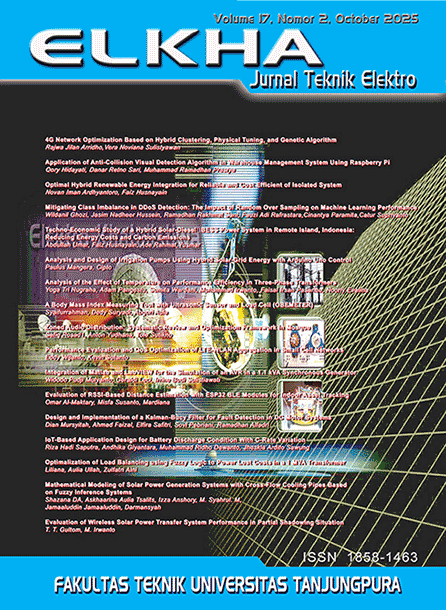
Downloads
Additional Files
Published
Issue
Section
License
Copyright (c) 2025 ELKHA : Jurnal Teknik Elektro

This work is licensed under a Creative Commons Attribution-NonCommercial-ShareAlike 4.0 International License.
1. Proposed Policy for Journals That Offer Open Access
Authors who publish with this journal agree to the following terms:
- Authors retain copyright and grant the journal right of first publication with the work simultaneously licensed under a Creative Commons Attribution License that allows others to share the work with an acknowledgement of the work's authorship and initial publication in this journal.
- Authors are able to enter into separate, additional contractual arrangements for the non-exclusive distribution of the journal's published version of the work (e.g., post it to an institutional repository or publish it in a book), with an acknowledgement of its initial publication in this journal.
- Authors are permitted and encouraged to post their work online (e.g., in institutional repositories or on their website) prior to and during the submission process, as it can lead to productive exchanges, as well as earlier and greater citation of published work (See The Effect of Open Access).
2. Proposed Policy for Journals That Offer Delayed Open Access
Authors who publish with this journal agree to the following terms:
- Authors retain copyright and grant the journal right of first publication, with the work [SPECIFY PERIOD OF TIME] after publication simultaneously licensed under a Creative Commons Attribution License that allows others to share the work with an acknowledgement of the work's authorship and initial publication in this journal.
- Authors are able to enter into separate, additional contractual arrangements for the non-exclusive distribution of the journal's published version of the work (e.g., post it to an institutional repository or publish it in a book), with an acknowledgement of its initial publication in this journal.
- Authors are permitted and encouraged to post their work online (e.g., in institutional repositories or on their website) prior to and during the submission process, as it can lead to productive exchanges, as well as earlier and greater citation of published work (See The Effect of Open Access).
