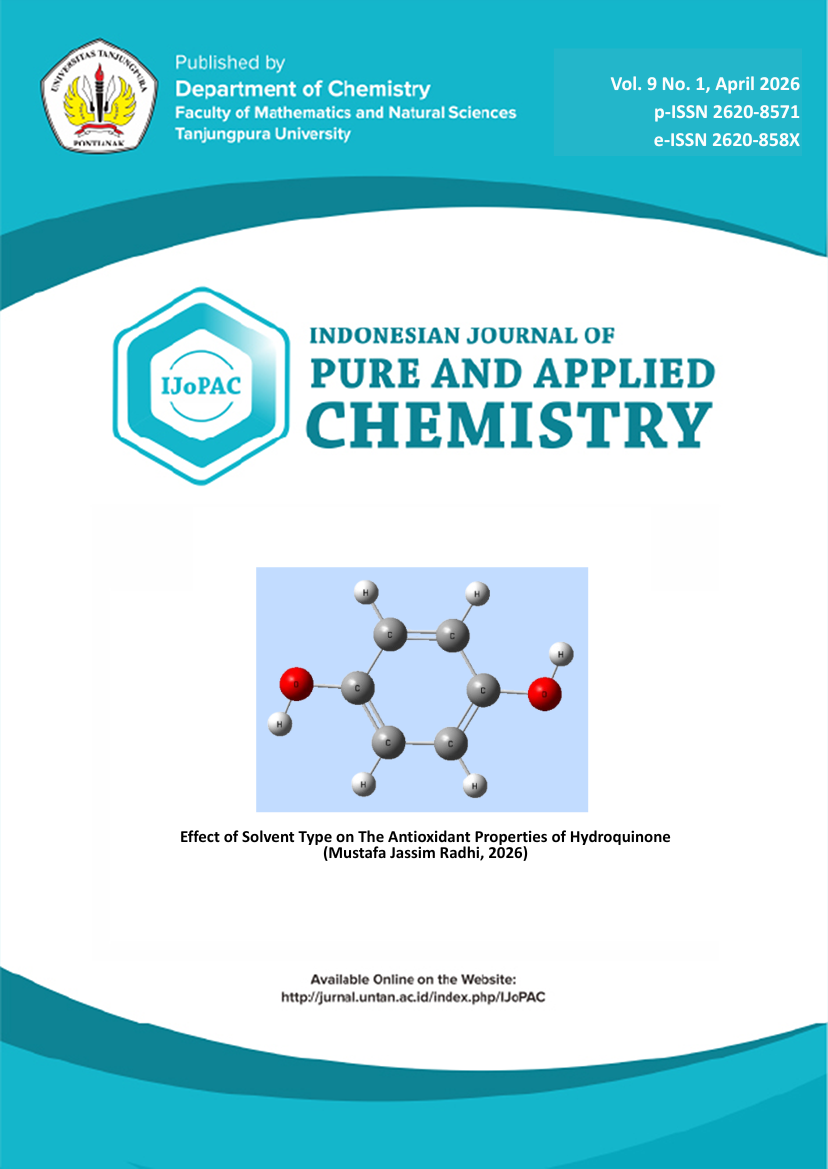
EFFECT OF SOLVENT TYPE ON THE ANTIOXIDANT PROPERTIES OF HYDROQUINONE
DOI:
https://doi.org/10.26418/indonesian.v9i1.101044Abstract
While hydroquinone (HQ) is a vital antioxidant, the precise mechanisms governing its activity—specifically HAT, SET-PT, and SPLET—and their dependencies on solvent environments remain a subject of debate. Standard implicit solvent models often fail to accurately predict these behaviors. In this study, the antioxidant mechanisms of hydroquinone in water, ethanol, and acetone were investigated using two computational approaches: a standard implicit model (PCM) and a hybrid explicit-implicit model. Results from the initial implicit model were found to be inconsistent with experimental observations, incorrectly identifying SET-PT as the dominant mechanism across all media and suggesting acetone as the most favorable solvent (∆G = 585.60 kJ/mol). However, the hybrid model, which accounts for direct solvent participation in proton transfer, revealed that the SPLET mechanism is the dominant pathway in protic solvents. The established order of antioxidant activity is: water (SPLET, 379.7 kJ/mol) > ethanol (SPLET, 479.4 kJ/mol) > acetone (SET-PT, 585.6 kJ/mol). These findings confirm that acetone is the optimal solvent for maintaining hydroquinone stability and underscore the critical necessity of employing hybrid models when simulating proton-coupled electron transfer reactions in protic environments.References
Giner R.M., Ríos J.L., and Máñez S. (2022). Antioxidant Activity of Natural Hydroquinones. Antioxidants, 11(2). doi: 10.3390/antiox11020343.
Chepeleva A.D., Grobov A.M., Sirik A.V., and Pliss E.M. (2021). Antioxidant Activity of Hydroquinone in the Oxidation of 1,4-Substituted Butadiene. Russ. J. Phys. Chem. A, 95(5). doi: 10.1134/S0036024421050071.
Tziveleka L.A., Kourounakis A.P., Kourounakis P.N., Roussis V., and Vagias C. (2002). Antioxidant potential of natural and synthesised polyprenylated hydroquinones. Bioorganic Med. Chem., 10(4). doi: 10.1016/S0968-0896(01)00346-7.
Owolabi J.O., Fabiyi O.S., Adelakin L.A., and Ekwerike M.C. (2020). Effects of skin lightening cream agents - hydroquinone and kojic acid, on the skin of adult female experimental rats. Clin. Cosmet. Investig. Dermatol., 13. doi: 10.2147/CCID.S233185.
Ketkomol P., Chongsa W., and Punjanon T. (2019). Qualitative and quantitative assessment of hydroquinone in skin whitening cosmetics in Pathum Thani Province, Thailand. J. Assoc. Med. Sci., 52(3). doi: 10.14456/jams.2019.28.
Desmedt B. et al. (2017). In vitro Dermal Absorption of Hydroquinone: Protocol Validation and Applicability on Illegal Skin-Whitening Cosmetics. Skin Pharmacol. Physiol., 29(6). doi: 10.1159/000454719.
Raucci U., Chiariello M.G., and Rega N. (2020). Modeling Excited-State Proton Transfer to Solvent: A Dynamics Study of a Super Photoacid with a Hybrid Implicit/Explicit Solvent Model. J. Chem. Theory Comput., 16(11). doi: 10.1021/acs.jctc.0c00782.
Šebesta F., Sovová Ž., and Burda J.V. (2024). Determination of Amino Acids’ pKa: Importance of Cavity Scaling within Implicit Solvation Models and Choice of DFT Functionals. J. Phys. Chem. B, 128(7). doi: 10.1021/acs.jpcb.3c07007.
Shakira R.M., Wahab M.K.A., Nordin N., and Ariffin A. (2022). Antioxidant properties of butylated phenol with oxadiazole and hydrazone moiety at ortho position supported by DFT study. RSC Adv., 12(27). doi: 10.1039/d2ra02140d.
Ma P. and Wang Z. (2023). Density Functional Theory Study on Antioxidant Activity of Three Polyphenols. J. Fluoresc., 33(3). doi: 10.1007/s10895-022-03104-z.
Boulmokh Y., Belguidoum K., Meddour F., and Amira-Guebailia H. (2021). Investigation of antioxidant activity of epigallocatechin gallate and epicatechin as compared to resveratrol and ascorbic acid: experimental and theoretical insights. Struct. Chem., 32(5). doi: 10.1007/s11224-021-01763-5.
Senthil kumar K. and Kumaresan R. (2012). A DFT study on the structural, electronic properties and radical scavenging mechanisms of calycosin, glycitein, pratensein and prunetin. Comput. Theor. Chem., 985. doi: 10.1016/j.comptc.2012.01.028.
Alakbaree M. et al. (2023). A computational study of structural analysis of Class I human glucose-6-phosphate dehydrogenase (G6PD) variants: Elaborating the correlation to chronic non-spherocytic hemolytic anemia (CNSHA). Comput. Biol. Chem., 104. doi: 10.1016/j.compbiolchem.2023.107873.
Bakheit A.H. et al. (2024). Theoretical study of the antioxidant mechanism and structure-activity relationships of 1,3,4-oxadiazol-2-ylthieno[2,3-d]pyrimidin-4-amine derivatives: a computational approach. Front. Chem., 12. doi: 10.3389/fchem.2024.1443718.
Ghosh R., Datta S., Mora A.K., Modak B., Nath S., and Palit D.K. (2023). Dynamics of hydrogen bond reorganization in the S1(ππ*) state of 9-Anthracenecarboxaldehyde. J. Photochem. Photobiol. A Chem., 436. doi: 10.1016/j.jphotochem.2022.114379.
Manian A., Chen Z., Hudson R.J., and Russo S.P. (2024). Simulation of Solvatochromic Phenomena in Xanthione Using Explicit Solvent Methods. Molecules, 29(23). doi: 10.3390/molecules29235609.
Kundu A., Mandal B., Maji B., and Adhikari D. (2023). DFT-Guided Mechanistic Insights into Chemodivergence: A Mixed Explicit–Implicit Solvent Description to Dictate the Chemoselectivity. J. Phys. Chem. A, 127(48). doi: 10.1021/acs.jpca.3c04458.
Kaur C. and Mandal D. (2025). The scavenging mechanism of hydrazone compounds towards HOO˙ and CH 3 OO˙ radicals: a computational mechanistic and kinetic study. RSC Adv., 15(1). doi: 10.1039/D4RA07625G.
Bendaas R. et al. (2024). Computational-based investigation of antioxidative potential polyphenolic compounds of Salvia officinalis L.: combined DFT and molecular docking approaches. J. Mol. Model., 30(3). doi: 10.1007/s00894-024-05866-8.
Moghaddam F.M., Jarahiyan A., Haris M.H., Pazoki P.Y., and Aghamiri B. (2023). High catalytic performance of CoCuFe2O4/ZIF-8(Zn) nanocatalyst for synthesis of new benzimidazole derivatives. J. Mol. Struct., 1285. doi: 10.1016/j.molstruc.2023.135496.
Downloads
Additional Files
Published
Issue
Section
License
Copyright (c) 2026 Mustafa Jassim Radhi

This work is licensed under a Creative Commons Attribution 4.0 International License.
Authors who publish with this journal agree to the following terms: 1. Authors retain copyright and grant the journal the right of first publication, with the work simultaneously licensed under a Creative Commons Attribution License that allows others to share the work with an acknowledgement of the work's authorship and initial publication in this journal. 2. Authors are able to enter into separate, additional contractual arrangements for the non-exclusive distribution of the journal's published version of the work (e.g., post it to an institutional repository or publish it in a book), with an acknowledgement of its initial publication in this journal. 3. Authors are permitted and encouraged to post their work online (e.g., in institutional repositories or on their website) prior to and during the submission process, as it can lead to productive exchanges, as well as earlier and greater citation of published work (see The Effect of Open Access).