ANALISIS UKURAN PARTIKEL SILIKA HASIL EKSTRAKSI DARI BATU PADAS ASAL KABUPATEN KETAPANG KALIMANTAN BARAT
DOI:
https://doi.org/10.26418/indonesian.v1i1.26042Abstract
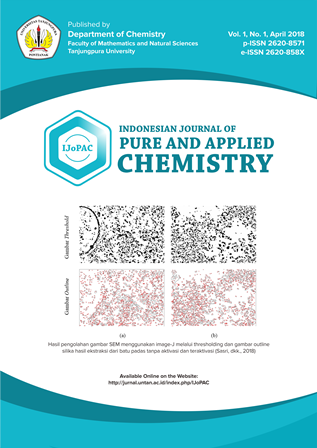
Analysis of particle size of silica was extracted from rocks from Ketapang Regency, West Kalimantan based on characterization using scanning electron microscope (SEM) have been carried out. The analysis was performed to determine the particle size change in extraction silica without and with activation using acid solution. SEM image processing was performed on a 10 μm scale at 350x magnification through the image-J software to determine the particle size distribution. The results of the analysis showed that the area and diameter of the silica particle extracted from rocks were 3,935 μm2 and 3,147 μm (without activation) and 4,28 μm2 and 3,267 μm (activated) respectively.
References
. Grible C. D. Routly’s Elements of Mineralogi. Edisi 27. 1988. Ijnwn Hyman, London.
. Kurniawan C., Waluyo T.B., Sebayang P. Analisis Ukuran Partikel Menggunakan Free Software Image-J. Prosiding Seminar Nasional Fisika. 2011.
. Podlasov A., Eugene A. Working and Development with ImageJ: A Student Reference, Joensuu: Departement of Computer Science, University of Joensuu. 2003.
. Abramoff M. D., Magalhaes P.J., Ram S.J. Image Processing with ImageJ. Biophotonic International. Laurin Publishing. 2004.
. Nurlina, Sasri R., Destiarti L., Syahbanu I. Pengaruh Konsentrasi Larutan NaOH Terhadap Karakteristik Silika Hasil Ekstraksi Dari Batu Padas Asal Kalimantan Barat. Prosiding Seminar Nasional Penerapan Ilmu Pengetahuan dan Teknologi. Universitas Tanjungpura. Pontianak, 23-24 Mei 2017: hlm. 165-169.
Downloads
Published
Issue
Section
License
Copyright (c) 2018 Risya Sasri, Nurlina Nurlina, Lia Destiarti, Intan Syahbanu

This work is licensed under a Creative Commons Attribution 4.0 International License.
Authors who publish with this journal agree to the following terms: 1. Authors retain copyright and grant the journal the right of first publication, with the work simultaneously licensed under a Creative Commons Attribution License that allows others to share the work with an acknowledgement of the work's authorship and initial publication in this journal. 2. Authors are able to enter into separate, additional contractual arrangements for the non-exclusive distribution of the journal's published version of the work (e.g., post it to an institutional repository or publish it in a book), with an acknowledgement of its initial publication in this journal. 3. Authors are permitted and encouraged to post their work online (e.g., in institutional repositories or on their website) prior to and during the submission process, as it can lead to productive exchanges, as well as earlier and greater citation of published work (see The Effect of Open Access).