GREEN SYNTHESIS NANOPARTIKEL PERAK MENGGUNAKAN EKSTRAK DAUN PUCUK IDAT (Cratoxylum glaucum) SEBAGAI BIOREDUKTOR
DOI:
https://doi.org/10.26418/indonesian.v1i2.30533Abstract
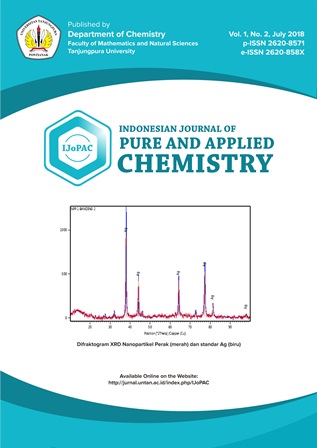
An environment friendly technique for green synthesis of silver nanoparticles has been reported. Silver nanoparticle have been synthesized using water extract of leaves of pucuk idat (Cratoxylum glaucum), commonly known as local Bangka plant. The flavonoid and tannin present in the extract act as reducing agent. AgNO3 0,05 M solution was reducing using the extract at room temperature by stirring. Color changing of the solution was detected at 30 minutes reaction time. The color tends to be darker by the increasing of reaction time. Various techniques used to characterize synthesized nanoparticles are UV-Visible spectrophotometer, x-ray diffraction (XRD) and scanning electron microscopy (SEM). UV-Visible spectrophotometer showed absorbance peak in 405 nm, the XRD shows that silver nanoparticles formed are crystalline. The average particle size of Ag nanoparticles estimated from the Scherrer formula is 35,59 nm, while SEM image shows shape of silver nanoparticle is random and some spherical shape.References
Mahardika, RG dan Roanisca, O. 2018., Antioxidant Activity and Phytochemical of Extract Ethyl Acetat Pucuk Idat (Cratoxylum Glaucum), Indo. J. Chem. Res, 5(2), 481-486 (2018)
Philip, D., Green Synthesis of Gold and Silver Nanoparticles Using Hibiscus rosasinensis, Physica E. 42(5): 1417- 1424 (2010).
Bandyopandhyay, A.K., Nano Material, New Age International Ltd, New Delhi (2008).
Feldheim, D.L and Foss, C.A Jr., Metal nanoparticles ; Sinthesis, characterization and Applications. Marcel Dekker Inc. Switzerland (2002).
Prasad, S.B., Current Understanding of Synthesis and Pharmacological Aspects of Silver Nanoparticles, American Journal of Phytomedicine and Clinical Therapeutics, 1(7): 536-547 (2013).
Caro, C., Castillo, P.M., Klippstein, R., Pozo, D., Zaderenko, A.P. Silver Nanoparticles: Sensing and Imaging Application. University of Seville-UPO-Junta the andalucia-spain, (2010).
Oldenburg, S.J., 2014, Silver Nanoparticles: Properties and Applications. (Online): www.sigmaaldrich.com/materi alsscience/nanomaterials/silvernanoparticles.html. diakses tanggal 10 Juli 2018 (2014).
Sastry.M, Ahmad. A, Khan. M, and Kumar. R, Microbial nanoparticle production, in Nanobiotechnology, ed. by Niemeyer CM and Mirkin CA. Wiley-VCH, Weinheim, 126, (2004).
Bhattacharya D, Rajinder G, Nanotechnology and potential of microorganisms, Crit Rev Biotechnol, 25:199-204, (2005).
Mohanpuria P, Rana Nisha K and Yadav SK, Biosynthesis of nanoparticles: technological concepts and future applications, Journal of Nanoparticle Research 10:507-517, (2008).
Li, L., C. Liu, Z. Liu, R. Tsao and S. Liu, Identification of phenylethanoid glycosides in plant extract of Plantago asiatica L. by liquid chromatography-electrospray ionization mass spectrometry, Chinese J. Chem. 27 : 541-545, (2009).
Vera-Montenegro. Y, F. Ibarra-Velarde, G. Ramirez-Avila and J. Munguia-Xochihua, In vitro fasciolicide activity of some plant extracts against newly excysted flukes, Ann. New York Acad. Sci., 1149:180-182, (2008).
Prabhu, N., T.R. Divya and G. Yamuna, Synthesis of silver phyto nanoparticles and their antibacterial efficacy, Digest J. Nanomater. Biostruct., 5 : 185-189, (2010).
Padmadhas, R. and R. Ragunathan, Effect of lead nano particle present in the leaf of Calotrphis Gigantea which result in the loss of the painted grass hoppe of the Western ghats species in India.Int, J. Nanotechnol. Appl., 3 : 89-96, (2009).
Masakke, Y, Rasyid M, Sulfikar, Biosintesis Nanopartikel Perak Menggunakan Ekstrak Metanol Daun Manggis (Garcinia mangostana L.). Jurnal Chemica 15 (2): 45 – 57 (2014).
Arief, S. Rahma, W. Wellia, D.V. Zulhadjri., Green Synthesis Nanopartikel Ag dengan Menggunakan Ekstrak Gambir Sebagai Bioreduktor. Prosiding Semirata 2015 Bidang Mipa Bks-Ptn Barat. Universitas Tanjungpura, Pontianak. 233 – 238 (2015).
Purnamasari, M.D., Sintesis Antibakteri Nanopartikel Perak Menggunakan Bioreduktor Ekstrak Daun Sirih (Piper betle linn) dengan Irradiasi Microwave, Skripsi, Jurusan Kimia FMIPA Universitas Negeri Semarang (2015).
Lembang E.Y, Maming, M. Zaki, Sintesis Nanopartikel Perak Dengan Metode Reduksi Menggunakan Bioreduktor Ekstrak Daun Ketapang (Terminalia catappa), Repository UNHAS (2013).
Leela A, Vivekanandan M., Tapping the Unexploited Plant Resources for the Synthesis of Silver Nanoparticles. African Journal of Biotechnology, 7(17):3162-3165 (2008).
Zargar M, Hamid, A. A., Bakar, F. A., Shamsudin, M. N., Shameli K, Jahanshiri F, Farahani F, Green Synthesis and Antibacterial Effect of Silver Nanoparticles Using Vitex Negundo L. Article Molecules, 16: 6667-6676 (2011).
Wijesekera, ROB, The Medicinal Plant Industry, Washington DC : CRC Press, pp. 85-90 (1991).
Skoog, D. A., Holler, E. J., Crouch, S. R., Principles of Instrumental Analysis. Thomson Higher Education. USA. Pp. 848-851 (2007).
Gurunathan S, Kalimuthu K, Ramanathan V, Venkataraman D, Sureshbabu RKP, Jeyaraj M, Nellaiah H, & Soo HE, Biosynthesis, purification, and characterization of silver nanoparticles using E. coli. Colloids and surface B: Biointerfaces 74: 328-335 (2009).
Thakkar, K.N., Mathre, S.S., dan Parikh, N.Y., Biological synthesis of metallic
nanoparticle. Nanomedicine: nanotechnology, biology and medicine, 6, 257- 262 (2010).
Kumar, V., Yadav, S. K., Plantmediated synthesis of silver and gol nanoparticles and their application, J. Chem. Technol. Biotechnol. 84: 151- 157 (2009).
Shankar, S. S., Rai, A., Ahmad A., & Sastry,M.., Rapid synthesis of Au, Ag,and bimetallic Au core–Ag shell nanoparticles using Neem (Azadirachta indica) leaf broth, J. Colloid Interface Sci., 275(4): 496-502 (2004).
Payapo, I.A, Zakir, M., Soekamto, N.H., Sintesis Nanopartikel Perak Menggunakan Ekstrak Daun Ketapang (Terminalia catappa) dan Potensinya sebagai Tabir Surya, Repository UNHAS (2016).
Yugandhar. P, Savithramma. N, Biosynthesis, characterization and antimicrobial studies of green synthesized silver nanoparticles from fruit extract of Syzygium alternifolium (Wt.) Walp. an endemic, endangered medicinal tree taxon, Appl Nanosci 6:223–233 (2015).
Fatimah, Is., Nur Afisa Lintang Mutiara, 2016. Biosynthesis of silver nanoparticles using putri malu (Mimosa pudica) leaves extract and microwave irradiation method. Jurnal Molekul 11 (2) : 288-298 (2016).
Sankar NS, Dipak P, Nilu H, Dipta S, Samir KP, Green synthesis of silver nanoparticles using fresh water green alga Pithophora oedogonia (Mont.) Wittrock and evaluation of their antibacterial activity. Appl Nanosci 5:703–709 (2014).
Matutu JM, Maming dan Taba P., Sintesis Nanopartikel Perak dengan Metode Reduksi Menggunakan Buah Merah (Pandanus Conoideus) Sebagai Bioreduktor. Jurusan Kimia FMIPA UNHAS (2016).
Amiruddin, M.A. dan Titik Taufikurrohmah., 2013, Sintesis dan Karakterisasi Nanopartikel Emas menggunakan Matriks Bentonit sebagai Material Peredam Radikal Bebas dalam Kosmetik. Journal of Chemistry. 2(1): 68- 75 (2013).
Solomon SD, Mozghan Bahadory, Aravindan V. Jeyarajasingam, Susan A. Rutkowsky, and Charles Boritz, Synthesis and Study of Silver Nanoparticles, Journal of Chemical Education, 84(2): 322-325 (2007).
Downloads
Published
Issue
Section
License
Copyright (c) 2018 Verry Andre Fabiani, Febry Sutanti, Desti Silvia, Megawati Ayu Putri

This work is licensed under a Creative Commons Attribution 4.0 International License.
Authors who publish with this journal agree to the following terms: 1. Authors retain copyright and grant the journal the right of first publication, with the work simultaneously licensed under a Creative Commons Attribution License that allows others to share the work with an acknowledgement of the work's authorship and initial publication in this journal. 2. Authors are able to enter into separate, additional contractual arrangements for the non-exclusive distribution of the journal's published version of the work (e.g., post it to an institutional repository or publish it in a book), with an acknowledgement of its initial publication in this journal. 3. Authors are permitted and encouraged to post their work online (e.g., in institutional repositories or on their website) prior to and during the submission process, as it can lead to productive exchanges, as well as earlier and greater citation of published work (see The Effect of Open Access).