SINTESIS DAN STUDI STABILITAS NANOPARTIKEL PERAK TERTUDUNG ASAM SALISILAT
DOI:
https://doi.org/10.26418/indonesian.v1i3.34195Abstract
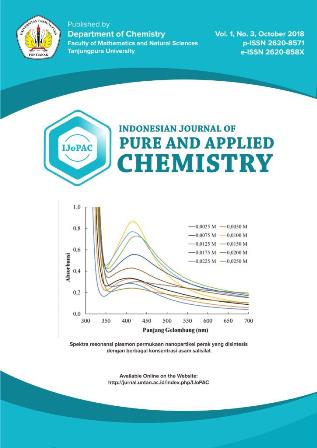
Silver nanoparticles capped with salicylic acid have been synthesized by reduction of silver nitrate with salicylic acid without additional capping agent. In the formation of silver nanoparticles, the solution of silver nitrate was first mixed with the pH 11 salicylic acid solutions at a mole ratio of 1:40. The mixture was heated for 45 minutes in a boiling water bath. The formation of silver nanoparticles was indicated by the appearance of yellow color and monitored using UV-Vis spectrophotometer. The maximum peak of resulted silver nanoparticles appeared in the range of 410-420 nm with the average size of particles was 66 ±28 nm. Stability test over a period of 16 weeks showed that silver nanoparticles capped with salicylic acid were stable. The results of stability test show that salicylic acid simultaneously act as reducing as well as capping agent in the formation of silver nanoparticles.References
Singh, D., Rathod, V., Ninganagouda, S., Hiremath, J., Singh, A.K., Mathew, J., Optimization and Characterization of Silver Nanoparticle by Endophytic Fungi Penicillium sp. Isolated from Curcuma longa (Turmeric) and Application Studies Against MDR E. coli and
S. aureus. Bioinorganic Chemistry and Applications. 2014; 2014: 1-8.
Sulistiawaty, L., Sugiarti, S., Darmawan, N., Detection of Hg+2 Metal Ions Using Silver Nanoparticles Stabilized by Gelatin and Tween-20. Indonesian Journal of Chemistry. 2015; 15(1): 1-8.
Wahyudi, T., Sugiana, D., Helmy, Q., Sintesis Nanopartikel Perak dan Uji Aktivitasnya terhadap Bakteri E. coli dan S. aureus. Arena Tekstil. 2011; 26(1): 1-60.
Saputra, A.H., Haryono, A., Laksmono, J.A., Anshari, M.H., Preparasi Koloid Nanosilver dengan Berbagai Jenis Reduktor sebagai Bahan Anti Bakteri. Jurnal Sains Materi Indonesia. 2011; 12(3): 202-208.
Junaidi, A.B., Wahyudi, A., Umaningrum, D., Sintesis AgNPs Secara Reduksi Kimia Menggunakan Capping Agent Kitosan dan Pereduksi Glukosa. Sains dan Terapan Kimia. 2015; 9(2): 70-80.
Apriandanu, D.O.B., Wahyuni, S., Hadisaputro, S., Harjono., Sintesis Nanopartikel Perak Menggunakan Metode Poliol dengan Agen Stabilisator Polivinilalkohol (PVA). Jurnal MIPA. 2013; 36 (2): 157-168.
Annadhasan, M., Muthukumarasamyvel, T., Babu Sankar, V.R., Rajendiran, N., Green Synthesized Silver and Gold Nanoparticles for Colorimetric Detection of Hg2+, Pb2+ and Mn2+ in Aqueous Medium. ACS Sustainable Chemistry Engineering. 2014; 2(4): 887-896.
Gusrizal, G., Santosa, S.J., Kunarti, E.S., Rusdiarso, B., Dual Function of p-Hydroxybenzoic Acid as Reducing and Capping Agent in Rapid and Simple Formation of Stable Silver Nanoparticles. International Journal of ChemTech Research. 2016; 9(8): 472- 482.
Gusrizal, G., Santosa, S.J., Kunarti, E.S., Rusdiarso, B., Synthesis of Silver Nanoparticles by Reduction of Silver Ion with m-Hydroxybenzoic Acid. Asian Journal of Chemistry. 2017; 29(7): 1417-1422.
Gusrizal, G., Santosa, S.J., Kunarti, E.S., Rusdiarso, B., Two Highly Stable Silver Nanoparticles: Surface Plasmon Resonance Spectra Study of Silver Nanoparticles Capped with m-Hydroxybenzoic Acid and p-Hydroxybenzoic Acid. Molekul. 2018; 13(1): 30-37.
Baghizadeh, A., Ranjbar, S., Gupta, V.K., Asif, M., Pourseyedi, S., Karimi, M.J., Mohammadinejad R., Green Synthesis of Silver Nanoparticles Using Seed Extract of Calendula officinalis in Liquid Phase. Journal of Molecular Liquids. 2015; 207: 159-163.
Downloads
Published
Issue
Section
License
Copyright (c) 2019 Rizky Noviani Ridwan, Gusrizal Gusrizal, Nurlina Nurlina, Sri Juari Santosa

This work is licensed under a Creative Commons Attribution 4.0 International License.
Authors who publish with this journal agree to the following terms: 1. Authors retain copyright and grant the journal the right of first publication, with the work simultaneously licensed under a Creative Commons Attribution License that allows others to share the work with an acknowledgement of the work's authorship and initial publication in this journal. 2. Authors are able to enter into separate, additional contractual arrangements for the non-exclusive distribution of the journal's published version of the work (e.g., post it to an institutional repository or publish it in a book), with an acknowledgement of its initial publication in this journal. 3. Authors are permitted and encouraged to post their work online (e.g., in institutional repositories or on their website) prior to and during the submission process, as it can lead to productive exchanges, as well as earlier and greater citation of published work (see The Effect of Open Access).