SINTESIS DAN KARAKTERISASI GEOPOLIMER BERBAHAN DASAR KAOLIN CAPKALA DENGAN VARIASI RASIO MOL SiO2/Al2O3
DOI:
https://doi.org/10.26418/indonesian.v2i2.36912Abstract
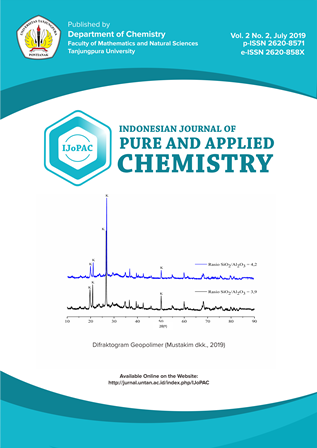
One of the potential raw materials for the preparation of geopolymers is kaolin. In the present report, the used activated kaolin is from Capkala Village in West Borneo. This paper presents an experimental study on the influence of different SiO2/Al2O3 molar ratios on the compressive strength and microstructural characteristics of the Capkala kaolin-based geopolymer. The used Capkala kaolin was a product of the calcination of the source material at 750 ºC 2 h. The alkaline activator solutions that were used to activate the activated capkala kaolin precursor were prepared by mixing NaOH solution with Na2SiO3 solution. The activator solution was allowed to equilibrate for a minimum of 24 h at a room temperature before use. The geopolymer was prepared by hand mixing of the Capkala kaolin and the activator solution. Experiments conducted with SiO2/Al2O3 molar ratios of 3.8; 3.9; 4.0; 4.1 and 4.2 for all mixing. The resulting pastes are cast in cylinder molds of 2.3 × 4.6 cm. The pastes hardened 24 h in the forms, at room temperature for 24 h. The geopolymer was dried at 60 ºC 2 h. The geopolymer was tested for compressive strength and sample pieces were taken from ones with the highest strength for XRD and SEM. Based on the test was obtained that geopolymer with 3.9 SiO2/Al2O3 ratios has the highest compressive strength that is 2.820 Mpa. The XRD analysis showed the peak at 2θ( º) 26,69o, 20,92o dan 19,77 o. The spectra FTIR of geopolymer showed the absorption at 3289.96 cm-1; 1647.67 cm-1 and 955.65 cm-1. Moreover, there are functional groups absorption for geopolymer such Al-OH stretch vibration (near 900 cm-1), stretch vibration of Si-O and Al-O (600-700 cm-1), Si-O-Al bend vibration (near 500 cm-1). The morphology of the capkala kaolin based geopolymer with SEM has succeeded in changing the kaolin structures in the form of regular slabs to be more irregular due to heating with a temperature of 750 ºC.References
Manuahe R, Sumajouw M. D. J, Windah R. S., 2014, Kuat Tekan Beton Geopolymer Berbahan Dasar Abu Terbang (Fly Ash), Jurnal Sipil Statik 2(6): 277-282
Aziz M., 2012, Karakterisasi Mineral Ampas Serta Evaluasinya untuk Pembuatan Material Geopolimer Bangunan, Jurnal Teknologi Pengelolaan Limbah (Journal of Waste Management Technology), 15(1).
Fansuri, H., Erviana, E., Rosyidah, M., Iqbal, R.M., Utomo, W.P. and Nurlina, 2018, Immobilization of Chromium from Liquid Waste of Electroplating Home Industries by Fly Ash Geopolymerization, IOP Conf. Series: Materials Science and Engineering 367: 310-316.
Cozzi, A.D., Bannochie, C.J., Burket, P.R., Crawford, C.L. and Jantzen, C.M., 2011, Immobilization of Radioactive Waste in Fly Ash Based Geopolymers, World of Coal Ash Conference 2011.
Davidovit, J., 2015, Geopolymer Chemistry and Application, Edisi ke-4, Institut Geopolymere, Perancis
Hajkova, P., 2018, Kaolinite Claystone-Based Geopolymer Materials: Effect of Chemical Composition and Curing Conditions, Minerals, 8, 444.
Zhuang XY, Chen L, Komarneni S, Zhou CH, Tong DS, Yang HM, Yu WH, Wang H. 2016. Fly ash-based geopolymer: clean producion, properties and applications. Journal of Cleaner Production 125: 253-267.
Zhang, Z.H.; Zhu, H.J.; Zhou, C.H. and Wang, H., 2016, Geopolymer from kaolin in China: An overview, Applied Clay Science, 119, 31-41.
Swanepoel, J.C., Strydom, C.A, 2002, Utilisation of fly ash in a geopolimeric material , Application Geochemistry 17, 1143-1148
Bakharev, T., 2005, “Geopolymeric Materials Prepared Using Class F Fly Ash and Elevated Temperature Curingâ€, Cement Concrete, 35, 1224 – 1232
Wahyuni. N , Georges Zissis, and Zéphirin Mouloungui, 2018, Characterization of Acid Sites on Modified Kaolinite by FTIR Spectra of Pyridine Adsorbed, 2nd International Conference on Chemistry, Chemical Process and Engineering (IC3PE)
Akmalia R; M. Mudjahid N, MS.; dan Fansuri H, 2014, Amobilisasi Ion Pb2+ Oleh Geopolimer yang Disintesis Dari Abu Layang PT. IPMOMI Probolinggo, Jurnal Sains dan Seni, 1,1.
Downloads
Published
Issue
Section
License
Copyright (c) 2019 Yatim Mustakim, Nurlina Nurlina, Intan Syahbanu

This work is licensed under a Creative Commons Attribution 4.0 International License.
Authors who publish with this journal agree to the following terms: 1. Authors retain copyright and grant the journal the right of first publication, with the work simultaneously licensed under a Creative Commons Attribution License that allows others to share the work with an acknowledgement of the work's authorship and initial publication in this journal. 2. Authors are able to enter into separate, additional contractual arrangements for the non-exclusive distribution of the journal's published version of the work (e.g., post it to an institutional repository or publish it in a book), with an acknowledgement of its initial publication in this journal. 3. Authors are permitted and encouraged to post their work online (e.g., in institutional repositories or on their website) prior to and during the submission process, as it can lead to productive exchanges, as well as earlier and greater citation of published work (see The Effect of Open Access).