PEMBUATAN DAN MODIFIKASI KARBON AKTIF PELEPAH KELAPA SAWIT (Cocus nucifera L.) SEBAGAI ADSORBEN METILEN BIRU (PREPARATION AND MODIFICATION OF ACTIVATED CARBON FROM PALM OIL (Cocus nucifera L.) AS ADSORBENT OF BLUE METHYLENE)
DOI:
https://doi.org/10.26418/indonesian.v3i2.46309Abstract
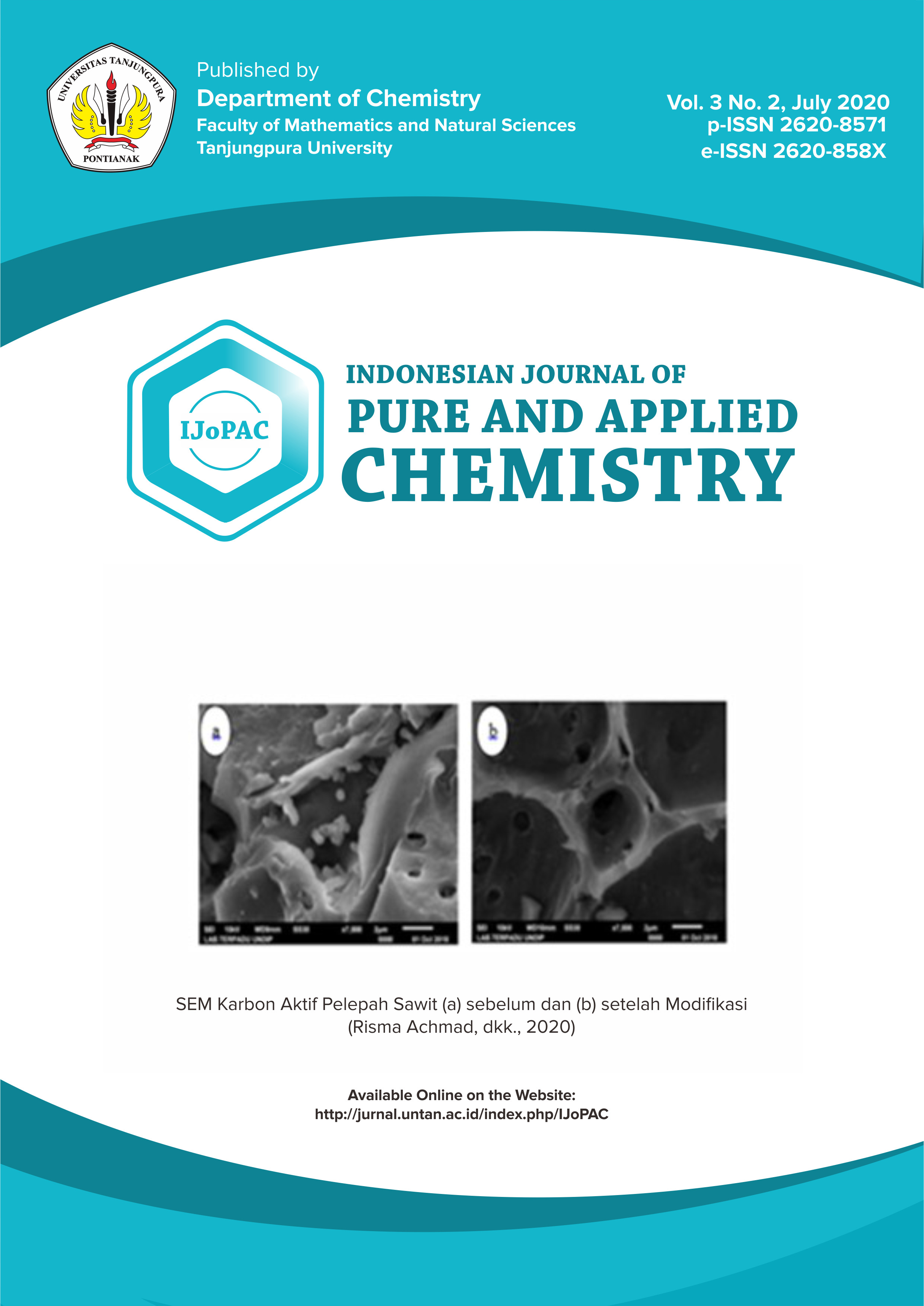
The methylene blue dye adsorbed by activated carbon from oil palm fronds modified with H2SO4 has been carried out. This study aims to utilize activated carbon from palm oil frond waste (Cocus nucifera L.) as an adsorbent to adsorb toxic methylene blue dye in textile industrial wastewater. The method consisted of several steps, namely: carbonization, carbon activation using 0.3M HCl activator, surface modification, and identification of functional groups using FTIR, characterization of the adsorbent material using SEM, BET, and surface area analysis with methylene blue. The optimal adsorption time of methylene blue by activated carbon is 20 minutes, longer than modified activated carbon which is 15 minutes. Adsorption of methylene blue by activated carbon and modified activated carbon according to the Langmuir isothermal model. The adsorption capacity of activated carbon was lower, namely 9.7847 mg / g compared to the adsorption capacity of modified activated carbon, which was 10.7642 mg / g. This proves that the active carbon modified by H2SO4 is better used as an adsorbent for adsorbing methylene blue dyeReferences
Krim, L., Salmoune, N., and Goma, B., (2006), Kinetics of Cloromium Sorption on Biomass Fungi from Aqueous Solution, American Journal of Environmental Science, 2(1): 31-36.
Hamdaoui, O., dan Chiha, M., (2006), Removal of Methylene Blue from Aqueous Solution by Wheat Bran, Acta Chimica Slovenia, 54(2): 407-418.
Handayani, L. W., Riwayanti, I., dan Ratnani, R.D., (2015), Adsorpsi Pewarna Metilen Biru Menggunakan Senyawa Xanthat Pulpa Kopi, Momentum, 11(1): 19-23.
Harti, R., Allwar., dan Fitri, N., (2014), Karakterisasi dan Modifikasi karbon aktif Tempurung kelapa sawit dengan asam nitrat untuk Menjerap logam besi dan tembaga dalam Minyak nilam, Indonesian Journal of Chemical Research, 2(1): 74-83.
Irawan, A., Puspa, R., dan Mekawati, R., (2010), Material dengan Kandungan Karbon Tinggi dari Pirolisis Tempurung Kelapa untuk Reduksi Bijih Besi, Seminar Rekayasa Kimia dan Proses, 7(2): 21-26.
Ramdja, A.F., Halim, M., dan Handi, J., (2008, Pembuatan Karbon Aktif dari Pelepah Kelapa (Cocus Nucifera), Jurnal Teknik Kimia, 15(2): 1-7.
Rizal, M., (2013), Uji adsorbansi metilen blue dengan menggunakan pelepah kelapa sebagai adsorben, Skripsi diterbitkan, Jurusan Kimia, UIN Syarif Hidayatullah, Tangerang Selatan.
Surest, A.H., Kasih, J.A.F., dan Wisanti, A., 2008, Pengaruh Suhu, Konsentrasi Zat Aktivator dan Waktu Aktivasi terhadap Daya Serap Karbon Aktif dari Tempurung Kemiri, Jurnal Teknik. Kimia, 15(2): 17-21
Miranti, S.T., 2012, Pembuatan Kabon Aktif Dari Bambu Dengan Metode Aktivasi Terkontrol Menggunakan Activating Agent H3PO4 dan KOH, Skripsi tidak diterbitkan, Fakultas Teknik Universitas Indonesia, Depok.
Aisyah, S., Yulianti, E., dan Fasya, A.G., 2010, Penenurunan Angka Peroksida dan Asam Lemak Bebas (FFA) pada Proses Bleaching Minyak Goreng Bekas oleh Karbon Aktif Polong Buah Kelor (Moringa oleifera. Lamk) dengan Aktivasi NaCl, Alchemy, 1(2): 53-103.
Koleangan, H.S.J., dan Wuntu, A.D., 2008, Kajian Stabilitas Termal dan Karakter Kovalen Zat Pengaktif pada Arang Aktif Limbah Gergajian Kayu Meranti (Shorea spp), Chemistry. Prog, 1(1): 43-46.
Aqbar, M., 2013, Kinetika Adsorpsi Ion Logam Cu2+ pada Karbon Aktif Sekam Padi yang Irradiasi Gelombang Ultrasonik, Skripsi tidak diterbitkan, Jurusan Kimia, FMIPA, Universitas Hasanuddin, Makassar
Lempang, M., Syafii, W., dan Pari, G., 2011, Struktur dan Komponen Arang serta Arang Aktif Tempurung Kemiri, Jurnal Penelitian Hasil Hutan, 3(23): 278-294.
Downloads
Published
Issue
Section
License
Copyright (c) 2021 Risma Achmad, St Fauziah, Muhammad Zakir

This work is licensed under a Creative Commons Attribution 4.0 International License.
Authors who publish with this journal agree to the following terms: 1. Authors retain copyright and grant the journal the right of first publication, with the work simultaneously licensed under a Creative Commons Attribution License that allows others to share the work with an acknowledgement of the work's authorship and initial publication in this journal. 2. Authors are able to enter into separate, additional contractual arrangements for the non-exclusive distribution of the journal's published version of the work (e.g., post it to an institutional repository or publish it in a book), with an acknowledgement of its initial publication in this journal. 3. Authors are permitted and encouraged to post their work online (e.g., in institutional repositories or on their website) prior to and during the submission process, as it can lead to productive exchanges, as well as earlier and greater citation of published work (see The Effect of Open Access).