A LOW-COST PAPER-BASED MICROFLUIDIC IMPEDIMETRIC DEVICEC FOR THE DETECTION OF WATER HARDNESS
DOI:
https://doi.org/10.26418/indonesian.v4i3.49447Abstract
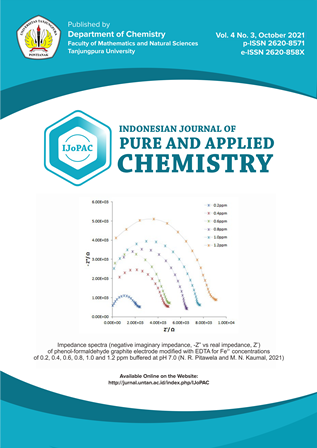
A microfluidic paper-based impedimetric device was developed as a water hardness sensor. This device is capable of performing the analysis with a sample volume of few microliters with no prior treatments. A phenol-formaldehyde graphene electrode modified with ethylenediaminetetraacetate was used as the working electrode. Ag pseudo reference and carbon electrodes were used to fabricate the device. Current simultaneous metal ion detection sensors are based on complex and expensive electrode setups. The proposed inexpensive, quick and portable device is capable of detecting Ca2+ and Mg2+ simultaneously. Electrode double layer-based charge transfer resistance and the maximum negative imaginary impedance produced a linear correlation with each metal ion concentration. The calculated limits of detection for Ca2+ and Mg2+ were 0.31 and 0.24 ppm, respectively. A set of samples containing Ca2+ and Mg2+ with a hardness of 2 ppm (as calcium carbonate) were used to test the device. The proposed tool is suitable as a semi-quantitative device for the determination of hardness in water.
References
Hayat, A. and Marty, J. L. (2018). Disposable screen printed electrochemical sensors: tools for environmental monitoring. sensors, 14(6):10432-10453. https://doi.org/10.3390/s140610432
Martinez, A. W., Phillips, S. T., Whitesides, G. M. and Carrilho, E. (2009). Diagnostics for the developing world: microfluidic paper-based analytical devices. Analytical Chemistry, 82(1):3-10. https://doi.org/10.1021/ac9013989
Rattanarat, P., Dungchai, W., Cate, D., Volckens, J., Chailapakul, O. and Henry, C. S. (2014). Multilayer paper-based Device for colorimetric and electrochemical quantification of metals. Analytical Chemistry, 86(7):3555-3562.
https://doi.org/10.1021/ac5000224
Mettakoonpitak, J., Boehle, K., Nantaphol, S., Teengam, P., Adkins, J. A., Srisa-Art, M..and Henry, C. S. (2016). Electrochemistry on paperâ€based analytical devices: A review. Electroanalysis, 28(7):1420-1436. https://doi.org/10.1002/elan.201501143
Saurina, J., López-Aviles, E., Le Moal, A. and Hernández-Cassou, S. (2002). Determination of calcium and total hardness in natural waters using a potentiometric sensor array. Analytica Chimica Acta, 464(1): 89-98.
https://doi.org/10.1016/S0003-2670(02)00474-9
Boonyasit, Y., Chailapakul, O. and Laiwattanapaisal, W. (2019). A folding affinity paper-based electrochemical impedance device for cardiovascular risk assessment. Biosensors and Bioelectronics, 130:389-396. https://doi.org/10.1016/j.bios.2018.09.031
Li, X., Qin, Z., Fu, H., Li, T., Peng, R., Li, Z., Rini, J. M. and Liu, X. (2021). Enhancing the performance of paper-based electrochemical impedance spectroscopy anobiosensors: An experimental approach. Biosensors and Bioelectronics, 177:112672. https://doi.org/10.1016/j.bios.2020.112672
Stora, T., Hovius, R., Dienes, Z, Pachoud, M. and Vogel, H. (1997). Metal ion trace detection by a chelator-modified gold electrode: A comparison of surface to bulk affinity. Langmuir, 13(20):5211-5214. https://doi.org/10.1021/la970504j
Shamsipur, M., Asgari, M., Maragheh, M. G. and Matt, D. (2015). Impedimetric sensing of cesium ion based on a thiacalix[4]arene self-assembled gold electrode. Sensors and Actuators B: Chemical, 209:9-14. https://doi.org/10.1016/j.snb.2014.11.047
Ihalainen, P., Majumdar, H., Viitala, T., Törngren, B., Närjeoja, T., Määttänen, A. and Peltonen, J. (2012). Application of paper-supported printed gold electrodes for impedimetric immunosensor development. Biosensors, 3(1):1-17. https://doi.org/10.3390/bios3010001
Wang, Y., Ping, J. , Ye, Z., Wu, J. and Ying, Y. (2013). Impedimetric immunosensor based on gold nanoparticles modified graphene paper for label-free detection of Escherichia coli O157:H7. Biosensors and Bioelectronics, 49:492-498. https://doi.org/10.1016/j.bios.2013.05.061
Ding, Q., Li, C., Wang, H., Xu, C. and Kuang, H. (2021). Electrochemical detection of heavy metal ions in water. Chemical Comunication, 57:7215-7231. https://doi.org/10.1039/D1CC00983D
Downloads
Additional Files
Published
Issue
Section
License
Copyright (c) 2021 Migelhewa Nidarsha Kaumal, Niroodha Pitawela

This work is licensed under a Creative Commons Attribution 4.0 International License.
Authors who publish with this journal agree to the following terms: 1. Authors retain copyright and grant the journal the right of first publication, with the work simultaneously licensed under a Creative Commons Attribution License that allows others to share the work with an acknowledgement of the work's authorship and initial publication in this journal. 2. Authors are able to enter into separate, additional contractual arrangements for the non-exclusive distribution of the journal's published version of the work (e.g., post it to an institutional repository or publish it in a book), with an acknowledgement of its initial publication in this journal. 3. Authors are permitted and encouraged to post their work online (e.g., in institutional repositories or on their website) prior to and during the submission process, as it can lead to productive exchanges, as well as earlier and greater citation of published work (see The Effect of Open Access).