POTENSI SENYAWA OKSIDA DARI BLONDO SEBAGAI KATODA BATERAI (POTENCY OF OXIDE COMPOUNDS FROM BLONDO AS BATTERY CATHODE)
DOI:
https://doi.org/10.26418/indonesian.v5i3.59225Abstract
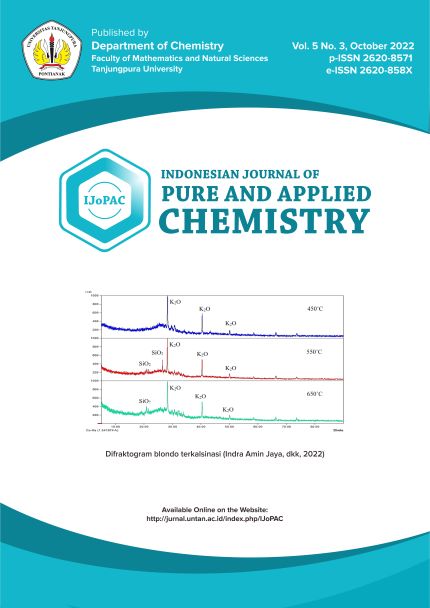
The limited source of Lithium (Li) as the main material for battery cathodes has become a problem in the development of the new and renewable energy (EBT) sector. Based on their reduction potential and availability on earth, elements that might be suspected include Potassium (K), Sodium (Na), Magnesium (Mg) and Calcium (Ca). All cannot be obtained from natural ingredients, one of which is blondo. Blondo is a by-product of coconut oil processing that has not been used optimally. This study used the calcination process by varying the time (5, 7, 9 hours) and temperature (450, 550, 650 °C) to obtain optimal oxide compounds from blondo. Making the cathode using a mixture of blondo and Polvinyl Alcohol (PVA) with a composition ratio of 20:1 attached to a stainless steel plate. Testing the percentage of oxide compounds was carried out using X-Ray Fluorescence (XRF) which showed that the calcination process caused the percentage levels of oxide compounds to increase K2O, P2O5, MgO and Cl. However, when the calcination time and temperature were increased, it did not give a much different effect on the levels of oxide compounds produced previously. The effect of calcination temperature is known from the results of X-Ray Diffraction (XRD) which shows that the higher the calcination temperature, the smaller the crystal size of the oxide compound. At temperatures of 450, 550 and 650 °C the yields are 50.0; 47.5 and 36.4 nm. This is also supported by the results of XRF testing where K2O is the most dominant component of the oxide compound in calcined blondo. The test as a cathode material was carried out for three cycles resulting in an average charge capacity of 14.67 mAh, and an average discharge capacity of 5.34 mAh so that the average efficiency was 55.68%.
Downloads
Published
Issue
Section
License
Copyright (c) 2022 Indra Amin Jaya, Intan Syahbanu, Nelly Wahyuni

This work is licensed under a Creative Commons Attribution 4.0 International License.
Authors who publish with this journal agree to the following terms: 1. Authors retain copyright and grant the journal the right of first publication, with the work simultaneously licensed under a Creative Commons Attribution License that allows others to share the work with an acknowledgement of the work's authorship and initial publication in this journal. 2. Authors are able to enter into separate, additional contractual arrangements for the non-exclusive distribution of the journal's published version of the work (e.g., post it to an institutional repository or publish it in a book), with an acknowledgement of its initial publication in this journal. 3. Authors are permitted and encouraged to post their work online (e.g., in institutional repositories or on their website) prior to and during the submission process, as it can lead to productive exchanges, as well as earlier and greater citation of published work (see The Effect of Open Access).