AKTIVITAS ANTIRAYAP DARI EKSTRAK METANOL GUBAL KAYU GAHARU BUAYA (Aetoxylon sympetalum) TERHADAP RAYAP TANAH (Coptotermes sp.) (ANTITERMITE ACTIVITY OF METHANOL EXTRACT AGARWOOD BUAYA (Aetoxylon sympetalum) ON SUBTERRANEAN TERMITES (Coptotermes sp.))
DOI:
https://doi.org/10.26418/indonesian.v6i2.62269Abstract
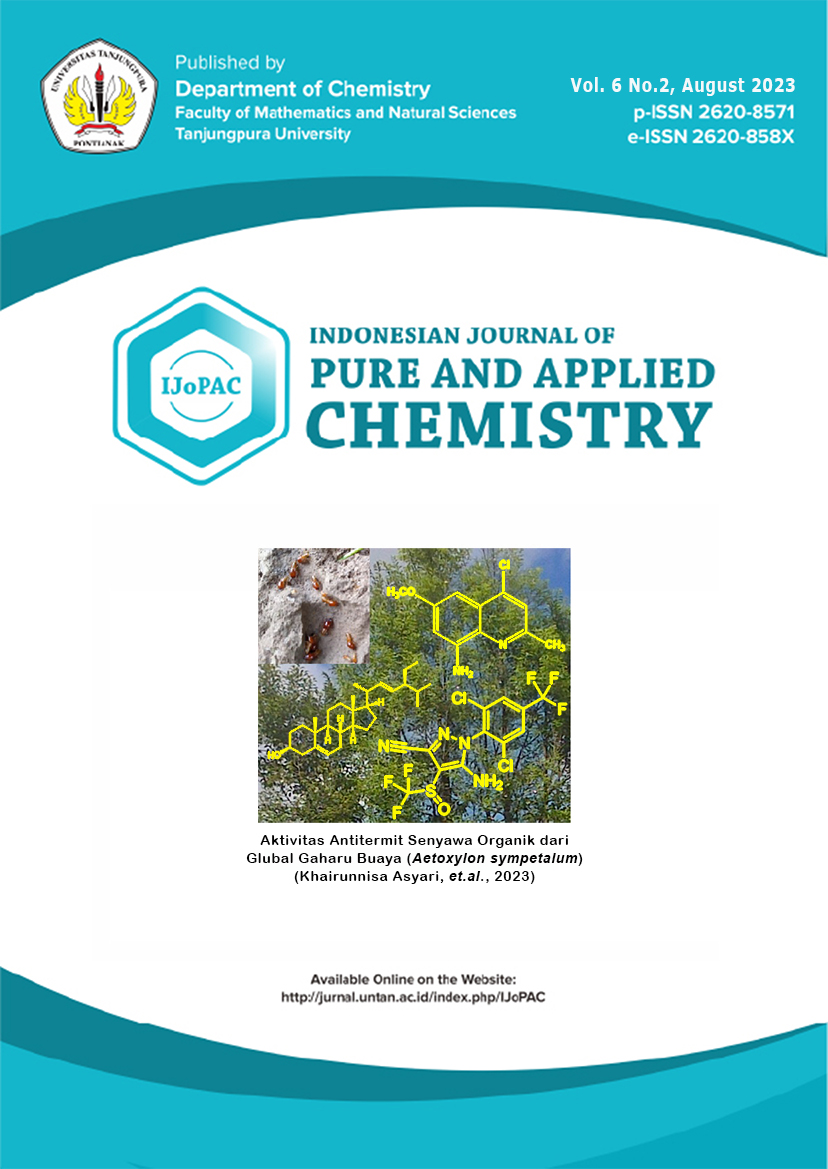
Agarwood buaya (Aetoxylon sympetalum) is a Kalimantan endemic plant whose utilization has not been optimal. This plant has potential as an anti-termite, one of which is sapwood. This study aims to determine the content of secondary metabolites from the results of phytochemical screening, components of agarwood buaya sapwood based on GC-MS analysis fraction n-hexane and anti-termite activity against subterranean termites (Coptotermes sp.). Research that has been done is divided into four steps, maceration and fractionation, phytochemical screening, GC-MS analysis, and testing the activity of termites using a forced feeding test method. Crude methanol extract from 1 kg of dried agarwood buaya sapwood was 240.787 g (24.0787%), consisting of 0.8339% n-hexane fraction, 86.3663% chloroform fraction, and 0.7571% methanol fraction. The results of phytochemical screening on agarwood buaya sapwood extract showed that it contained flavonoid, terpenoid, steroid, and phenolic compounds. Identification of the components of agarwood buaya sapwood fraction n-hexane through GC-MS yielded compounds a4-chloro-6-methoxy-2-methylquinolin-8-amine (10.33%), stigmasterol among other (5.94%), n-hexa-decanoic acid (3.2%), 6-octa-decenoic acid (2.99%), and 1,2-Benzene-diol, 3,5-bis(1,1-dimethyl-ethyl) (2.01%). Termite activity test was carried out for 3 days with variations in the concentration of 0% (negative control), 0.1%, 0.2%, 0.3%, 0.4% (w/v), and 0.25% (v/v) (fibronil as positive control). The results of anti-termite testing show the most active fraction was the methanol fraction (LC50 0.146%) followed by the chloroform fraction (LC50 0.167%), methanol crude extract (LC50 0.192%), and the n-hexane fraction (LC50 0.208%).References
Pratama, B.A., Rahmawati, K., Atikah, T.D., Wardani, W., dan Apandi, I. (2017). Populasi Gaharu Buaya (Aetoxylon sympetalum (Steenis & Domke) Airy Shaw) di Kabupaten Kapuas Hulu, Kalimantan Barat: SEMNAS BIOETI ke-4 & Kongres PTTI ke-12 (105-112). Padang: Lembaga Ilmu Pengetahuan Indonesia.
Meidianto A., Jayuska A., dan Wibowo M.A. (2019). Bioaktivitas Antirayap Ekstrak Kayu Gaharu Buaya (Aetoxylon sympetalum) Terhadap Rayap Tanah (Coptotermes sp). Jurnal Kimia Khatulistiwa, 8(1):11-16.
Hadi M. (2008). Pembuatan Kertas Antirayap Ramah Lingkungan Dengan Memanfaatkan Ekstrak Daun Kirinyuh (Eupatorium odoratum). Berkala Ilmiah Biologi, 10(1):12-18.
Zulyusri, Desyanti, dan Mardia, U. (2013). Keefektifan Daun Sangitan (Sambucus javanica Reinw) Sebagai Insektisida Nabati Dalam Pengendalian Rayap Tanah (Coptotermes sp.): Prosiding Semirata (pp. 521-528). Lampung: FMIPA Universitas Lampung.
Harborne, J.B. (1987). Metode Fitokimia: Cara Menganalisa Tanaman. Terjemahan Padmawinata, K., dan Sudiro, I. (alih bahasa), Bandung: Institut Teknologi Bandung.
Puteri I.R., Jayuska A., dan Alimuddin A.H. (2016). Aktivitas Antirayap Daun Gaharu (Aquilaria malaccensis Lam.) Terhadap Rayap Tanah Coptotermes sp. Jurnal Kimia Khatulistiwa, 5(2):6-14.
Indrayani Y., Oramahi H.A., dan Nurhaida. (2011). Evaluasi Asap Cair Sebagai Bio-Termitisida Untuk Pengendalian Rayap Tanah Coptotermes sp. Jurnal Ilmu Kehutanan Tengkawang, 1(2): 87-96.
Yuliana T. (2013). Isolasi dan Pemurnian Wedelolakton dari Tumbuhan Urang Aring (Eclipta alba L. Hassk). Jurnal Kimia Terapan Indonesia, 15(1):1-7.
Marliana S.D., Suryanti V., dan Suyono. (2005). Skrining Fitokimia dan Analisis Kromatografi Lapis Tipis Komponen Kimia Buah Labu Siam (Sechium edule Jacq. Swartz.) dalam Ekstrak Etanol. Biofarmasi, 3(1):26-31.
Ambarwati, Rakhmawati R., dan Wahyuni D.S.C. 2015. Uji Toksisitas Fraksi Daun Ambre (Geranium radula) Terhadap Artemia salina dan Profil Kandungan Kimia Fraksi Teraktif. Biofarmasi, 13(1):15-24.
Adrianta K.A. (2016). Identifikasi Senyawa Antosianin dan Metabolit Sekunder Dari Ekstrak Etanol Beras Ketan Hitam (Oryza sativa L.) Dalam Pemanfaatannya Sebagai Alternatif Pengobatan Demam Berdarah Dengue. Jurnal Ilmiah Medicamento, 2(1):17-22.
Ergina, Nuryanti S., dan Pursitasari I.D. (2014). Uji Kualitatif Senyawa Metabolit Sekunder Pada Daun Palado (Agave angustifolia) yang Diekstraksi Dengan Pelarut Air dan Etanol. Jurnal Akademika Kimia, 3(3):165-172.
Prijono D. (1998). Insecticidal Activity of Meliaceous Seed Extracts Againts Crocidolomia binotalis Zeller. Buletin Hama dan Penyakit Tumbuhan, 10(1):1-7.
Noverita, Jayuska A., dan Alimuddin A.H. (2014). Uji Aktivitas Antirayap Minyak Atsiri Kulit Jeruk Purut (Cytrus hystric D.C) Terhadap Rayap Tanah (Coptotermes sp). Jurnal Kimia Khatulistiwa, 3(2):19-22.
Nandika, D., Rismayadi, Y., dan Diba, F. (2003). Rayap Biologi dan Pengendaliannya. Surakarta: Universitas Muhammadiyah.
Manzoor F., Sayyed A.H., Rafique T., dan Malik S.A. (2012). Toxicity and Repellency of Different Insecticides Against Heterotermes Indicola (Isoptera: Rhinotermitidae). Journal of Animal and Plant Sciences, 22(1): 65-71.
Robinson, T. (1991). Kandungan Organik Tumbuhan Tingkat Tinggi. Bandung: Institut Teknologi Bandung.
Sastrodihardjo. (1999). Pengantar Entomologi Terapan. Bandung: Institut Teknologi Bandung.
Sudrajat. (2012). Toksisitas Ekstrak Batang Kayu Bawang (Scorodocarpus Borneensis Becc.) Fraksi Etanol-Air terhadap Rayap Coptotermes sp. (Isoptera: Rhinotermitidae). Mulawarman Scientifie, 11(1): 29-40.
Ohmura W., Doi S., Aoyama M., dan Ohara S. (2000). Antifeedant Activity of Flavonoids and Related Compounds Against the Subterranean Termite Coptotermes formosanus Shiraki. Journal of Wood Science, 46: 149-153.
Downloads
Published
Issue
Section
License
Copyright (c) 2023 Khairunnisa Asyari, Afghani Jayuska, Muhamad Agus Wibowo, Puji Ardiningsih

This work is licensed under a Creative Commons Attribution 4.0 International License.
Authors who publish with this journal agree to the following terms: 1. Authors retain copyright and grant the journal the right of first publication, with the work simultaneously licensed under a Creative Commons Attribution License that allows others to share the work with an acknowledgement of the work's authorship and initial publication in this journal. 2. Authors are able to enter into separate, additional contractual arrangements for the non-exclusive distribution of the journal's published version of the work (e.g., post it to an institutional repository or publish it in a book), with an acknowledgement of its initial publication in this journal. 3. Authors are permitted and encouraged to post their work online (e.g., in institutional repositories or on their website) prior to and during the submission process, as it can lead to productive exchanges, as well as earlier and greater citation of published work (see The Effect of Open Access).