BIOSINTESIS DAN KARAKTERISASI PARTIKEL PERAK EKSTRAK TANAMAN DAUN PORANG (Amorphophallus muelleri Blume) SEBAGAI PENDETEKSI ION LOGAM MERKURI
DOI:
https://doi.org/10.26418/indonesian.v6i1.63771Abstract
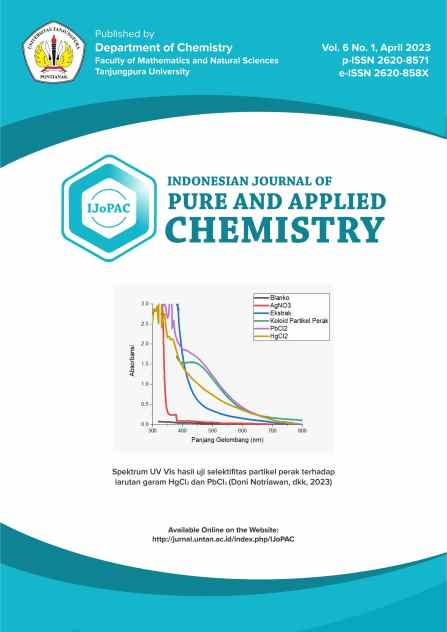
This study aims to synthesize and characterize silver particles using Porang leaf extract (Amorphophallus muelleri Blume) and determine the selectivity of silver particles as mercury metal ion detectors. The study employed Porang leaf extract as a bioreductor and stabilizer, 0.01M AgNO3 solution as a precursor, and HgCl2 salt solution and PbCl2 salt solution as standard salt solutions to be tested for selectivity. The 2 g of Porang leaves used were cleaned, cut into pieces, allowed to stand at room temperature for three days, and mashed. Porang leaf powder was added with 50 mL of demineralized water and then heated for 15 minutes at a solution temperature of 80 °C. The reaction of silver particle formation was carried out by adding Porang leaf extract and AgNO3 0.01M in variations of 1:3, 1:4, 1:5, 1:6, and 1:7, then irradiating under indirect sunlight for 15 minutes. The reaction results of a mixture of colloidal extract and AgNO3 solution showed a change in color to brownish-yellow. The color change indicated the formation of silver particles. The silver particles were then characterized with a UV-Vis spectrophotometer after 15 minutes of heating, 1 hour, and 5 hours at room temperature. The results obtained with colloidal silver particles can be synthesized with a bioreductor of Porang leaf extract (Amorphophallus muelleri Blume) with optimum variations of 1:3 and 1:4. The PSa results obtained in the mixture of silver particles formed were micro-nano-sized silver particles. The results of silver particles tested against metal ions showed that silver particles selectively detect Hg (II) metal ions in HgCl2 solutions compared to Pb (II) metal ions in PbCl2 solutions.
References
Aritonang, H. F., Koleangan, H., and Wuntu, A. D. (2019). Synthesis of Silver Nanoparticles Using Aqueous Extract of Medicinal Plants ( Impatiens balsamina and Lantana camara) Fresh Leaves and Analysis of Antimicrobial Activity.
Sari, D. K., Retnosulistyo, D. L., dan Indar, K. (2016). Pengaruh Ekstraksi Berbantu Gelombang Ultrasonik dan Variasi Pengeringan Terhadap Sintesis Nanopartikel Perak. Jurnal Teknika, 12(3), pp. 387–394.
Zielinska, A., Ewa, S., Adriana, Z., Maria, G., dan Jan, H. 2009. Preparation of Silver Nanoparticles with Controlled Particles Size. Procedia Chemistry, 1, (2). pp. 1560–1566. doi: 10.1016/j.proche.2009.11.004.
Sal Prima, Y. S., Falahudin, A., Meka, S. P., Gustian, I., & Ikram, S. (2017). Melastoma malabathricum Fruit Extract-Mediated Synthesis of Silver Nanoparticles with Sensing Ability for High Concentrations of Mercury (II) Nitrate. The Journal of Pure and Applied Chemistry Research, 6(3), 261.
Adriansyah, R. dan Firdaus, M. L. (2017). Analisis Logam Hg2+ dengan Menggunakan Nanopartikel Perak (NPP) sebagai Indikator Kolorimetri dengan Metode Spektrofotometri. Jurnal Pendidikan dan Ilmu Kimia, 1(2), pp. 136–143.
Maryani, D., Muhammad, L. F., dan Nurhamidah. (2017). Biosintesis Nanopartikel Perak Menggunakan Ekstrak Buah Passiflora flavicarva (Markisa) untuk Mendeteksi Logam Berat. Jurnal Pendidikan dan Ilmu Kimia, 1(1), pp. 49–54.
Firdaus, M. L., Ikka, F., Santhy, W., Yeni, W. H., Renat, K., Jason A. M., Hajime O., dan Toshitaka, G. (2017). Colorimetric Detection of Mercury (II) Ion in Aqueos Solution Using Silver Nanoparticles. Analytical Sciences, 33.
Fabiani, V. A., Desti, S., Dinda, L., dan Herul, A. (2019). Sintesis Nanopartikel Perak Menggunakan Bioreduktor Ekstrak Daun Pucuk Idat (Cratoxlum glaucum) Melalui Iradiasi Microwave serta Uji Aktivitasnya Sebagai Antibakteri. Fullerene Journ of Chemistry, 4(2),96-101.
Sari, P. I., Firdaus, M. L. dan Elvia, R. (2017). Pembuatan Nanopartikel Perak (NPP) dengan Bioreduktor Ekstrak Buah Muntingia calabura L untuk Analisis Logam Merkuri. Jurnal Pendidikan dan Ilmu Kimia, 1(1), pp. 20–26.
Handayani, W. (2011). Pemamfaatan Tumbuhan Tropis Untuk Biosintesis Nanopartikel Perak dan Aplikasinya Sebagai Indikator Kolorimetri Keberadaan Logam Berat. Universitas Indonesia. Depok.
Annadhasan, M., T, M., V, R. S. B., and N, R. (2014). Green Synthesized Silver and Gold Nanoparticles for Colorimetric Detection of Hg2+, Pb2+, dan Mn2+ In Aqueous Medium. Journal Sustainable Chemistry and Engineering, 4 (2) 887-896.
Notriawan, D., Nesbah., Gustria, E., Muhammad, A. F., Risky, H.W., Reza, P., dan Vinolla, I. (2021). Aktivitas Antibakteri Membran Nanokomposit Kitosan/Nanopartikel Perak. Alchemy Journal Of Chemistry, 9(1), 26-31.
Moores, A dan Goettmann, F. (2006). The Plasmon Band in Noble Metal Nanoparticles: An Introduction To Theory and Applications. New Journal of Chemistry, 30(8), pp. 1121–1132.
Nalawati, A. N., Suyatma, N. E., dan Wardhana, I. (2021). Sintesis Nanopartikel Perak (NPAg) Dengan Bioreduktor Ekstrak Biji Jarak Pagar dan Kajian Aktivitas Antibakterinya. Jurnal Teknologi dan Industri Pangan. 32(2), pp. 98–106. doi: 10.6066/jtip.2021.32.2.98.
Downloads
Published
Issue
Section
License
Copyright (c) 2023 Doni Notriawan, Febrika Laila, Eka Angasa, Gustria Ernis, Teja Dwi Sutanto, Reza Pertiwi, Ida Ayu Suci

This work is licensed under a Creative Commons Attribution 4.0 International License.
Authors who publish with this journal agree to the following terms: 1. Authors retain copyright and grant the journal the right of first publication, with the work simultaneously licensed under a Creative Commons Attribution License that allows others to share the work with an acknowledgement of the work's authorship and initial publication in this journal. 2. Authors are able to enter into separate, additional contractual arrangements for the non-exclusive distribution of the journal's published version of the work (e.g., post it to an institutional repository or publish it in a book), with an acknowledgement of its initial publication in this journal. 3. Authors are permitted and encouraged to post their work online (e.g., in institutional repositories or on their website) prior to and during the submission process, as it can lead to productive exchanges, as well as earlier and greater citation of published work (see The Effect of Open Access).