ANTI-INFLAMMATORY GERANYL ESTER OF IBUPROFEN AND CORRESPONDING FURFURYL AND ISOAMYL AMIDES WITH IN SILICO ANALYSIS
DOI:
https://doi.org/10.26418/indonesian.v7i1.64408Abstract
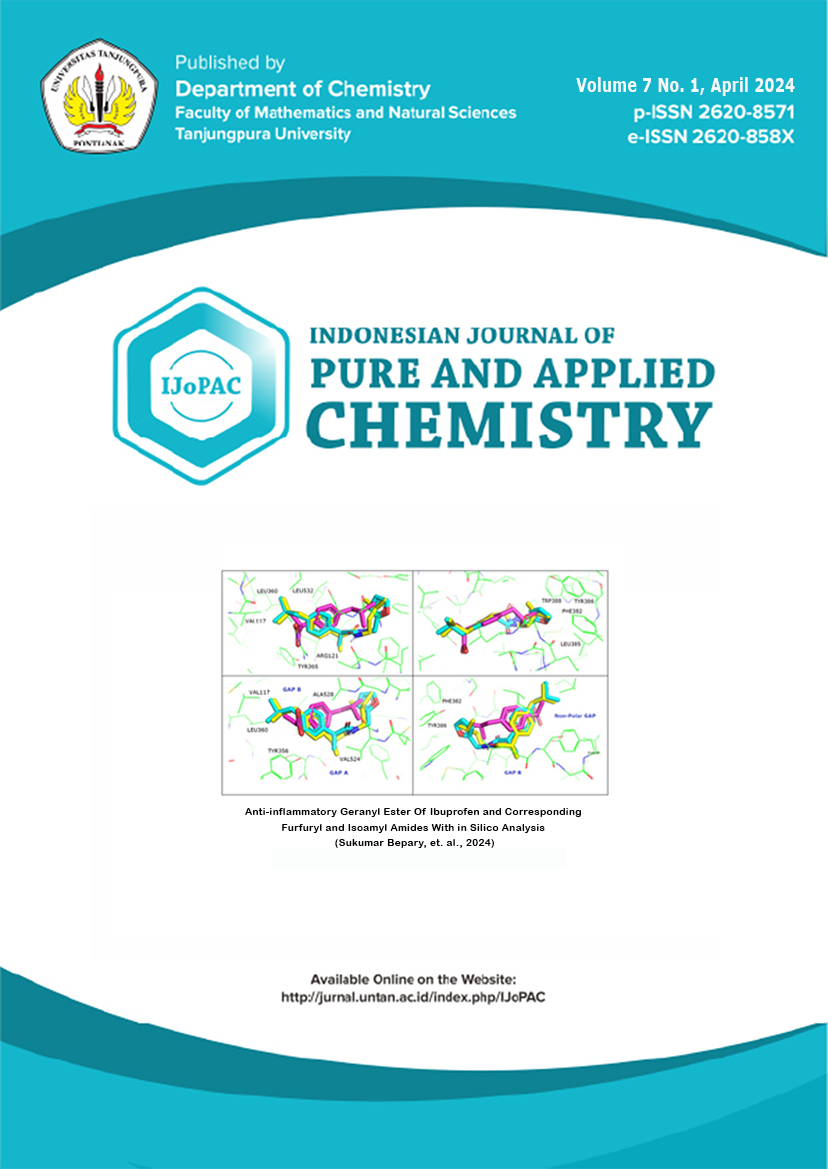
Ibuprofen is a commercially available and widely used non-steroidal antiinflammatory drug being used in managing inflammatory disorders worldwide. This acid molecule has been subjected to esterification by coupling with geraniol as well as to amide formation by coupling with furfurylamine and isoamylamine for observing the changes in anti-inflammatory potential due to the addition of relatively long aliphatic chains. During these reactions, the reaction yields were within 88-94%. In this in vitro evaluation, the prevention of egg albumin denaturation and human red blood cell (HRBC) membrane stabilization were observed. For observing potential for preventing egg albumin denaturation, the synthesized compounds were applied as doses of 10 μg/ml, 20 μg/ml, 30 μg/ml, and 40 μg/ml. For observing the better response from ester derivative, 50 μg/ml, 100 μg/ml and 200 μg/ml doses were also tried. For observing the Human RBC membrane stabilization with amides, 50 μg/ml and 100 μg/ml doses were tried. Ibuprofen was taken as the reference compound and was applied in same doses in all of the experiments. The antiinflammatory potential of the synthesized geranyl ester was remarkable in comparatively higher doses (16%, 45%, and 54% reduction in protein denaturation from 50 μg/ml, 100 μg/ml, and 200 μg/ml doses respectively). Isoamylamide was relatively more potent than geranyl ester in preventing egg albumin denaturation (reductions were 9%, 13%, 17%, and 31% from 10, 20, 30, and 40 µg/ml doses respectively). Furfurylamide was more potent than isoamylamide by showing 9%, 17%, 31%, and 46% inhibitions respectively. There were dose-dependent antiinflammatory actions observed from both the geranyl ester and amides. The synthesized compounds were also subjected to the in silico study for observing the ligand-receptor interactions in the binding site of the cyclooxygenase enzyme.References
Kamble A.A., Khan N.D., Khan Z.H., Mular S.M., and Sohail S. (2016). In vitro anti-arthritic activity, Prog. Drug Res., 71(2):123–127. DOI: 10.1007/978-3-319-26811-8_19.
Yadav R. and Mahalwal V.S. (2018). In-Vitro Anti-Inflammatory Activity of Oral Poly Herbal Formulations. Pharma Innov. J., 7(2):272–276.
Sangeetha G. and Vidhya R. (2016). In vitro anti-inflammatory activity of different parts of Pedalium murex (L.). Int. J. Herb. Med., 4(3):31–36.
Moore N. (2007). Ibuprofen: A journey from prescription to over-the-counter use. J. R. Soc. Med. Suppl. 100(48):2 6. DOI: 10.1177/014107680710004801s01.
de Martino M., Chiarugi A., Boner A., Montini G. and de’ Angelis G.L. (2017). Working Towards an Appropriate Use of Ibuprofen in Children: An Evidence-Based Appraisal. Drugs, 77(12):1295–1311. DOI: 10.1007/s40265-017-0751-z.
Bushra R. and Aslam N. (2010). An Overview of Clinical Pharmacology of Ibuprofen. Oman Med J, 25(3):155-161. DOI: 10.5001/omj.2010.49.
Arnott J.A. and Planey S.L. (2012). The influence of lipophilicity in drug discovery and design. Expert Opin Drug Discov. 7(10):863-75. DOI: 10.1517/17460441.2012.714363.
Chen W. and Viljoen A.M. (2010). Geraniol — A review of a commercially important fragrance material. South African Journal of Botany. 76:643–651. https://doi.org/10.1016/j.sajb.2010.05.008
Lei Y., Fu P., Jun X., Cheng P. (2019). Pharmacological Properties of Geraniol – A Review. Planta Med. 85:48 55. DOI https://doi.org/10.1055/a-0750-6907.
Tiwari M. and Kakkar P. (2009). Plant derived antioxidants-geraniol and camphene protect rat alveolar macrophages against t-BHP induced oxidative stress. Toxicol in Vitro. 23:295 301. DOI:
1016/j.tiv.2008.12.014.
Polo M.P. and De Bravo M.G. (2006). Effect of geraniol on fatty acid and mevalonate metabolism in the human hepatoma cell line Hep G2. Biochem Cell Biol. 84:102 111. DOI: 10.1139/o05-160.
Peffley D.M. and Gayen A.K. (2003). Plant-derived monoterpenes suppress hamster kidney cell 3-hydroxy-3-methylglutaryl coenzyme a reductase synthesis at post-transcriptional level. The Journal of Nutrition. 133, 38 44. DOI: 10.1093/JN/133.1.38.
Pattanayak M., Seth P.K., Smita S. and Gupta, S.K. (2009). Geraniol and limonene interaction with 3-hydroxy-3-methylglutaryl CoA (HMG-CoA) reductase for their role as cancer chemo-preventive agents. Journal of Proteomics & Bioinformatics. 11:466 474. DOI: 10.4172/jpb.1000107.
Duncan R.E., Lau D., El-Sohemy A. and Archer M.C., (2004). Geraniol and β-ionone inhibit proliferation, cell cycle progression, and cyclin-dependent kinase 2 activity in MCF-7 breast cancer cells independent of effects on HMG-CoA reductase activity. Biochem Pharmacol. 68:1739 1747. DOI: 10.1016/j.bcp.2004.06.022.
Widiyarti G., Megawati M. and Hanafi M. (2019). The Potential use of Geraniol Esters from Citronella Oil as Anticancer Agents. Oriental Journal of Chemistry. 35(3):987-996. DOI:
13005/ojc/350310
Mahmuda R., Islam S., Shoshi N.S., Poly K.A., Saha P, Akhter S, De T.Q. and Bepary S. (2020). In vitro anti-inflammatory resorcinol derivatives and their in silico analysis. Can Tho University Journal of Science. 12(3):80-84. DOI: 10.22144/ctu.jen.2020.027.
Kariawasam K.W.J.C., Pathirana R.N., Ratnasooriya W.D., Handunnetti S. and Abeysekera, W.P.K.M. (2017). Phytochemical profile and in vitro anti-inflammatory activity of aqueous leaf extract of Sri Lankan variety of Psidium guajava L. Journal of Pharmacognosy and Phytochemistry, 6(4):22-26.
Orlando B.J., Lucido M.J., Malkowski M.G. (2015). The structure of ibuprofen bound to cyclooxygenase-2. J Struct Biol 189:62-66. DOI: 10.1016/j.jsb.2014.11.005.
Trott, O. and Olson, A.J. (2010). AutoDock Vina: Improving the speed and accuracy of docking with a new scoring function, efficient optimization, and multithreading. J Comput Chem. 31(2): 455-461. DOI: 10.1002/jcc.21334.
Downloads
Additional Files
Published
Issue
Section
License
Copyright (c) 2024 Sukumar Bepary, Bishyajit Kumar Biswas, Sayeda Jahan, Sanjida Rahman, Md. Toufiqul Islam

This work is licensed under a Creative Commons Attribution 4.0 International License.
Authors who publish with this journal agree to the following terms: 1. Authors retain copyright and grant the journal the right of first publication, with the work simultaneously licensed under a Creative Commons Attribution License that allows others to share the work with an acknowledgement of the work's authorship and initial publication in this journal. 2. Authors are able to enter into separate, additional contractual arrangements for the non-exclusive distribution of the journal's published version of the work (e.g., post it to an institutional repository or publish it in a book), with an acknowledgement of its initial publication in this journal. 3. Authors are permitted and encouraged to post their work online (e.g., in institutional repositories or on their website) prior to and during the submission process, as it can lead to productive exchanges, as well as earlier and greater citation of published work (see The Effect of Open Access).